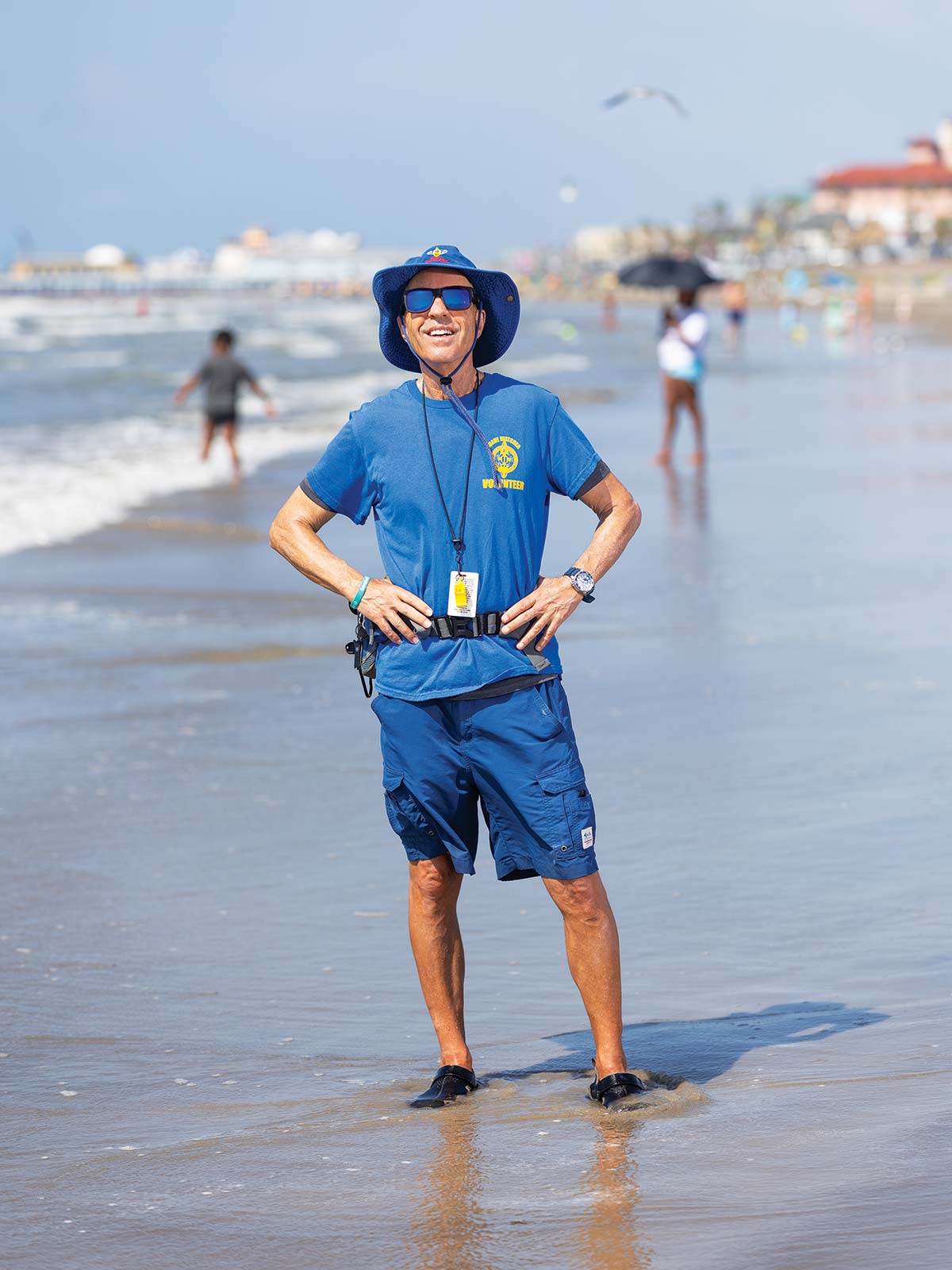
A yellow flag flaps from a pole along the Galveston Seawall, a notice to beachgoers that the surf is up slightly and they should stay alert if they venture into the water.
Robert Krout points out the marker, then leads the way down the steps onto a sandy beach streaked with sargassum. As part of the city’s Wave Watchers program, Krout and about 30 other volunteers patrol these beaches, monitoring for people in trouble and talking with visitors about how to stay safe.
Krout, retired chair of the music therapy department at Southern Methodist University in Dallas and a part-time ukulele instructor, signed up to attend the city’s first Wave Watcher Academy 10 years ago after reading a notice about the program in the Galveston newspaper. He had worked as a pool lifeguard in California and New York and enjoyed strolling the seawall.
As a Wave Watcher, he figured, he could help his community at the same time.
“One of the reasons I moved to Galveston was to be near a beach,” says Krout, 70. “It’s a great volunteer opportunity and a reason to talk to people.”
Wave Watchers spend a week each year in training, where they learn about hazards such as venomous marine life and dangerous currents and how the professional first responders of the Galveston Island Beach Patrol operate. When Krout reports for duty, he wears a yellow whistle around his neck and packs a waist belt with bandages, antiseptic wipes, aloe vera gel, a CPR mask, insect repellent, hand sanitizer and water.
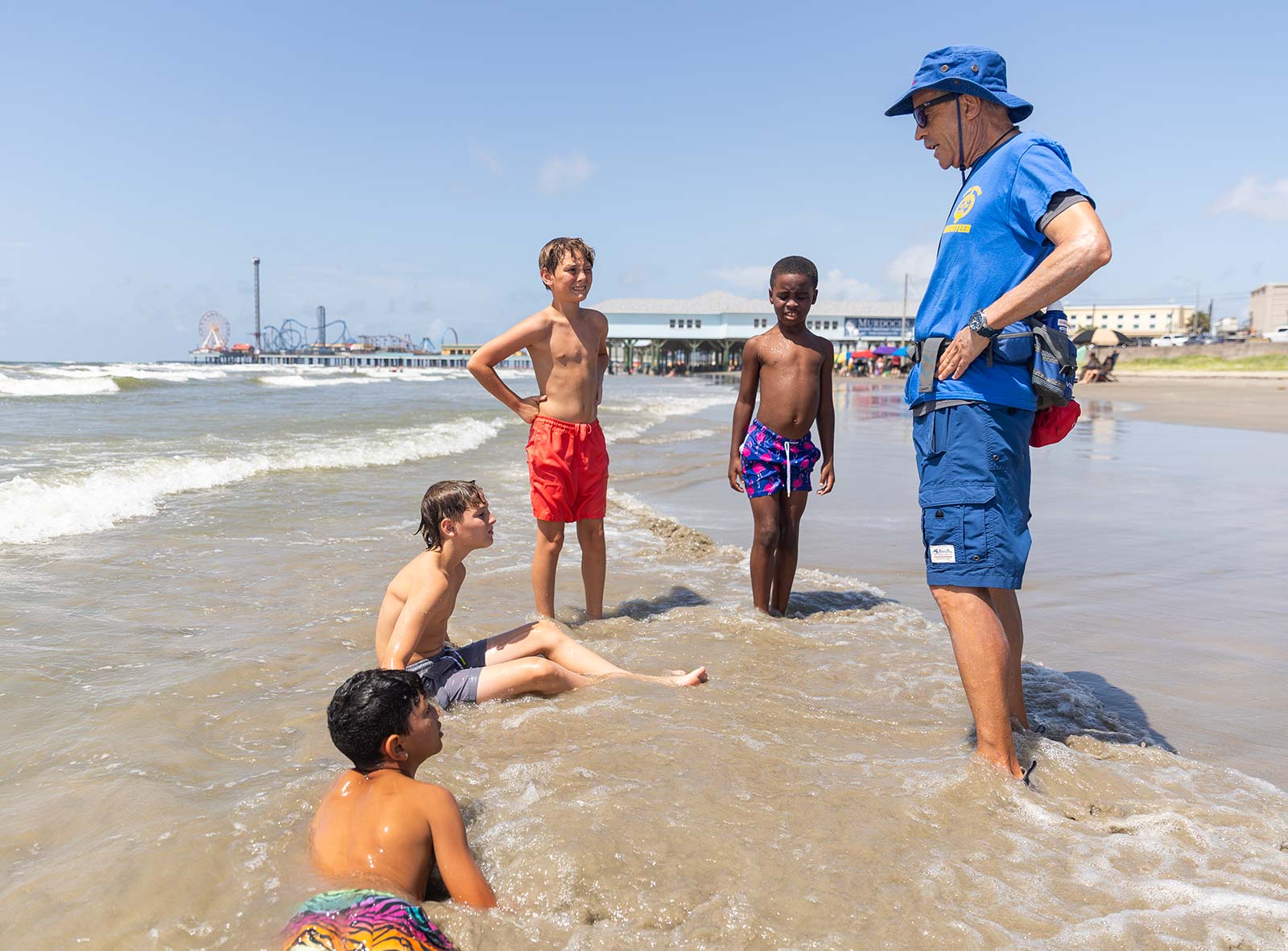
Krout speaks with children in the surf near Pleasure Pier about beach safety. “One of the reasons I moved to Galveston was to be near a beach,” he says. “It’s a great volunteer opportunity and a reason to talk to people.”
Erich Schlegel
It’s early in the season and skies are cloudy, so the beach isn’t busy today. But as we walk past two children playing in the surf, Krout’s eyes scan the beach, looking for their parents. Once he sees they’re paying attention, we move on.
Farther down, we spot a venomous Portuguese man-of-war, puffed up like a blue plastic baggie on the sand. The jellyfish-like creature can deliver a powerful sting, even if it’s dead. Krout, who knows fresh water can worsen the pain, carries a bottle of saline to douse any injuries.
Wave Watchers don’t enforce beach rules but act as a force multiplier for the beach patrol’s guard staff of about 80, says Patrol Chief Austin Kirwin. He hopes to expand the program.
“It’s been very beneficial for us, just having local citizens who are already on the beach keeping an eye out,” he says. “We train them on what to look for and how to spot a rip current and give beach safety talks.”
Galveston sees an average of six to eight drownings each year. Many occur at night, often near places like jetties, where rip currents form. “The more trained eyes we have out there, the better it is for the whole community,” Kirwin says.
Unless there’s an emergency, lifeguards stay in their stands, where they focus on what’s happening in the water. But Wave Watchers can walk the beach, interacting with visitors and dispensing advice, like what to do if you’re caught in a rip current. (Don’t fight it; let it carry you out, then swim parallel to shore to escape.)
They never enter the water to make rescues and can’t provide medication, but they alert Beach Patrol to problems. They also help with crowd control in case of an incident, reunite lost children with their parents and remind beachgoers to tread carefully if they walk on the jetties.
The volunteers concentrate their efforts between the Galveston Fishing Pier and East Beach, a 10-mile stretch that includes Stewart Beach, where thousands congregate on summer weekends.
“They’re a huge sigh of relief,” says Genevieve Weber, a lifeguard working a stand just west of Pleasure Pier. “Things unfold so quickly out here. Everything happens in a matter of seconds.”
For Wave Watchers, it’s all about keeping people out of dangerous situations before they happen—and, sometimes, cheering up someone who’s having a bad day. For that, Krout carries a pouch filled with shark’s teeth he’s found on the beach. If you get stung by a jellyfish, he might just hand you one.