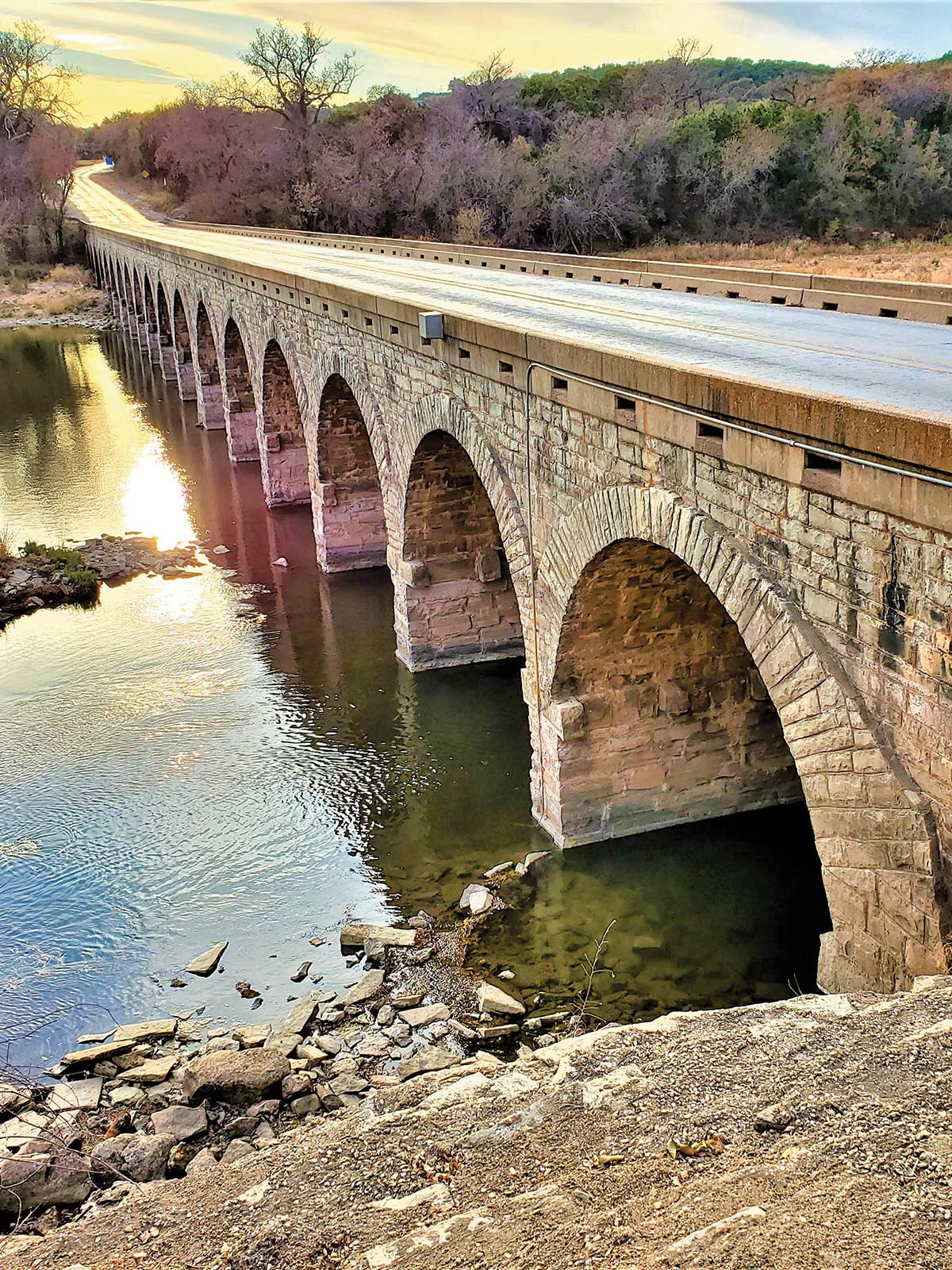
Most drivers on State Highway 16 likely don’t even realize it as they whiz over the Brazos River on their way to Possum Kingdom Lake in North Texas. And locals like me take it for granted when we cross the structure.
But there’s a marvel of history and engineering holding up this roadway—the longest stone arch bridge in Texas.
The Possum Kingdom Stone Arch Bridge used a keystone arch design perfected by the ancient Romans. The Work Projects Administration completed the bridge in 1942, designed to withstand floodwaters released from the Morris Sheppard Dam, about a mile upriver.
Workers were brought in and returned home on converted cattle trucks. Most of the more than 300 workers were unemployed coal miners from the Mingus, Strawn and Thurber areas who had experience cutting stone.
Sand and gravel for the bridge’s mortar and concrete came from the riverbed near the site. Lumber and other materials left over from the dam construction were used for form boards, temporary bracing and scaffolding.
The design of the structure uses a special wedge-shaped stone to lock in place all other stones in the arch to convey heavy weight along the curves to the hard, gray sandstone bedrock. Abutments keep the bottom sections from sliding apart.
The bridge is 433 feet, 4 inches long and contains more than 7,200 cubic yards of local limestone with 18 arches spanning 23–30 feet each. Areas inside the stone framework are filled with layers of compacted soil.
An unimproved access area by the bridge is a popular launch point for canoers and kayakers embarking on a journey down one of the most scenic sections of the Brazos River. The Texas Legislature created the John Graves Scenic Riverway in 2005 to ensure water quality by bringing greater oversight to keep quarries and industrial activities from degrading the river. The riverway begins below the dam and extends about 116 river miles, nearly to Lake Granbury.
It’s a favorite site for fishing, wading, bird and wildlife watching, and picnicking. The Texas Parks and Wildlife Department stocks the river with rainbow trout from December to February. Catfish, bass and sunfish can also be caught. Large striped bass have been caught in designated areas below the dam, a popular spot for fly-fishers.
The flowing waters and rocky riffles in the river below the bridge are perfect habitat for the harmless Brazos water snake, a threatened species found only in this region.
An 8.4-mile section of State Highway 16, including the stone arch bridge, has been listed on the National Register of Historic Places. Texas historian T. Lindsay Baker included the bridge in his book, Building the Lone Star: An Illustrated Guide to Historic Sites. Elsewhere, Baker has named it as one of the 100 most interesting and historic engineering examples. “It’s an extraordinary bridge,” he said. “I would call it spectacular.”
The bridge and its surroundings occupy a special place in Texas history, enduring the test of time. Our obligation is to enjoy and maintain it by leaving no trace and preserving the site for future Texans and visitors.