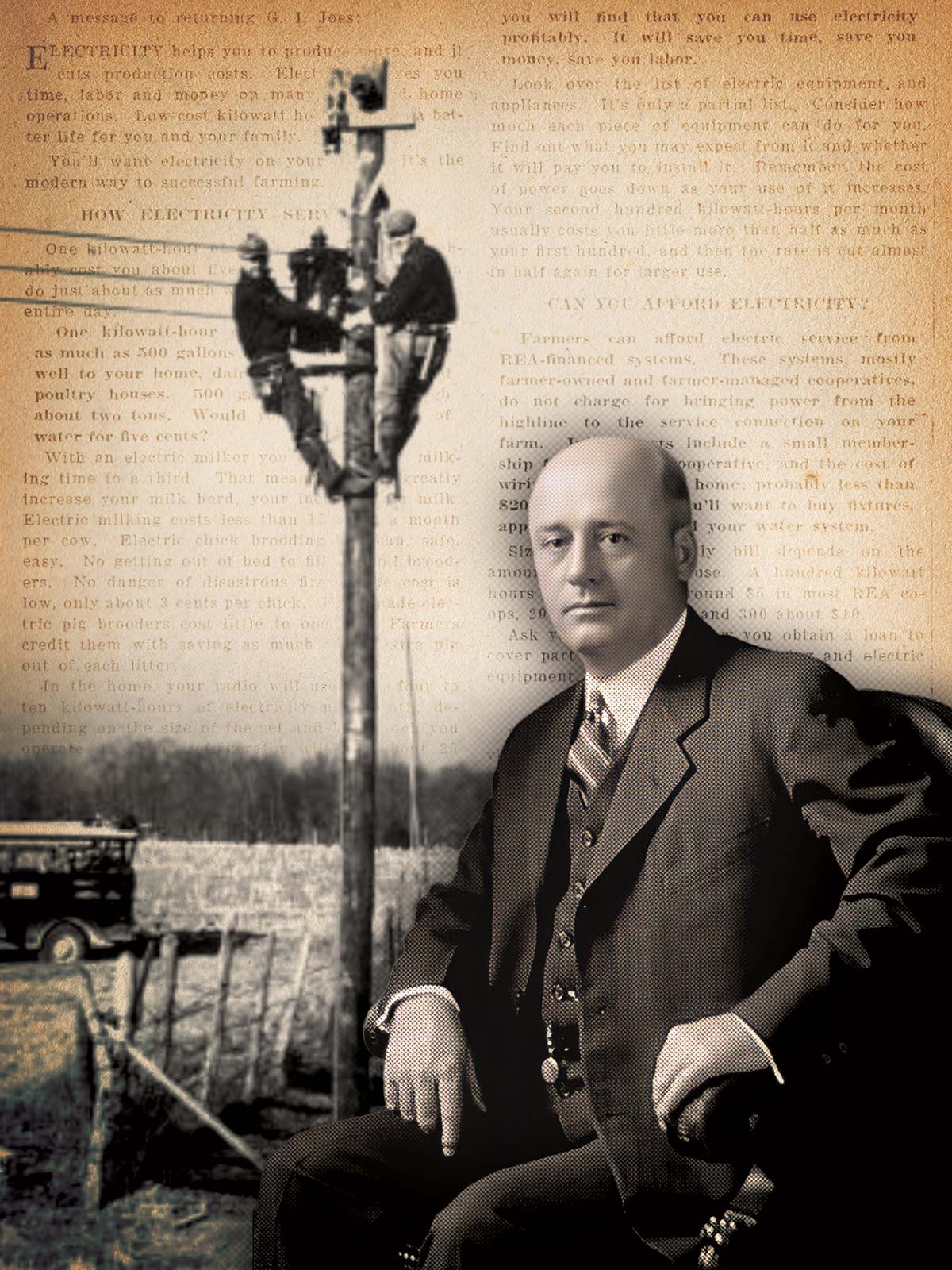
Before the passage of the Rural Electrification Act nearly a century ago, in the depths of the Great Depression, most U.S. farmsteads made do in the dark while their neighbors in cities a few miles away experienced a higher standard of living. Investor-owned utilities didn’t deem it profitable to run miles of power lines across the countryside.
Without electric lights and appliances, farm families cooked over smoky woodstoves, read and studied under kerosene lamps, and performed laborious agricultural chores by hand.
By the mid-1930s, change was afoot, thanks in large part to a dedicated and diplomatic Texan intent on the empowerment of rural communities. The REA, enacted 90 years ago this month—May 20, 1936—made available low-cost federal loans to rural landowners who had banded together in hopes of threading the countryside with electric lines.
Electric cooperatives were born, starting with the first, Bartlett Electric Cooperative in Central Texas.
Before the REA, only around 10% of U.S. farms had electricity. By 1950, the federal financing the legislation shook loose had helped electrify nearly 80% of farms. Today, more than 900 co-ops power rural and suburban residents.
A 1960 Department of Agriculture video describes electricity as “magic from nowhere and everywhere” and details “the drab, colorless days” before its rural availability. The video colorizes a black-and-white sequence, Wizard of Oz style, demonstrating the life-changing force of electricity coursing through the home of the fictional family it depicts.
Similar transformations, effected many times across prewar rural landscapes nationwide, were largely enabled by the efforts and advocacy of U.S. Rep. Samuel Taliaferro Rayburn, who cosponsored the REA legislation with Nebraska Sen. George Norris.
Rayburn, born in Tennessee, moved with his family to an unelectrified Fannin County farm, in North Texas, when he was 5, in 1887.
He attended grade school through law school in Texas and served in the Legislature before catapulting to Congress in 1913, where he set records as the longest-serving speaker of the U.S. House of Representatives—17 years over 10 sessions spanning the 1930s to 1960s, accrued piecemeal during his near-half-century tenure.
Rayburn didn’t forget his former neighbors. In his papers, housed at the Briscoe Center for American History at the University of Texas, a March 1938 thank-you on Fannin County Electric Cooperative letterhead notes the co-op’s progress in installing its first 110 miles of line, thanks to a $100,000 REA requisition.
In July 1940, Farmers Electric Cooperative sent its own note to Rayburn, chiefly attributing to him the REA’s “birth and success.” Enclosed with the letter was a humble precursor to this magazine, a monthly newsletter called the REA Co-op Message, which included a rundown of the co-op’s recent annual meeting, a list of new members and updates about members’ appliance purchases.
Readers learned that member W.C. McKay had installed an electric range at home. “Naturally,” the newsletter reads, “Mrs. McKay is very happy.”
She wasn’t alone. Thanks to Rayburn, life in Co-op Country was changed forever.