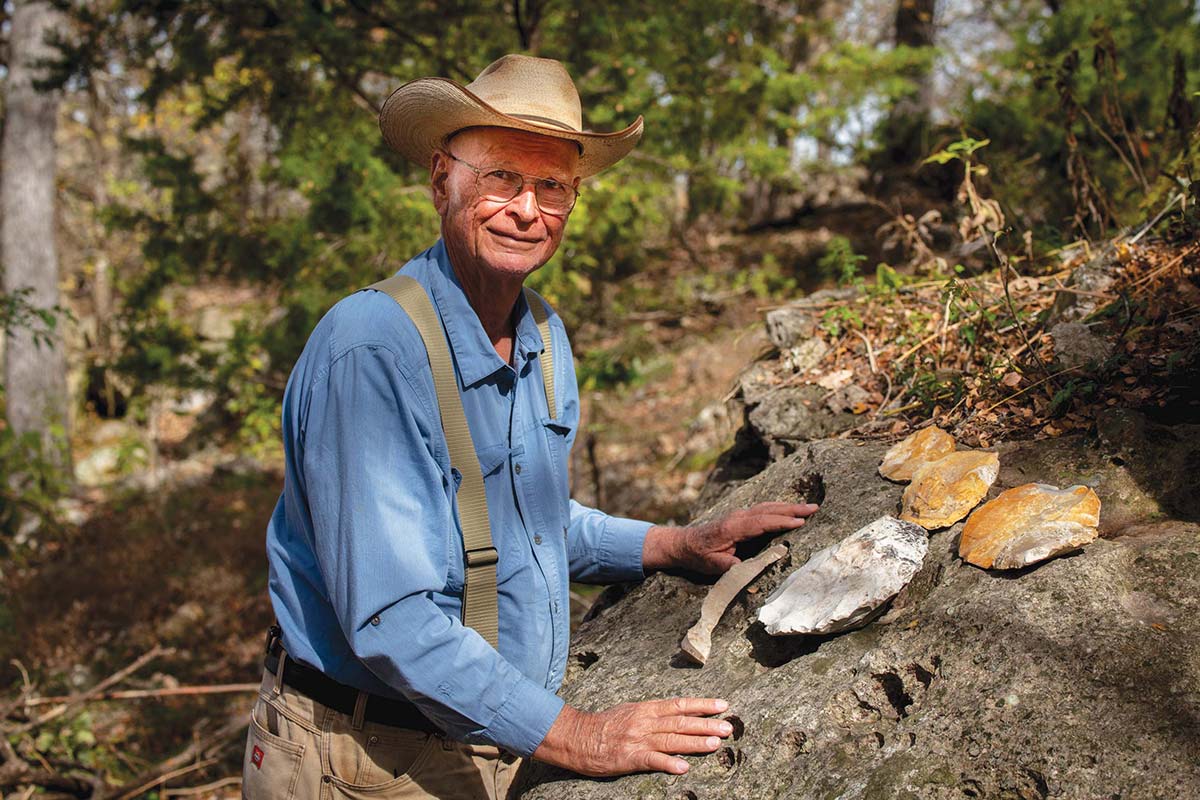
Last summer, Michael Collins gazed over a tree-lined valley near Florence, his eyes scanning the grassy field where he once led excavations that changed our understanding of how and when humans first populated North America.
“I describe it as coming back to an old friend,” Collins said during that visit to the Gault archaeological site, about 50 miles north of Austin.
Collins sat beneath pecan trees for a picnic that day with others who had worked at Gault and filmmaker Olive Talley, whose 2025 documentary, The Stones Are Speaking, explores the site’s significance—and Collins’ role in saving it.
In the 1980s and ’90s, the film explains, artifact hunters lugging buckets and shovels flocked to the 30-acre plot of land, where a creek flowed and an abundant supply of flint rippled through a rocky ledge. They paid $25 a day to search for scrapers, projectile points and knives made by Native Americans and walk away with whatever they found. They left behind empty holes and mounds of dirt.
By taking those stone artifacts, collectors were destroying much of the history that they held. “It’s like looking at a book, tearing a picture out and throwing away the rest of the book,” said Elton Prewitt, a longtime Texas archaeologist.
The Gault story could have ended there—as a pay-to-dig site whose significance disappeared along with the ancient implements once scattered in its soil. But that’s not what happened.
In 1990, collectors digging at Gault found something unusual: two stones with hatch marks etched onto their surface. Word got back to the University of Texas, where the discovery perked the ears of Thomas Hester, then the director of the Texas Archeological Research Laboratory, and Collins, then the lab’s associate director.
The two drove to the site, where more etched stones turned up—along with a Clovis spearpoint, named for a Paleo-Indian archaeological site near Clovis, New Mexico, where scientists had discovered distinctive human-made tools more than 11,000 years old.
Most archaeologists long believed that humans first funneled into North America via a land bridge that formed between Russia and Alaska across what is now the Bering Strait about 13,000 years ago. The so-called Clovis culture was thought to be the oldest in the Americas.
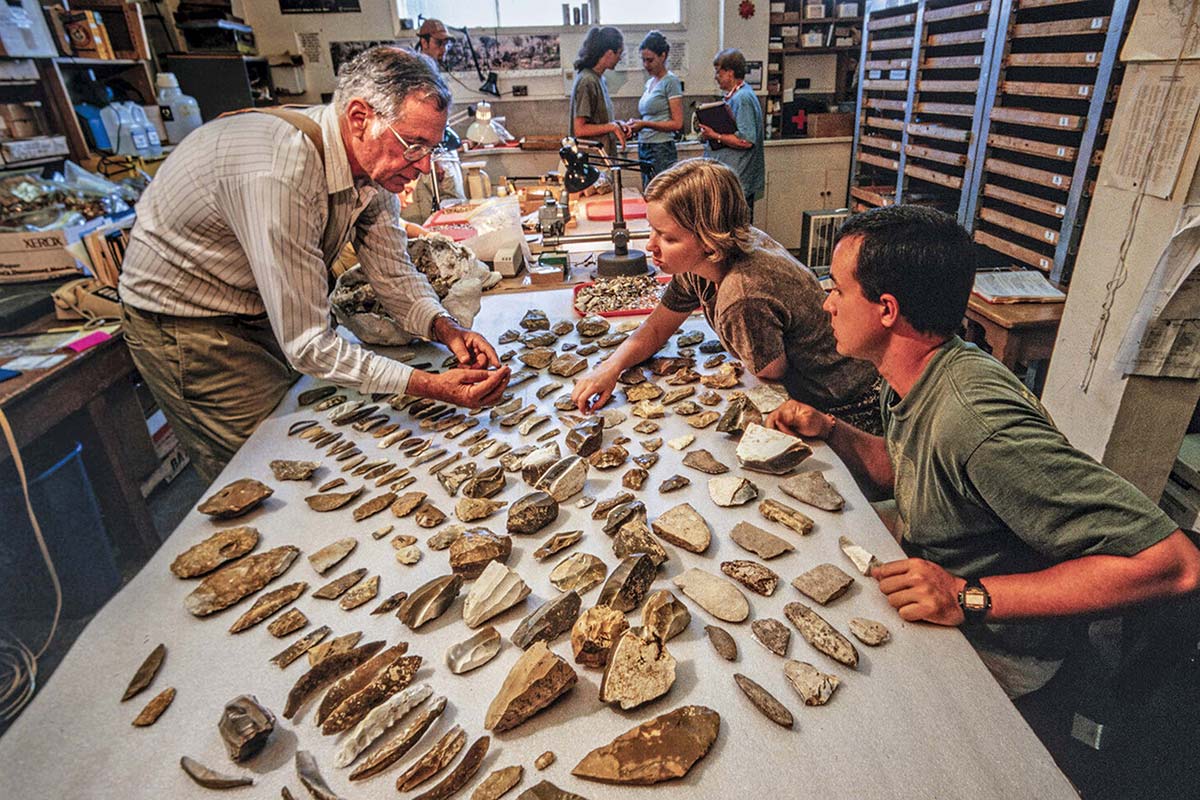
Archaeologist Michael Collins examines Gault artifacts with Angela Davis, center, and Jon Lohse in 1999.
Courtesy Kenneth Garrett
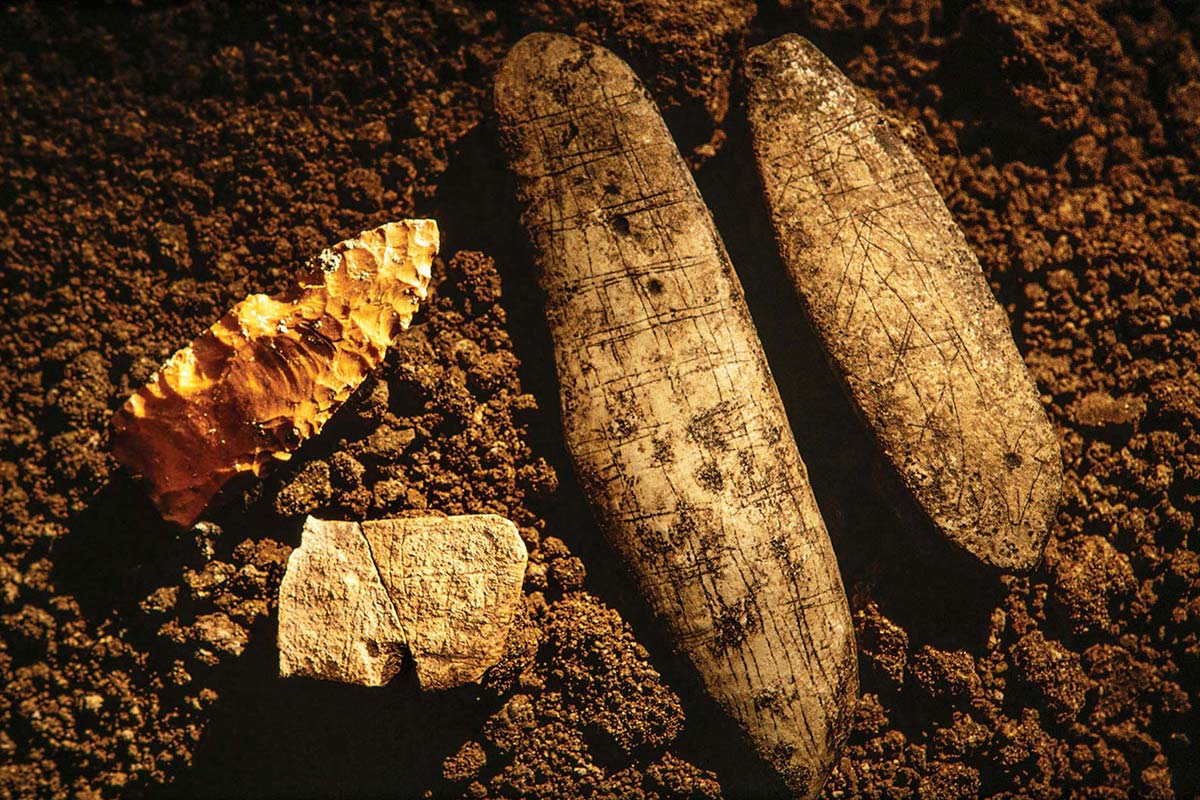
Artifacts found at the Gault site by a collector in 1990 include two stones with hatch marks etched onto their surface.
Courtesy Kenneth Garrett
Because Clovis tools had been found at Gault, Collins knew the site was important. But at the time, nobody knew just how significant.
Over the next few years, the land changed hands, and the pay-to-dig operation ended. When the property’s new owners, Howard and Doris Lindsey, stumbled onto some mammoth bones, Collins again got the call. He struck up a friendship with the Lindseys, and in 1998, Collins convinced them to allow a three-year lease so he could conduct an excavation.
That dig turned up more artifacts from the Clovis period, but Collins ran out of time. He filled in the pit and left when the lease ended, convinced the site held even more significance.
Collins stayed in touch with the Lindseys, and in 2007 they agreed to sell him the land. (They still live nearby and keep an eye on the property.) Collins and his wife, Karen, used their own money to buy the site, then immediately donated it to the nonprofit Archaeological Conservancy, where it would be protected in perpetuity.
Collins began a meticulous, long-term excavation project. The people who had come here thousands of years ago made tools, discarded some and lost others, leaving behind a record. The researchers uncovered thousands of artifacts, plus a human-made surface believed to be the floor of a structure at least 15,000 years old.
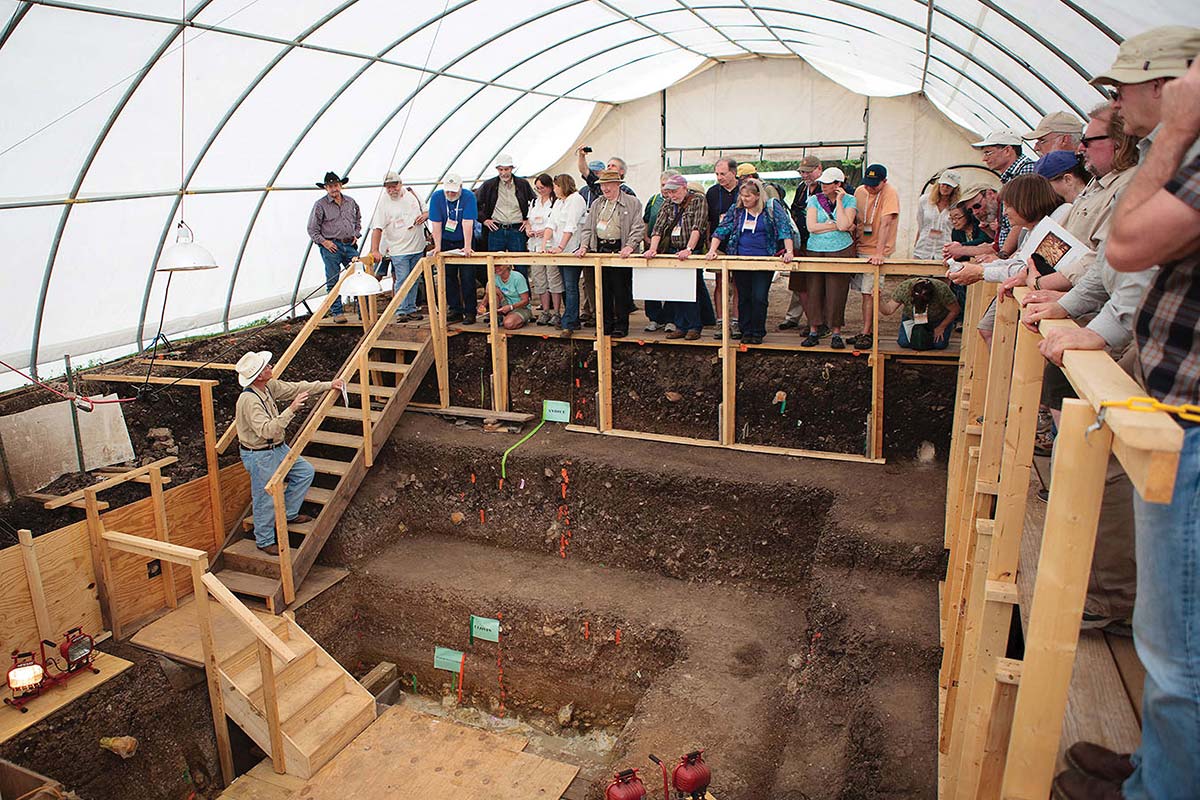
Collins with volunteers at the last part of the Gault site to be excavated. Currently there are no open excavation sites on the property and no digs planned.
Courtesy Gault School of Archaeological Research
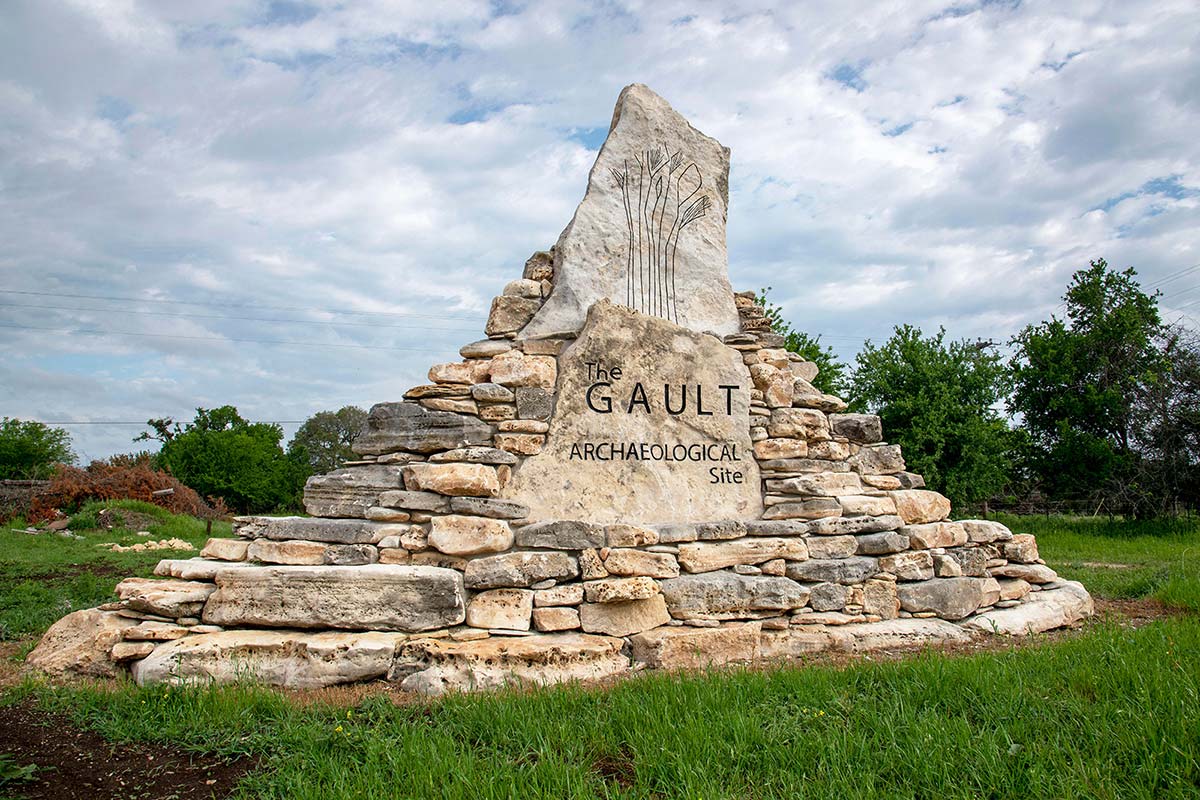
The entrance sign to the Gault archaeological site in Bell County, where scientists have uncovered more than 2.6 million artifacts.
Courtesy Kenneth Garrett
At first, not everyone believed what the stones were saying. Some pushed back on the idea that humans had been in Central Texas since before the Clovis people. But using a technique called optically stimulated luminescence, which tells scientists when sediments were last exposed to light, Collins and his team proved that some of the most deeply buried artifacts were indeed older than Clovis.
Today, most archaeologists agree that humans began to move into North America before the land bridge at the Bering Strait opened, using boats to cross the water and spread down the coast.
Evidence discovered through Collins’ excavations show signs that humans have come to the water at this Texas site—what is now nearby Buttermilk Creek—for 20,000 years. That arguably makes it the oldest demonstrably inhabited site in the Western Hemisphere.
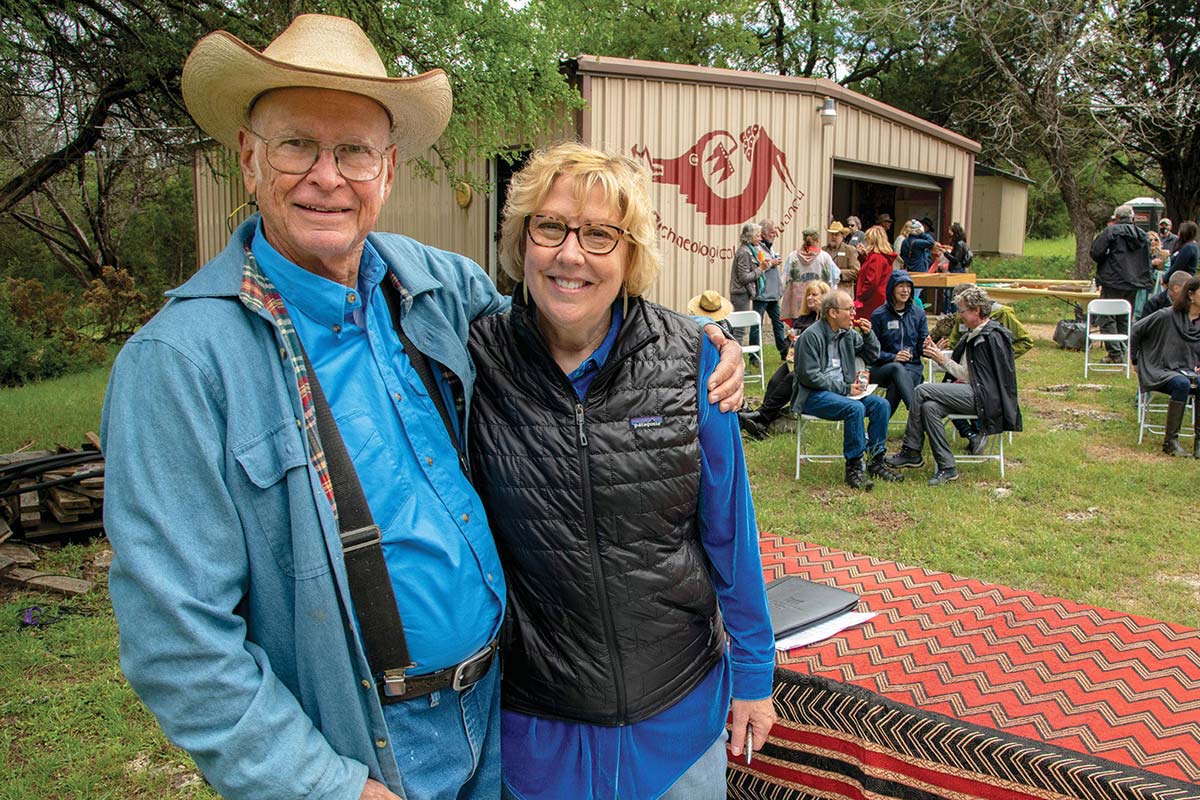
Michael Collins with Olive Talley, who spent five years researching and creating her 2025 documentary, The Stones Are Speaking.
Courtesy Kenneth Garrett
“What’s important about this site is what we’ve learned about ourselves from it,” says Tim Brown, a board member at the nonprofit Gault School of Archaeological Research, which Collins founded. “This site has been so important in the rewriting of the book about the very early story of man in the Americas.”
And it may have more stories to tell.
Collins, now in his 80s, was diagnosed with Alzheimer’s in 2022, and the main excavation pit was covered in 2016. But just 3% of the land here has been excavated. New technologies may help future archaeologists unravel even more of its past.
“Walk across this soil,” Brown says. “If you don’t get a humble, awestruck reaction, there’s something wrong. And without Mike, we’d have no idea.”