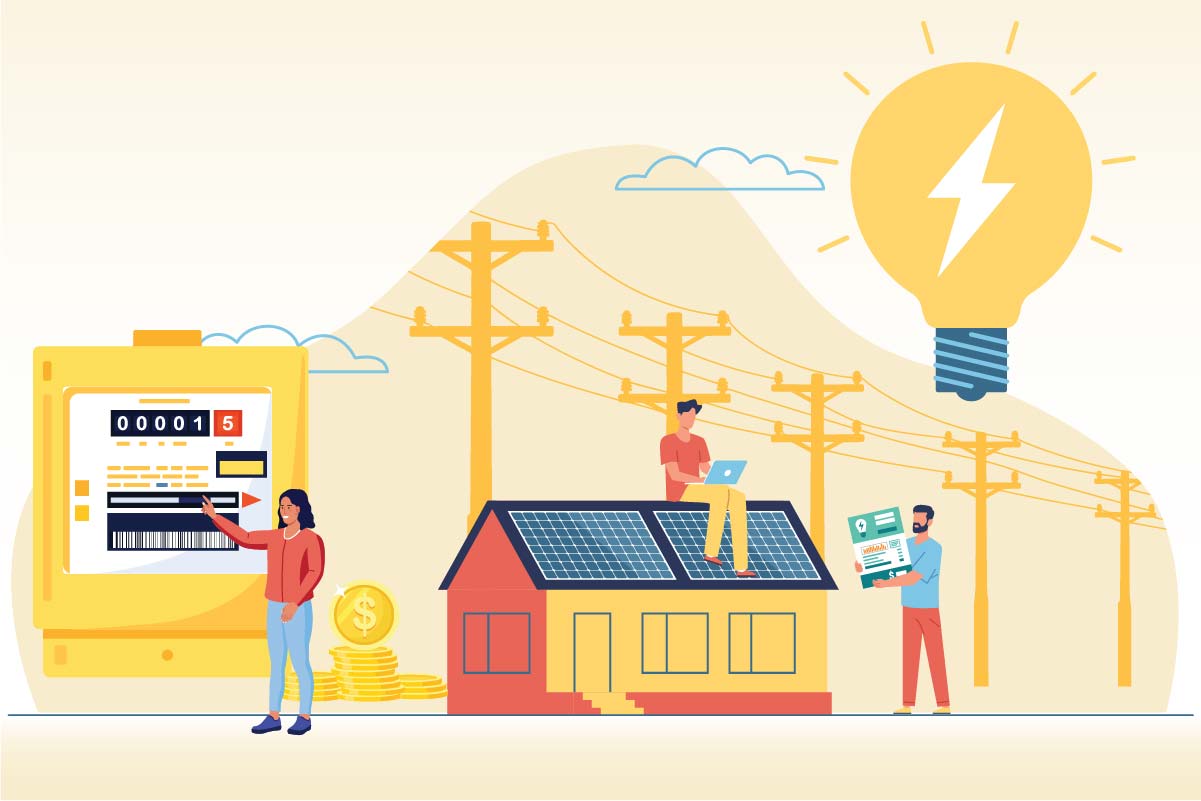
In the past few months, we’ve talked about the strategies we use to keep electricity costs low, and we’ve dug into how transmission costs are calculated, and what we’re doing to reduce them.
Now, we’re at the final part of electricity’s journey, the distribution system, which is entirely located within CoServ’s service territory.
Distribution: The Local Electric System
Distribution costs are 25-30% of the total cost of your bill. CoServ’s distribution system consists of poles, wires, and underground conduit that take electricity from substations to our Members, whether it’s a home, business, park, or school.
CoServ stands apart from the deregulated utilities that serve Texas because, unlike CoServ, retail electric providers don’t own their distribution systems but rather serve as a middleman between the consumer and the for-profit company that does. That means the retail electric providers must charge more to make a profit while also having no control over the Delivery Charge on customers’ bills – transmission and distribution costs are billed by a separate for-profit utility that owns that infrastructure.
CoServ doesn’t do this. We own all of the infrastructure that delivers reliable power to our Members every day, and as a result, we have one of the most reliable electric distribution systems in the state.
What Drives Distribution Costs: Reliability, Growth, and Safety
Inflation has affected the cost of everything in recent years, and distribution infrastructure is no different.
CoServ has control over distribution costs and much of that is credited to our relationship with Irby, our material supplier. Irby orders more than 2,000 unique items for our electric system alone.
The copper and aluminum in the wires, the steel core inside the transformer, and the cost of fuel to transport it have increased an overall average of about 30% over the last year alone, said Dan Brown, Irby’s Vice President of Utility Sales & Operations.
Then consider that CoServ added nearly 400 miles of new overhead and underground power lines in 2025, largely due to explosive growth in North Texas. And that doesn’t include the miles of wire that were upgraded with higher capacity line to increase safety and reliability.
In addition to the equipment needed to meet our growth, CoServ also needs to be prepared for disasters, such as the tornado that hit Valley View and Sanger over the Memorial Day weekend in 2024. That storm damaged several miles of infrastructure, requiring new poles, pole-mounted transformers, and wire. CoServ was able to restore power to all Members who could accept power within a matter of days because we had adequate stock on hand.
How CoServ Manages Distribution Costs: Planning and Local Investment
Affordability is always top of mind for CoServ.
As with the Energy and Transmission costs, we have found ways to reduce costs in a volatile market. Strategic purchasing decisions and the ability to store inventory have helped shield CoServ and Members from price spikes.
“CoServ’s engineering and planning departments do a great job of sharing all of the incoming work order information for all the jobs on the horizon with Irby,” Craig Scoggins, Manager of Materials Supply and Coordination, said. “They’re typically able to get firm pricing from the manufacturer based on the total volume instead of reacting to what we use and then restocking.”
CoServ requires a steady stream of new distribution infrastructure, so our material supplier, Irby, keeps several months’ worth of stock on hand. It’s a delicate balancing act, though, because transformers and other equipment can’t sit too long or the warranty could expire.
Other utilities that don’t take advantage of these tactics are paying 20% more for the same items in some cases, Dan said.
Fuel costs are also rising, so CoServ utililizes in-house fueling and repair capabilities – particularly with the Krum service center – to reduce costs and return vehicles back to service quicker.
It’s just another way that CoServ goes the extra mile to reduce costs and ultimately keep your electric rate as low as possible.
Looking to the Future
Providing reliable service requires careful management of costs that are changing over time. We believe Members deserve a clear, straightforward look at what’s driving those shifts and how they impact CoServ and you.
While CoServ has taken several steps to reduce energy, transmission, and distribution costs, the pace of inflation has moved even faster. For the first time since 2001, CoServ will raise rates this year. The increase is mostly due to rising distribution costs.
This rate increase will be as low as possible so CoServ can cover its costs while still delivering the same great service Members have come to expect.
Stay tuned for more details.