June 19, 2025, started out calmly at Hamilton County Electric Cooperative. Employees attended their monthly safety meeting in the morning, then leadership training continued into the afternoon as the thermometer inched toward the mid-90s in Central Texas.
After the training, Gregg Belcher, a crew foreman with 31 years under his belt, headed out to change a pole in Hamilton—his crew’s only work order for the day.
Soon after, George Luker, the co-op’s safety manager, wondered about the two calls in rapid succession that had vibrated his phone during the training. Suddenly, the radio crackled with the kind of news that stops hearts and, for an instant, seems unreal.
Except it wasn’t: We had an electrical contact. It’s bad.
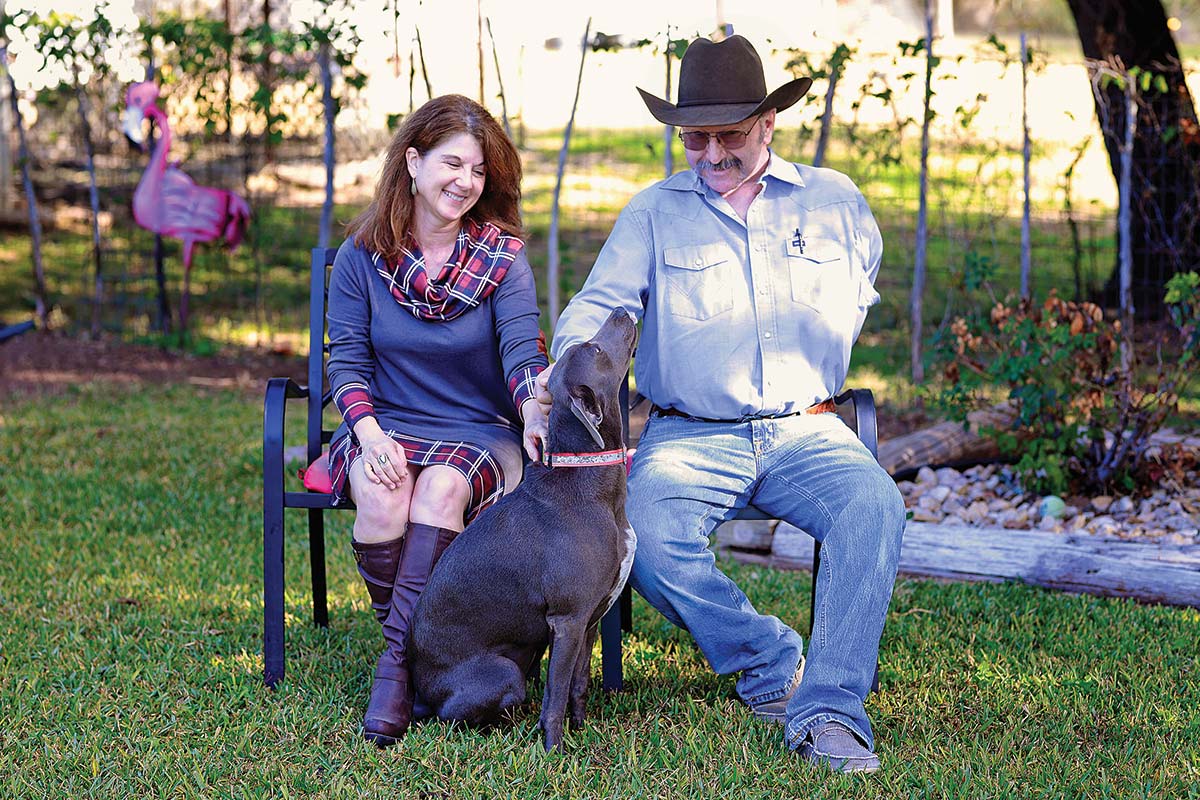
Lori and Gregg Belcher at their home outside Hico with Whiskey, one of their blue lacys, in November.
Tracy Cox | Hamilton County EC
HCEC, like all co-ops, repeatedly prepares for such a crisis. But this wasn’t a drill. Luker rushed directly to the jobsite, just three minutes from the office. He didn’t know exactly what happened or who was involved until he got there and saw Gregg on the ground, obviously badly injured.
“My heart sank,” Luker said. But he immediately noted that Gregg’s crew and other co-op employees who had rushed to the scene were performing as they were trained. They got him down from the bucket he was working in, deployed an automated external defibrillator and cut away constricting clothing. Emergency medical services were on the way.
“That kind of stuck out in my head, that they’ve secured the scene, and they were providing immediate care to Gregg when I rolled up,” Luker said. “They did a fantastic job in a terrible situation.”
Meanwhile, General Manager Cody Lasater called Lori, Gregg’s wife, who was at their home outside Hico. Lasater relayed news and details that told her life might never be the same: Gregg has been in an accident and has been taken by CareFlite to Parkland Memorial Hospital in Dallas. Parkland has one of the largest civilian burn units in the nation.
“Your brain just sort of stops working for a minute,” Lori said.
By sunset, she and Gregg—heavily medicated, with wires and tubes crawling all over his upper body—had been thrust into an agonizing hospital stay that tested the limits of their physical and emotional strength over four months. It was a stay that almost ended before it started.
“I was dead when they brought me down,” Gregg said from the hospital in October, days before he was discharged. “It was the opinion of quite a few of the people around here that I might not make it, and that’s kind of what they told Lori. They didn’t try to tell her I was going to be OK.”
He was far from OK.
“We were three weeks in before he was even recognizable as himself, because of the swelling and the burns,” Lori said. Questions lingered about whether his kidneys and liver would survive the trauma.
His left arm, burned beyond repair, had to be amputated—first at the elbow and then, a few days later, all the way to his shoulder.
That’s about when Lori first saw the ghastly injury to his back. Electricity had burned away much of the flesh, leaving a raw, open wound. “It was tough to look at. It was very deep,” she said. “And I remember thinking, ‘How can they fix this? You know, how is it humanly possible to fix something like this?’ ”
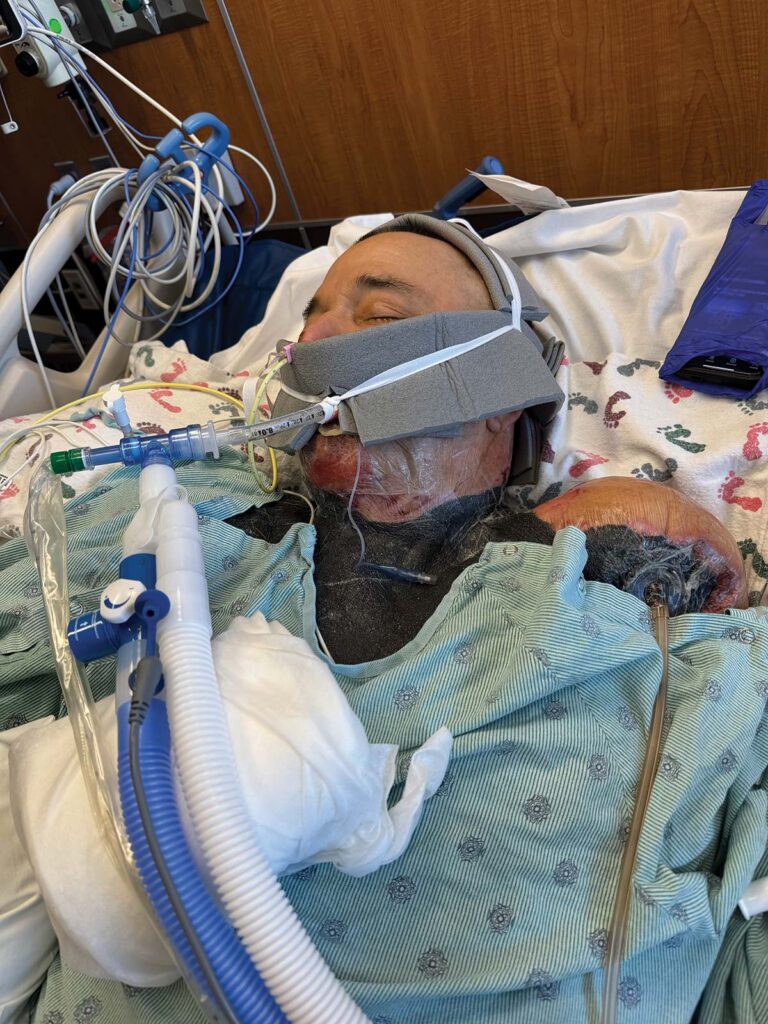
Gregg in late June at Parkland Memorial Hospital in Dallas.
Courtesy Lori Belcher
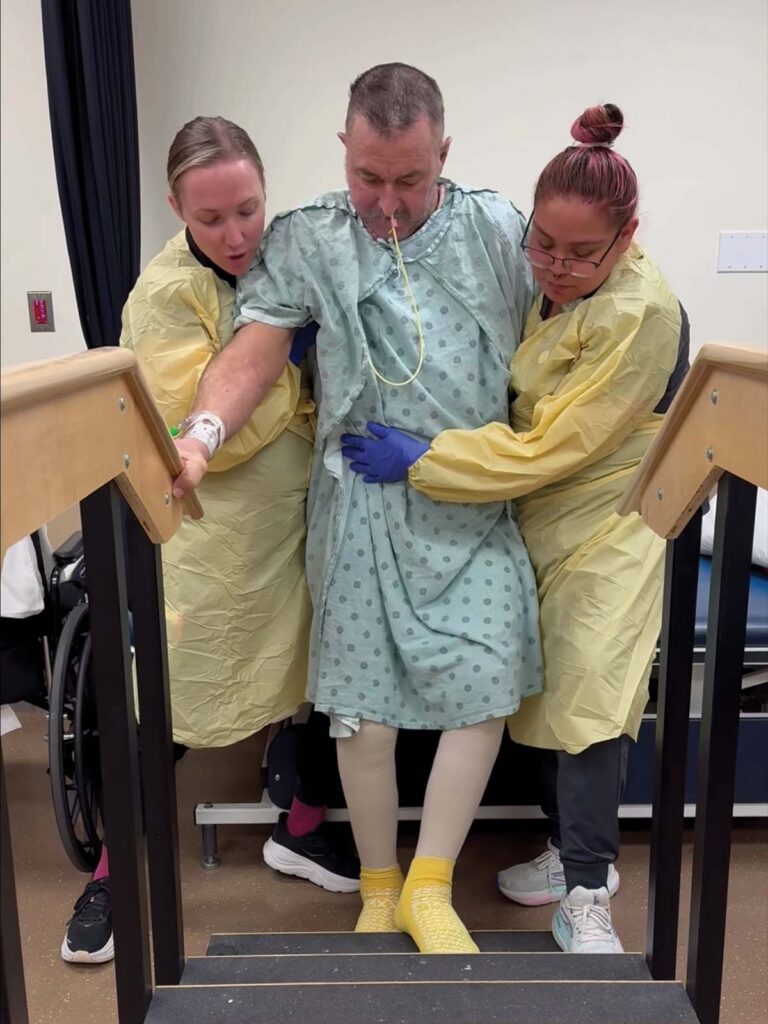
By September, therapists had Gregg back on his feet to regain strength and his sense of balance.
Courtesy Lori Belcher
What made it possible was a team of countless surgeons, nurses, therapists and specialists working around the clock. Gregg endured more than a dozen surgeries, some during the first four weeks, when he was unconscious. A flap of skin from his flank was grafted onto his back, then carefully monitored to ensure blood flow so it would successfully heal.
His recovery, while excruciatingly slow, offered promise in small measures. One day he blinked. Then he squeezed a nurse’s fingers. And started wiggling his toes. He was coming back.
That didn’t surprise the people who know him. “He’s got such a great attitude, and he’s working so hard,” Lasater said. “He’s just a badass.”
Lori agreed. “I would say that’s accurate. Yeah, a 59-year-old badass.”
“That’s a good term for him,” Luker said.
Luker also had high praise for Lori. “That lady has not left his side. She’s 5-foot-nothing, but she is a pillar of strength. God bless her.”
Lori knew falling to pieces would not help anybody, and she found strength in prayer. “I feel like I’m walking through this in a God bubble, and I have just peace,” she said.
Lori posted Facebook updates almost daily about Gregg’s progress, giving hope to a vast community of family and friends back home. “We’re really close here at this co-op,” Lasater said. “We consider ourselves a family.”
That network of co-workers and friends in Hico and Hamilton and at neighboring co-ops rallied with fundraising to help with expenses, collecting $93,000 at a benefit event in August and through other donations.
“The communities of Hico and Hamilton have been incredible,” Lori said. “We were just blown away by the love that people have shown us.”
At Parkland, Gregg remained focused on recovery and regaining mobility.
One day in the hallway, a therapist asked him to walk 10 feet. With her holding onto him and Gregg steadying himself with a cane, he shuffled along for 10 feet. Then he kept going, 15 feet farther. The therapist became emotional.
“The next day, she asked me, ‘What’s your goal?’ I said, ‘To make you cry.’
“I got lots of angels in this hospital that have helped me,” Gregg said days before he was discharged. “A lot of angels. A lot of angels.”
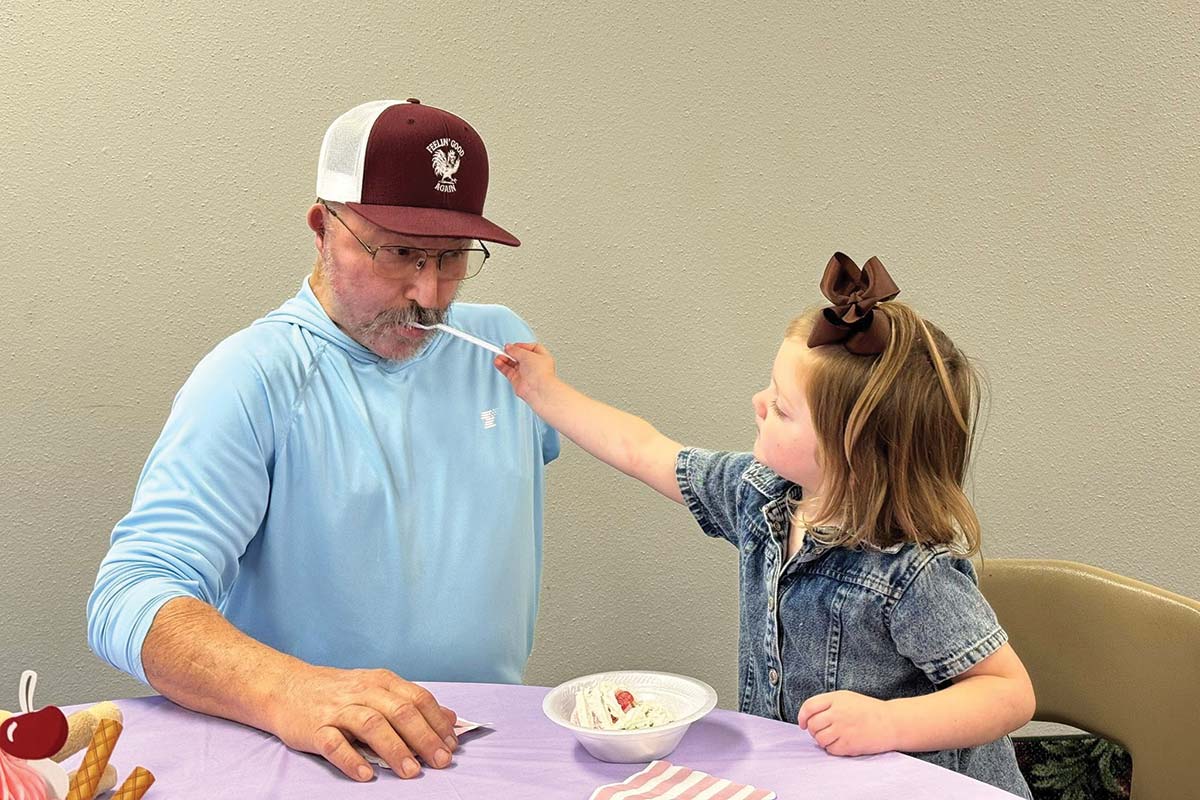
Back home, granddaughter Steely James Stafford feeds Gregg cake. “He’d let her feed him worms if that’s what she wanted,” Lori said.
Courtesy Lori Belcher
By mid-October, he was eager to get home to his three dogs—two blue lacys and a Plott hound—which he had been training to recover game animals wounded during hunts.
Christmas 2025 was going to be special for the Belchers. As he adjusts to navigating life with one arm, Gregg knows he’s lucky to be alive. And he realizes he was misguided, as he said most lineworkers are, to think such a horrific accident happens only to other people.
“You know, we’re 10 feet tall and bulletproof,” Gregg said. “We don’t think it’s going to happen to us.”
Luker remains troubled that his close friend has become a walking example of what safety professionals constantly preach: You might only get one mistake in line work.
“Whether you have two years of experience or whether you have 30 years—that voltage, it doesn’t care,” Luker said. “Those years of experience don’t give you any kind of a free pass.”