What Kevin Price saw in July 2025 cannot be re-created: trees ripped from the ground and entire structures effortlessly swept away by the Guadalupe River as it rose 34 feet, devastating communities in the Hill Country and killing more than 135.
What came next he had seen before: a carefully coordinated search-and-rescue effort. Those skills and strategies are carefully replicated and reinforced on a continual basis at a training complex unlike any other in the world on the outskirts of College Station.
Welcome to Disaster City, part of the Texas A&M Engineering Extension Service, called TEEX. Price is a training manager there. The city’s “mayor”—Scott Salter, rescue program director—says it’s dedicated to preparing first responders, rescue technicians and emergency management professionals in the most challenging and chaotic environments imaginable.
“Disaster City provides realistic, high-fidelity disaster simulations so responders can develop the skills, confidence and teamwork needed to protect communities when they’re in need,” Salter says. “It’s one-of-a-kind in scale, complexity and realism. While other states operate regional training centers or individual rescue props, no other facility combines the size, diversity of environments and multidisciplinary training elements found at Disaster City.”
The facility is widely recognized as the premier urban search-and-rescue training site in the U.S. and one of the most advanced in the world, Salter says.
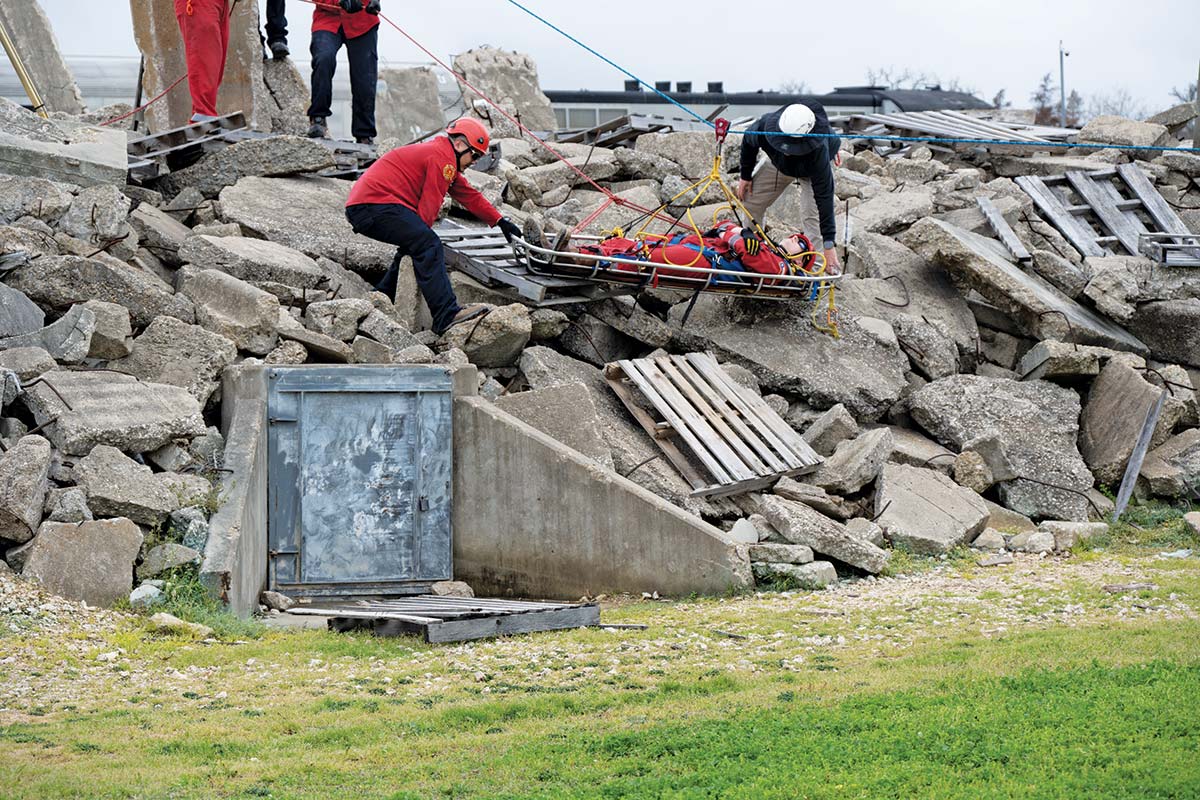
Disaster City offers a variety of large-scale disaster simulations that prepare first responders for the real thing.
Courtesy Texas A&M Engineering Extension Service
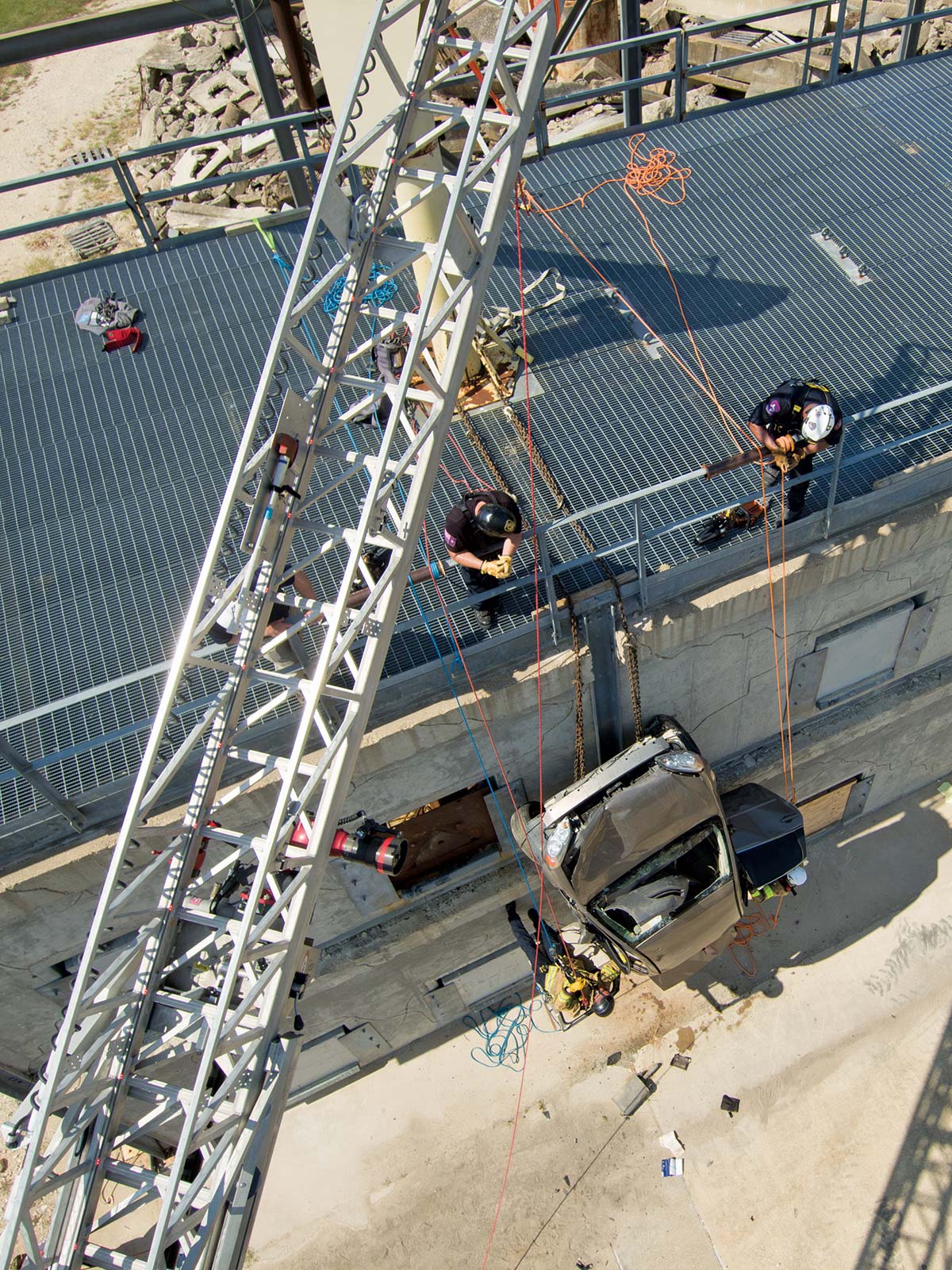
Campus exercises simulate real-world emergencies such as vehicle recovery and victim extraction, helping teams build readiness for complex crises.
Courtesy Texas A&M Engineering Extension Service
TEEX built Disaster City in the late 1990s to meet a growing need. It was an outgrowth of the intense training program for firefighters that dates back to 1929, when the State Firefighters’ and Fire Marshals’ Association of Texas chose Texas A&M University as the site for a permanent school for firefighters.
Salter says two events proved to be the tipping point for the establishment of Disaster City: the 1993 New York World Trade Center below-ground parking lot bombing and the 1995 federal building bombing in downtown Oklahoma City. Such large-scale emergencies required better planning and better strategies than had been available.
“Texas has also faced many major disasters,” Salter says. “The most prominent in recent years include the widespread 2011 wildfires, the 2013 fertilizer plant explosion in West, Hurricane Harvey flooding in 2017, and multiple oil refinery and chemical plant incidents along the Gulf Coast.”
Disaster City’s Building 137, or the Rescue Building, is the hub of the 52-acre complex. This “city hall” houses classrooms, offices and support facilities. It’s also the gateway to the disaster response training complex.
Dotting the landscape are multiple collapsed buildings that simulate damage from earthquakes and bombings. There’s a passenger train derailment, complete with a locomotive and a heap of train cars. There’s a crashed aircraft fuselage. There are underground tunnels, rubble piles, and structures used for breaching-and-breaking training. And that’s just a sampling of the chaotic conditions that confront trainees.
“The true strength of Disaster City lies in the diverse training props available to instructors,” says Kevin Farmer, a 20-year firefighter, paramedic and instructor with the nearby Bryan Fire Department. “Disaster City allows us to simulate some of the most complex and challenging rescue scenarios imaginable and to test our team to its full capability.”
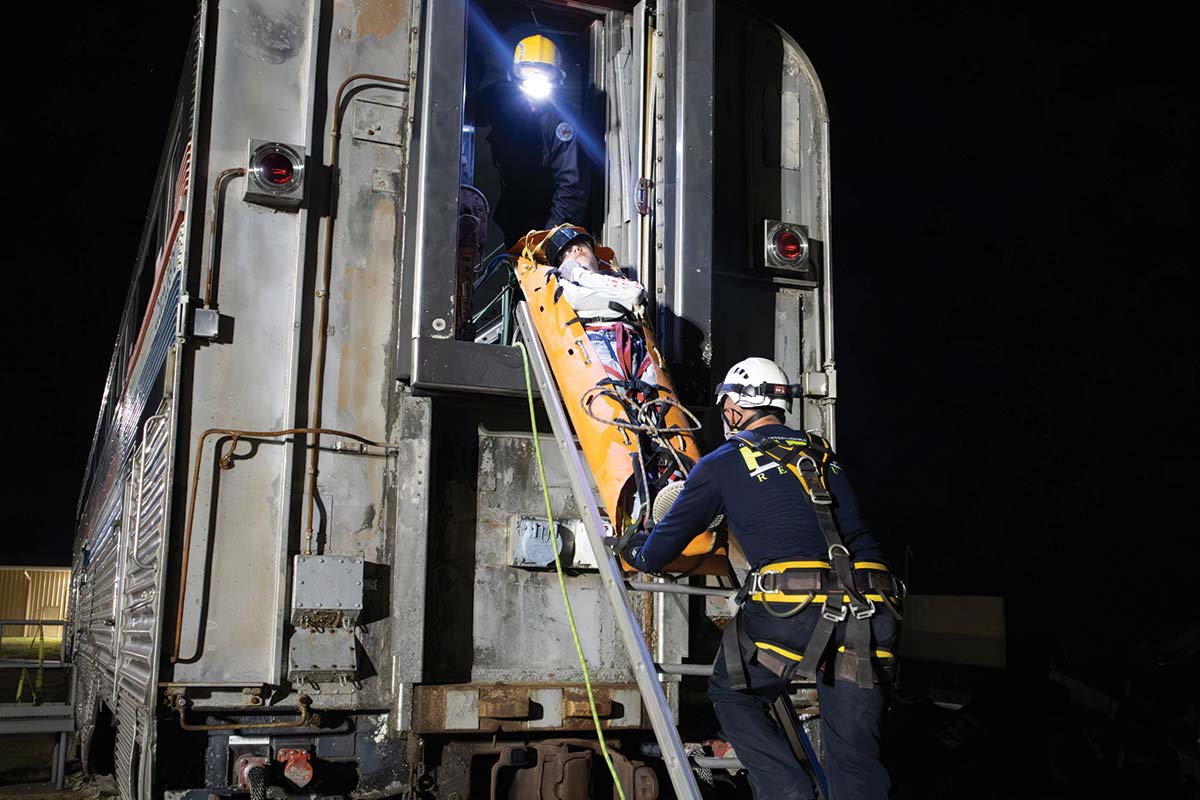
First responders remove a mock victim from a train car.
Courtesy Texas A&M Engineering Extension Service
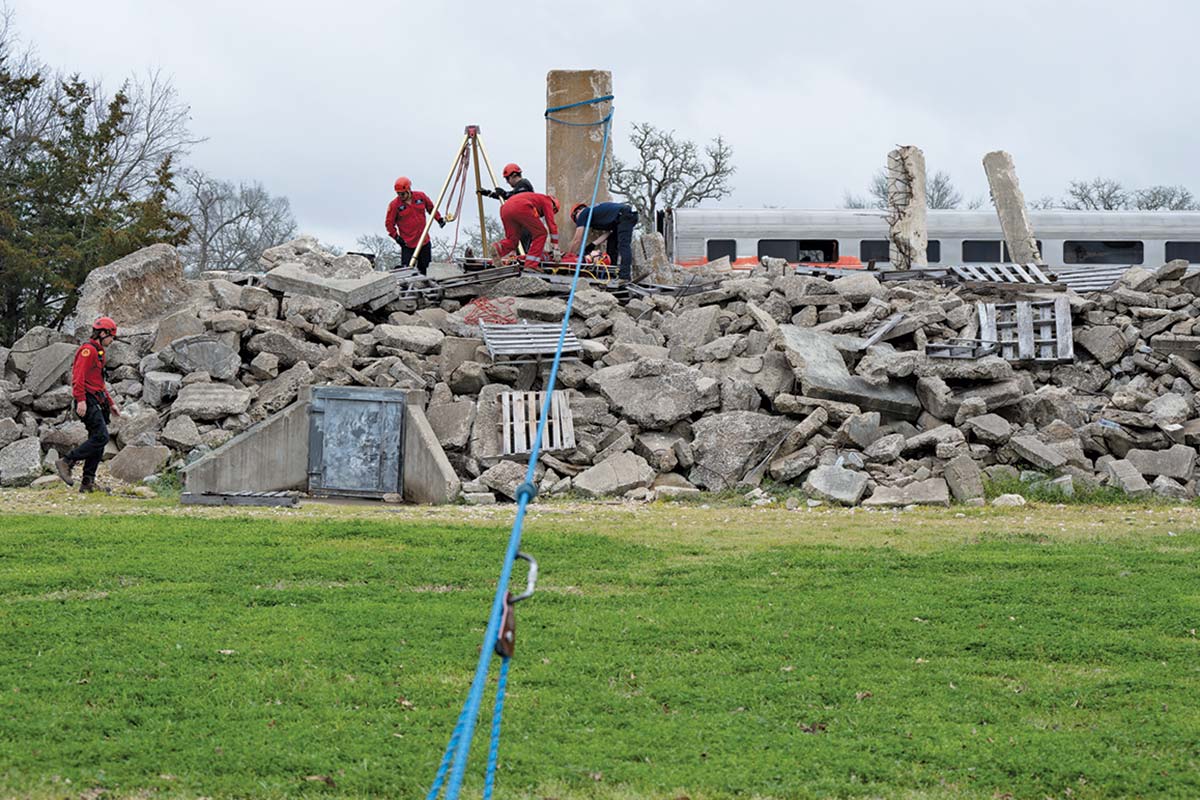
Disaster City, built more than 25 years ago, allows students to practice shoring operations, breaching collapsed structures and locating survivors under rubble.
Courtesy Texas A&M Engineering Extension Service
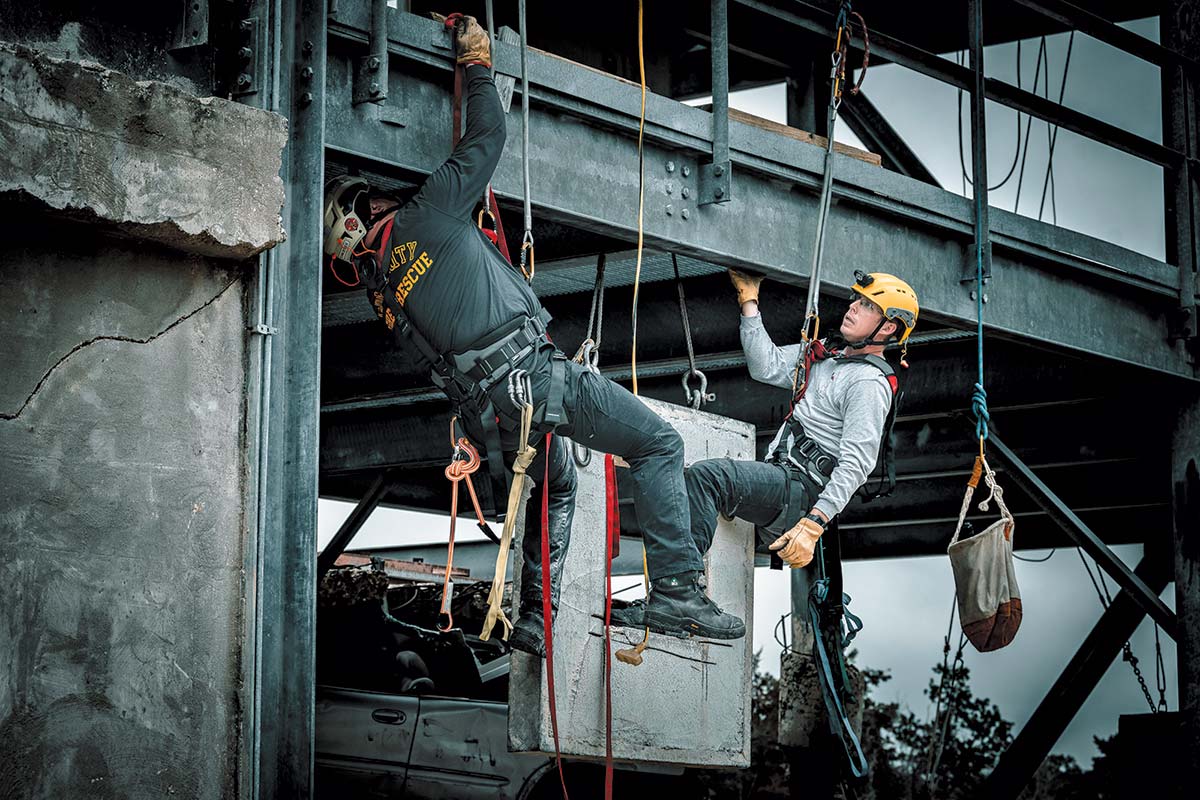
Basic to the rescue of disaster victims in all sorts of circumstances is expertise in the use of ropes. Trainees must master knot-tying and rigging and even understand the physics involved in the successful use of ropes to save lives. Grasping these fundamental principles leads to almost 100 specialized courses in technical rescue and disaster response.
The school offers a Federal Emergency Management Agency canine course that trains dogs and handlers. There’s also a spokesperson training course that teaches how to communicate with an anxious public in the aftermath of a disaster.
“Among the rescue courses we offer, the structural collapse, rope/confined space and swift water/floodwater consistently attract the largest number of participants,” Salter says. “Each year, more than 22,000 responders—representing Texas, the broader United States and international partners—participate in hands-on and computer-based training with TEEX and Disaster City. This diverse group includes firefighters, law enforcement officers, emergency managers, military personnel and international rescue teams preparing for deployment.”
Disaster City has helped Texas lead the way in standardizing urban search-and-rescue training; improving communication through joint exercises involving fire, emergency medical services, law enforcement and public works; and enhancing flood and wide-area search protocols.
“After the July 4 Hill Country flooding, Disaster City played a major support role by providing highly trained wide-area search personnel,” Salter says. “They assisted local authorities with searching in inaccessible flood zones, documentation of damaged infrastructure and debris field analysis, to name a few of their many contributions.
“Those responders that deployed to the Hill Country had been trained by TEEX at Disaster City, allowing agencies to work together seamlessly under extreme conditions.”
Kevin Price was one of those responders. The TEEX instructor spent a week amid the devastation and came away amazed by the immensity of what he saw: nature’s forces and the power of teamwork that came next.
Salter, an El Paso native who spent the early part of his career fighting fires in North Carolina, was among an international contingent of hundreds of responders who witnessed firsthand the pain and misery caused by the swollen Guadalupe and its tributaries a year ago.
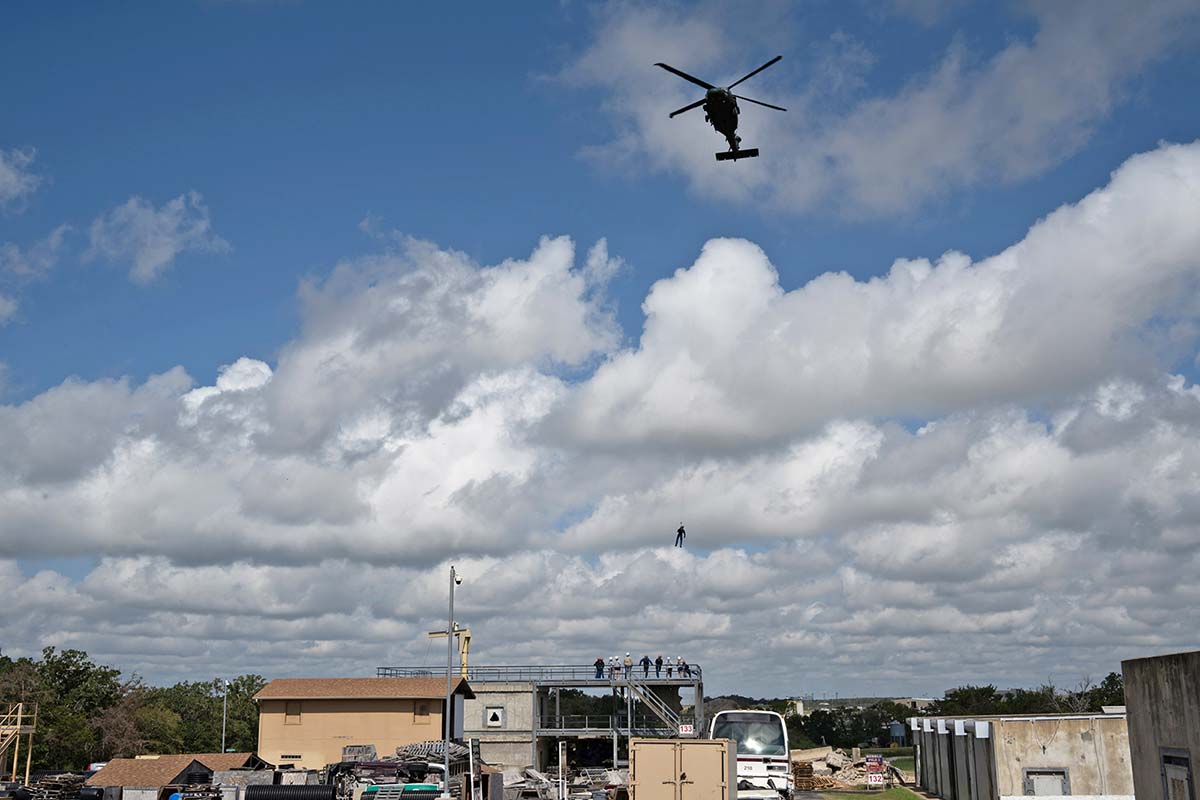
Training includes helicopter search-and-rescue exercises.
Courtesy Texas A&M Engineering Extension Service
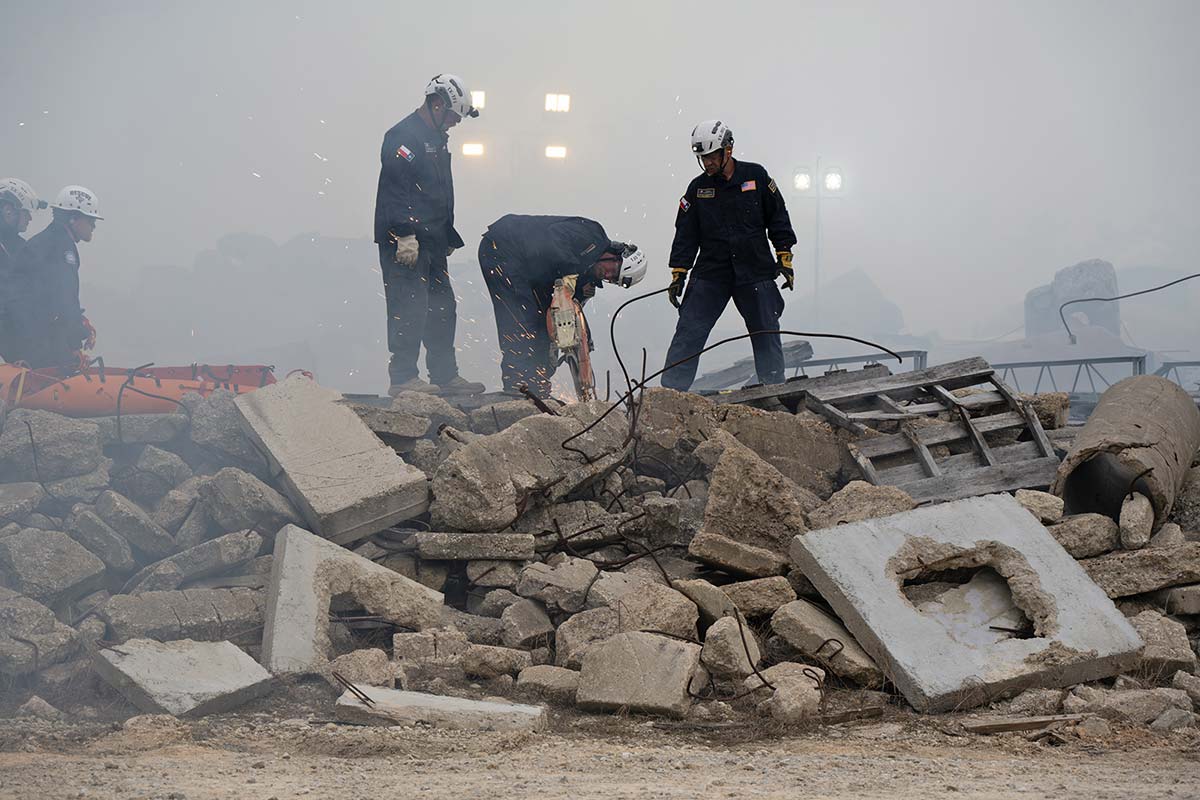
The 52-acre site is dedicated to preparing teams for real-world disaster response scenarios. “The true strength of Disaster City lies in the diverse training props available to instructors,” says Kevin Farmer, a 20-year firefighter, paramedic and instructor with the Bryan Fire Department.
Courtesy Texas A&M Engineering Extension Service
Yet the disaster that remains foremost in his mind and the one that truly motivates him to help others is Hurricane Matthew, which struck North Carolina in 2016. The Category 1 storm caused catastrophic flooding that submerged neighborhoods, cut off highways and overwhelmed infrastructure.
“Working in that environment—swift water, debris-filled currents, compromised structures—was a stark reminder that disaster conditions don’t have to be extreme on paper to be devastating,” he says. “It also reinforced the importance of training responders in wide-area search, flood rescue and interagency coordination.”
Year-round Salter and his team help students respond to known disasters. But they’re also preparing for the disasters we haven’t seen yet. “As threats evolve, our training must evolve with them,” he says. “Thus, we are actively exploring several next-generation rescue and disaster scenarios.”
These include subterranean rescues in transportation tunnels and utility conduits; wind turbine rescues; accidents involving lithium batteries; and advanced industrial rescues focused on petrochemical, rail and energy industry emergencies.
“Our goal is to remain ahead of emerging risks and to ensure Disaster City continues to be the nation’s premier training environment,” Salter says.
He believes Disaster City’s greatest accomplishment is its role in transforming how responders train for large-scale, complex emergencies. They’ve also helped create a common language and operational standards for search-and-rescue teams, enabling agencies that had never trained together to operate seamlessly during real disasters.
But his greatest satisfaction still comes from seeing people arrive at Disaster City as students and leave as confident, highly skilled rescuers.
“Watching them push through difficult, exhausting training and then applying those skills in a real disaster is incredibly rewarding,” Salter says. “But there’s even deeper satisfaction knowing that our work strengthens the entire community. When a responder leaves Disaster City better prepared, that capability extends to every person they may someday help—neighbors, co-workers, total strangers.
“Being part of that chain of impact is what drives me every day.”