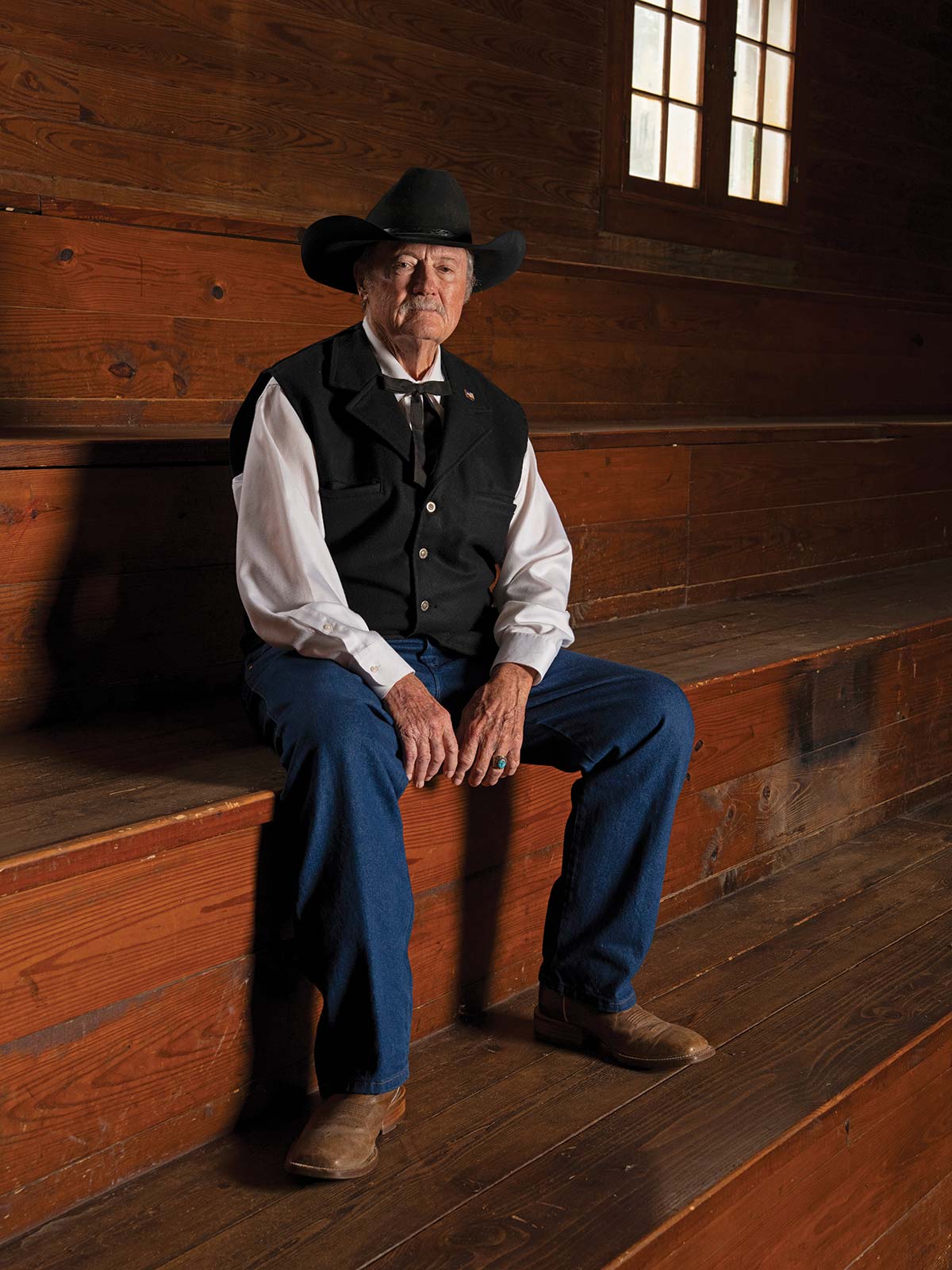
Every December, John Milsap Compere dresses in a cowboy hat, blue jeans, a white shirt, black vest and Western string tie—traditional 1880s attire—and makes his way to Pioneer Hall, a historic dance hall in Anson, north of Abilene, for the town’s annual three-day reenactment of the 1885 Texas Cowboys’ Christmas Ball.
“Anson was a new community on the frontier. That was the end of civilization,” says Compere, an 84-year-old retired Army brigadier general and judge and the historian for the Texas Cowboys’ Christmas Ball Association.
One hundred and forty years ago, the owner of the town’s lone hotel, the Star, hosted a ball, supposedly to honor a newlywed couple, and invited all the locals. Compere’s great-grandfather and namesake, John Milsap, attended and invited his friend, author and rancher William Lawrence Chittenden.
Chittenden was so impressed by the ball that he wrote a poem titled The Cowboys’ Christmas Ball in 1890, which would later make the event famous thanks to its inclusion in folklorist John A. Lomax’s 1910 book Cowboy Songs and Other Frontier Ballads.
The ball became an annual tradition, and when the hotel burned down, it was held at local ranches before World War I halted it.
Two schoolteachers, Leonora Barrett and Hybernia Grace, revived the ball in 1934, organizing a historical reenactment in a high school gym. An Anson city ordinance prohibiting dancing had become law the year before, but an exemption was granted for the three nights of the event.
The reenactment was such a success that Pioneer Hall was constructed to host it in 1940. The 8,591-square-foot building with a stone facade is a designated state historic site but had to be padlocked 362 days a year due to the dancing ban. The ball, itself an official state historic event, has been held annually on the Thursday, Friday and Saturday before Christmas—December 18–20 this year—except for a one-year pandemic hiatus.
The association that organizes and runs the event was established in 1937 and ensures the tradition is carefully preserved, namely its cowboy dances. The Paul Jones, schottische, Virginia reel, heel-and-toe polka and waltz are among the dances performed each year.
“They wanted the old-time, old-fashioned dances and music,” Compere says. “We still go by those rules and our bylaws that were written back in the ’30s.”
Per those 140-year-old rules, there’s no alcohol, smoking, horse riding, shooting, spitting, cussing or fighting. On the dance floor, women must wear dresses (skirts can be borrowed at the cloakroom), and men are required to check hats, spurs and guns. The dress code only applies to women on the dance floor, not those watching from the built-in wooden bleachers that line the sides of the hall.
There have been a few rule testers and breakers over the years. Two cowboys had a few too many drinks elsewhere and rode their horses into the hall in 2005. At the 2015 ball, the high schoolers staffing the coatroom were surprised when a historical gun reenactment group checked all their unloaded rifles, handguns and derringers at the door.
Musical traditions are another centerpiece. Each night a grand march honors a newlywed couple, a tribute to the ball’s origins. Chittenden’s poem is performed by a soloist, a tradition started in 1946 when Colorado folklorist Gordon Graham set it to music. The song was recorded in 1985 by Grammy Award nominee Michael Martin Murphey, who will make his 32nd ball appearance this year.
In the 1970s, an updated but now defunct citywide dancing ban included a unique exception for the ball.
While the dance draws roughly 300 people a night, Compere considers it a family tradition with children “dancing with their parents and grandparents” as he did. When his first grandchild was 2 months old, she became the sixth generation to attend. He took her onto the dance floor and kissed her under the mistletoe draped from the wagon wheel chandeliers.
Engaging younger generations is a priority. High school students traditionally work the cloakroom and concession stand. The association sponsors a writing contest for students, who write about the history of the ball, and a holiday pageant. Pageant winners are honored on the final night of the ball, a family affair with an appearance by a cowboy Santa Claus.
“As long as people will support it,” Compere says, there will always be Christmas dancing in Anson.