When Anthony Knopp first came to the campus of Texas Southmost College in 1976, his office was in an old barrack, and some faculty members lived in single-story, 100-year-old former military buildings, recalls the retired history professor.
While the old structures lacked modern amenities, Knopp made the most of teaching at a historic site. “When studying U.S. history, particularly relations with Mexico and 20th-century wars,” he says, “I was able to connect students to what was here at Fort Brown.”
Today, a former 48-bed hospital houses the college president’s offices on the campus in Brownsville, in the Rio Grande Valley. Fort Brown’s hospital annex (built in 1868), commissary (1904), guardhouse and morgue (1870) support various college departments.
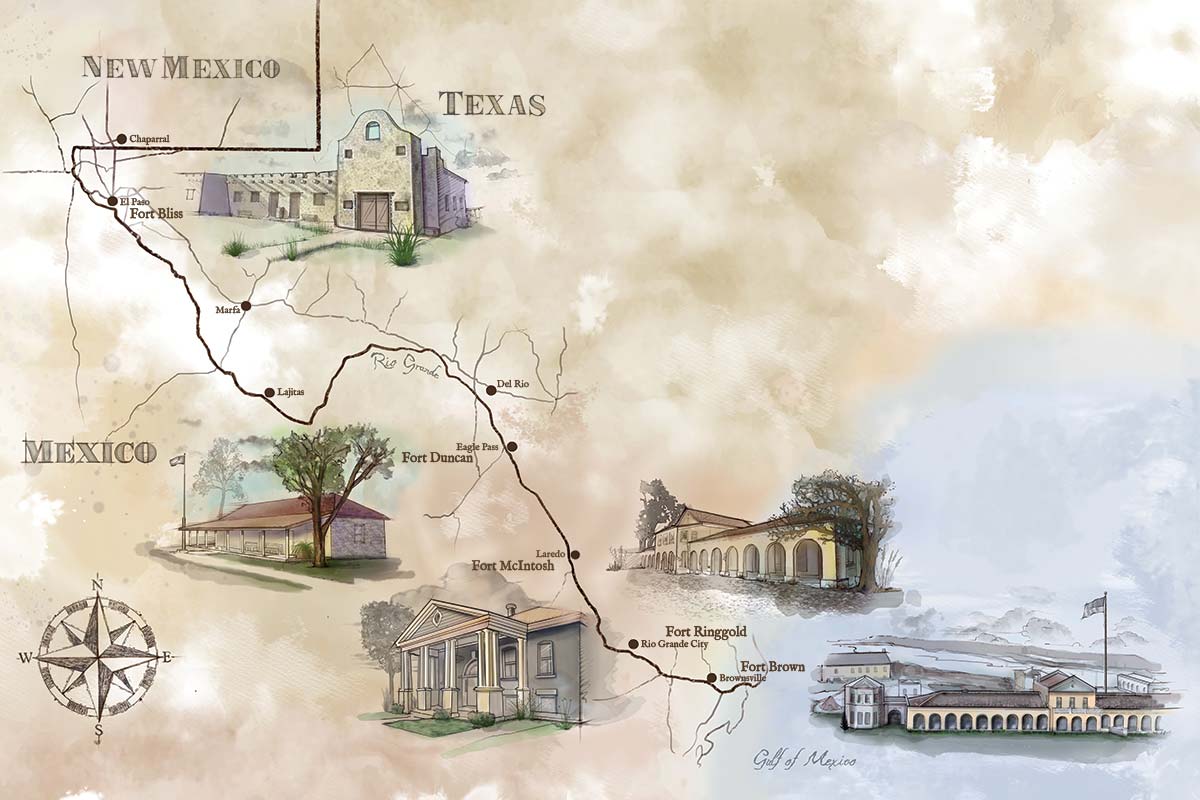
Fort Brown and four other U.S. Army forts, established along the Rio Grande in the years after Texas became a state in 1845, endured for decades as military installations.
Unlike Texas frontier forts of the 1800s, such as Fort Concho in San Angelo and Fort McKavett in Menard County, which were rapidly abandoned as the frontier moved west, the border forts in Brownsville, Rio Grande City, Laredo and Eagle Pass remained defensive posts, off and on, for nearly 100 years. Fort Bliss in El Paso is still in use.
Today—178 years after the Mexican-American War—repurposed buildings from these border forts contribute to the vitality and identity of those Texas towns. Retaining their 1800s ambiance, the former Army headquarters, barracks and hospitals serve as schools, colleges, museums and parks.
The border forts had much in common, each named for veterans of the Mexican-American War, fought immediately following Texas statehood. At Rio Grande crossings, most about 100 miles apart, each fort shifted locations several times before being rebuilt as permanent posts after the Civil War.
Troops at the forts alternately dealt with Mexican bandits and rustlers and rowdy revolutionaries from both sides of the border, protected travelers and settlers from raids by Comanche and Lipan Apache tribes, and trained troops for both world wars. The garrisons shaped the cities that grew around them, as Army suppliers set up shops that also catered to local residents.
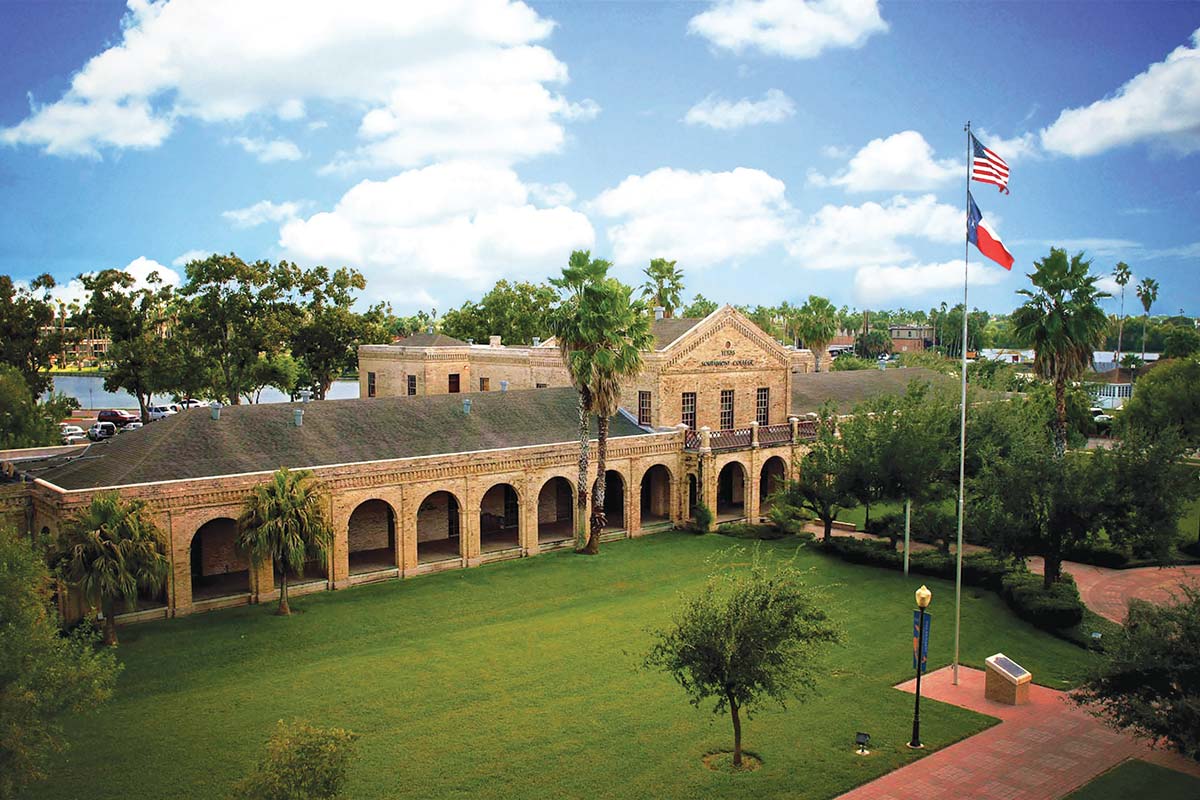
Much of the Fort Brown site serves as the campus of Texas Southmost College in Brownsville.
Courtesy Texas Southmost College
Fort Brown
Count riverboat pilot Mifflin Kenedy among the early merchants who cashed in on Army contracts. He ferried troops and equipment from Fort Brown, near the Gulf Coast, up the Rio Grande during the Mexican-American War.
He later started a steamboat company, married a wealthy widow and acquired hundreds of thousands of acres. He is the namesake of the Kenedy Ranch, the town of Kenedy and Kenedy County.
Fort Brown evolved from a star-shaped earthen fort to a commanding presence after the Civil War, when 70 buildings were erected of locally made border brick. With wide arches fronting shaded breezeways, Fort Brown’s 1869 hospital (said to be the most beautiful hospital in the Army) was of crucial importance during epidemics of yellow fever and cholera as the only hospital in Cameron County until 1909.
Quartermasters negotiated contracts with local businesses for goods and services such as beans, flour, coffee pots and hay for horses. Although a brick wall separated the town from Fort Brown and its palm-lined parade grounds, traffic flowed between them.
“Interactions resulted in marriages,” Knopp says. “Married soldiers either stayed in the area or returned.”
Fort Brown provided several forms of entertainment for the town: parades, concerts and sporting activities. Sunday afternoon polo matches, a cavalry favorite, drew locals as did concerts at the post bandstand, held twice a week.
A tree-shaded “lovers’ lane” curled between the fort and the river. Troops marched in local parades and Charro Days celebrations. Off-duty troops ate at local restaurants. The officers’ club hosted dances while enlisted men attended dances on the patio of El Jardin Hotel. Soldiers’ sisters and daughters met and married local men, too.
Deactivated in 1944 when the last U.S.-based mounted soldiers left, Fort Brown almost immediately started a new life as part of what is now Texas Southmost College. New campus construction echoes the border brick architecture of bygone days.
Fort Brown tours, arranged by the Brownsville Historical Association, link the past to its visible remnants.
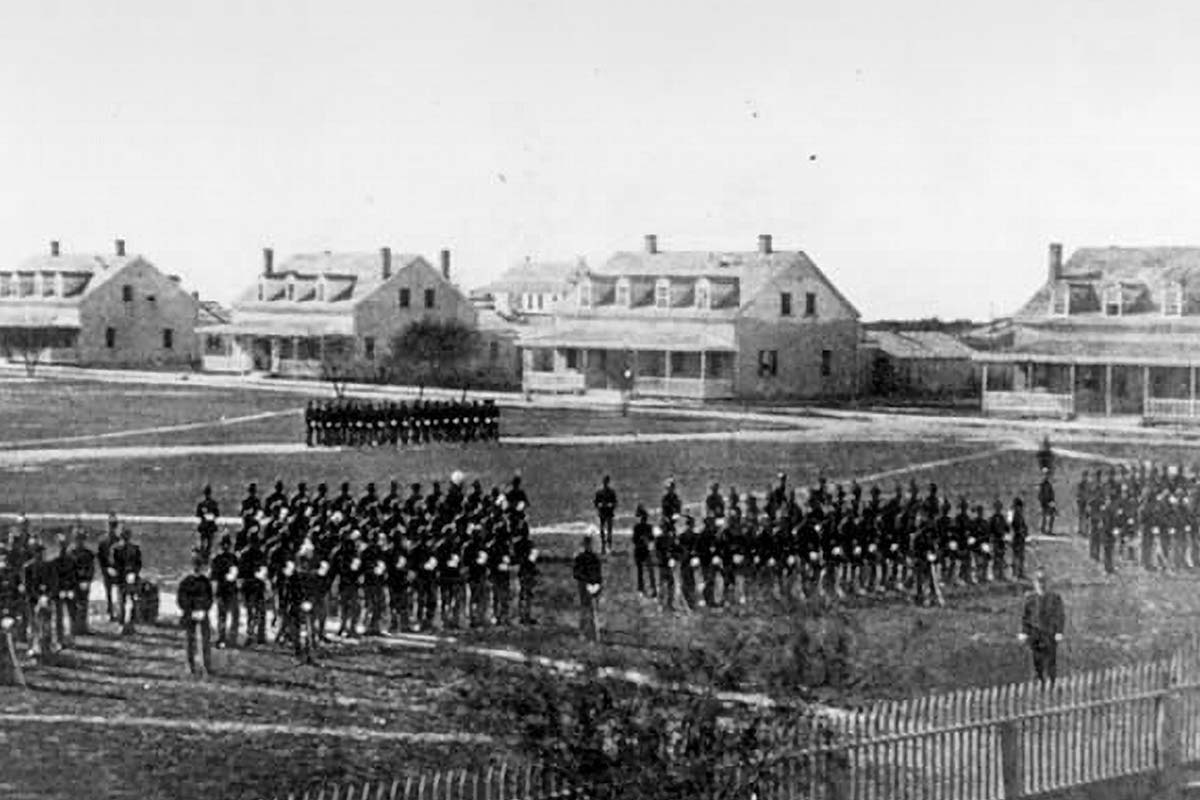
Troops perform drills in the late 1800s at Fort Ringgold in Rio Grande City.
Courtesy University of Texas at Austin
Fort Ringgold
Upriver at Rio Grande City, Fort Ringgold followed Fort Brown’s trajectory. Veterans of the Mexican-American War went into business, not always successfully.
Capt. Forbes Britton and partners failed at making their Rio Grande City riverboat landing a major stop for Kenedy’s steamboats. But construction booms after the Civil War and continuing through World War I boosted the local economy.
At Fort Ringgold, barracks, a jail, an arched brick hospital and officers’ quarters surrounded a parade ground, which was larger than a football field.
“The parade ground gives a real picture of what Fort Ringgold looked like 150 years ago, about 1870,” says Aminta Reyna Alaniz, a Rio Grande City historian and tour guide. The post bugler played reveille and taps in front of a megaphone longer than 5 feet on the parade ground, signaling the troops as well as townsfolk.
Alaniz identifies 17 fort buildings—from the guardhouse and bakery to warehouses and six barracks—that are today used by the Rio Grande City Grulla Independent School District.
The school district purchased the fort’s 325 acres and buildings in 1947 with plans for an education complex and park. Along F Troop and 12th Cavalry streets, tan- and white-painted brick buildings house registration, curriculum and instruction units.
Near a two-story enlisted cavalry barracks that once housed about 100 soldiers (and later was used as an elementary school), girls played softball on a recent Sunday afternoon. The expansive parade ground hosts marching band practice and school Christmas displays.
Until recently, Alaniz says, an electronic sound system broadcast a digital bugle call morning and night. But even those echoes have ended.
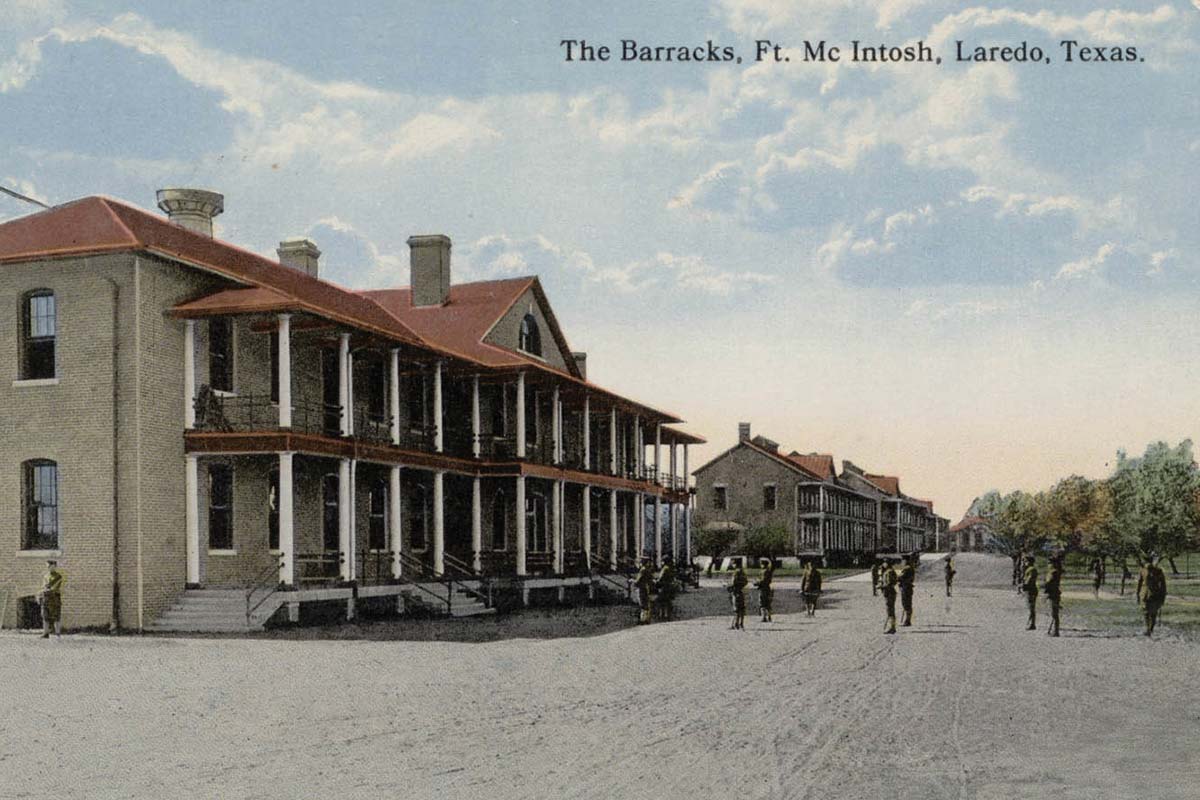
A colorized postcard from the early 1900s shows barracks at Fort McIntosh in Laredo.
Courtesy Laredo Public Library
Fort McIntosh
Fort McIntosh was built at a long-established Rio Grande crossing in 1849, opposite a former Spanish presidio. Laredo grew along with the fort, which held as many as 400 soldiers on over 400 acres with a requisite hospital, jail, barracks and cemetery.
In 1946, the International Boundary and Water Commission and the city of Laredo divided up the former fort. The city created what is now the Fort McIntosh campus of Laredo College in 1947.
Inside the Fort McIntosh Historic District, streets are named for post commanders and soldiers. The brick hospital has become Laredo College’s purchasing department. The former officers’ quarters houses the campus student ministry, and the old commandant’s house became a museum furnished with Victorian-era pieces.
The bakery is occupied by a customs brokers association. Other refurbished McIntosh campus buildings are used for classrooms. The cemetery is empty, the remains relocated.
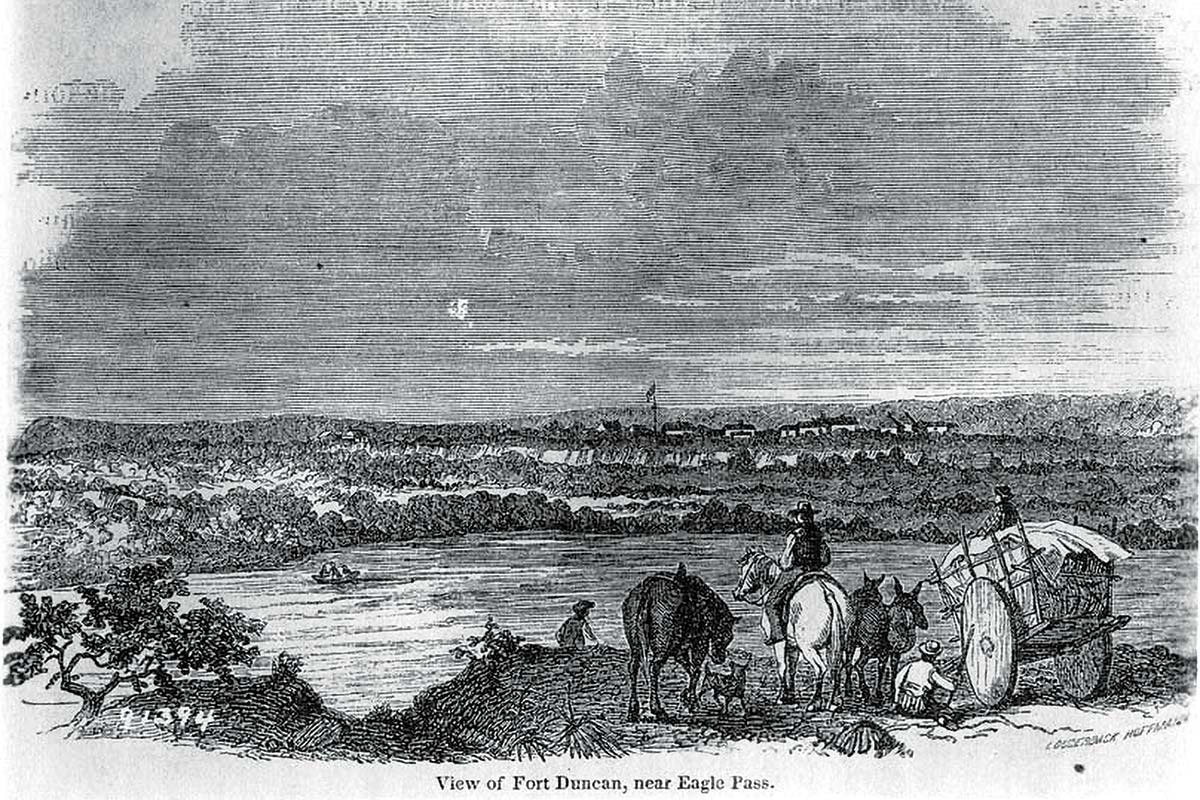
An 1850s engraving of Fort Duncan near Eagle Pass.
Courtesy University of Texas at Austin
Fort Duncan
In Eagle Pass, Fort Duncan, constructed across from what was then a tiny Mexican village, was home for infantry troops in 1851 and a mounted rifles unit in 1856.
Buffalo soldiers, all-Black units created after the Civil War, were assigned to Fort Duncan, considered a safe stopping point for travelers on the California road. Before and during World War I, some 16,000 troops trained at Fort Duncan.
The town of Eagle Pass took over the fort property in 1938, creating a public park and loaning it back to the Army during World War II. Today the post headquarters is the Fort Duncan Museum, and seven other original buildings have been restored and listed on the National Register of Historic Places.
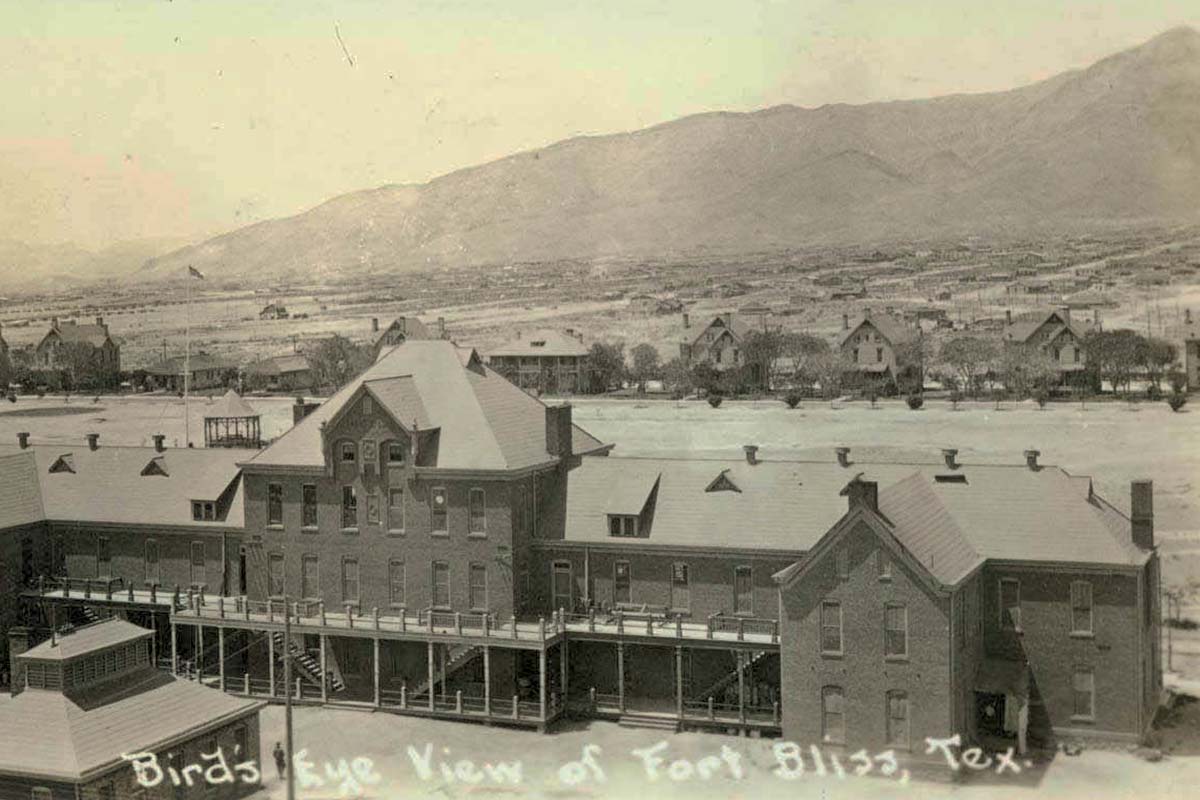
Fort Bliss in El Paso, with the Franklin Mountains in the background.
Courtesy El Paso Public Library
Fort Bliss
In 1848, more than 400 miles up the Rio Grande, a fifth border fort was established at El Paso. It too moved locations multiple times as El Paso flourished around it.
Hoping to remain prosperous, the residents in 1890 purchased and donated land for a permanent Army post, which remains active today.
Unlike the other forts in this list, Fort Bliss grew after World War II. It now covers 1.1 million acres of Texas and New Mexico and is among America’s largest Army posts, home to about 20,000 troops.
Replicas of Fort Bliss’ early adobe buildings were constructed for the fort’s centennial in 1948 and house a museum, which is open to the public.
But at the other four border forts, troops and time marched on. Swords were beaten into street signs. Some of those streets are named for the soldiers who shaped those towns’ histories.