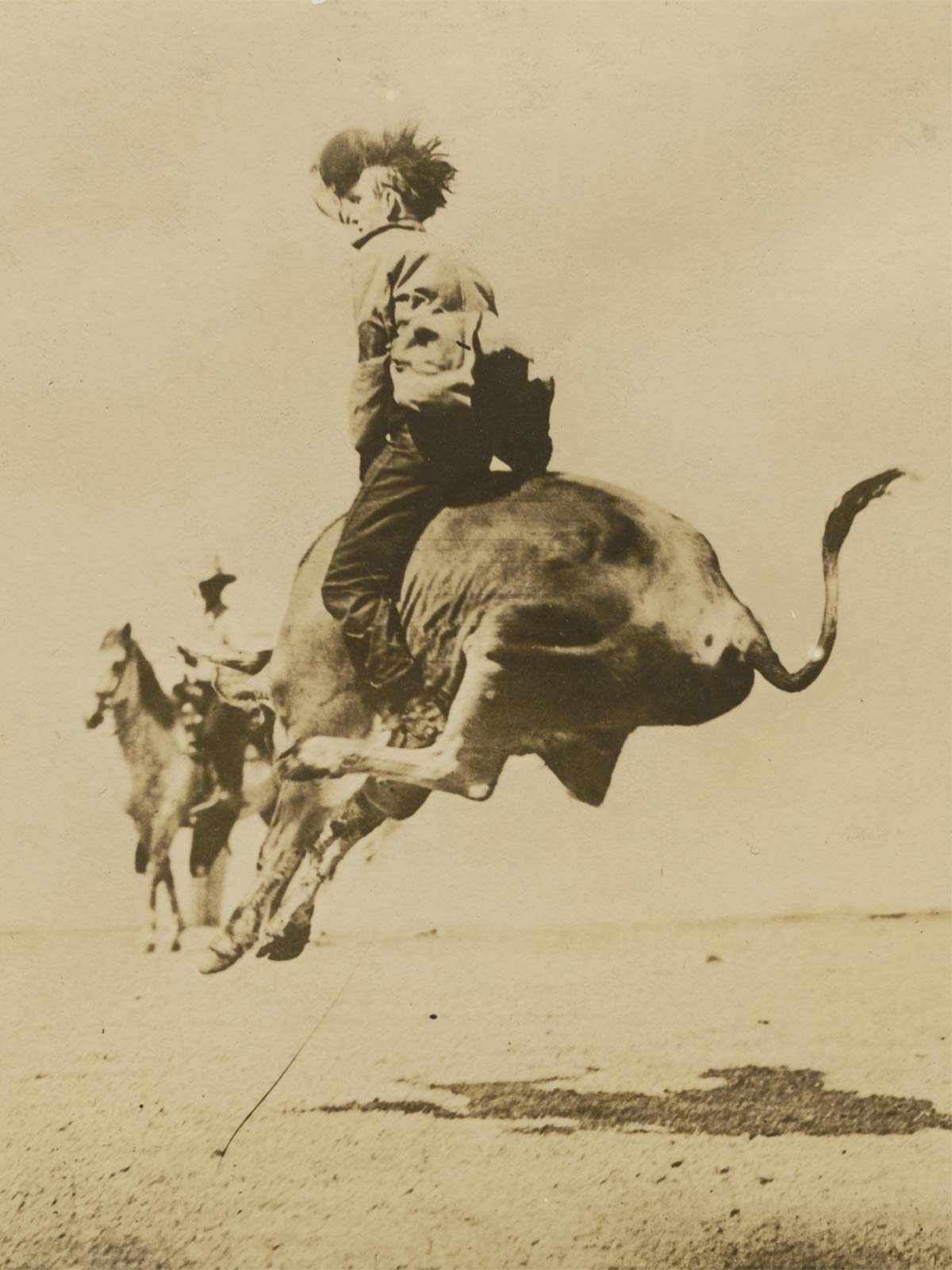
It was claimed, journalist Jerry Armstrong once wrote, that rodeo clown Red Sublett would ride anything that “a saddle, a riggin’ or a rope could be used on”—horses, mules and bulls, of course, but also cows, buffaloes, zebras and at least one ostrich. Sometimes he rode them straight, sometimes backwards but always with zany antics that left the crowd laughing.
Sublett was “the greatest and the highest-paid arena comic of his day,” Armstrong wrote.
He was born John Dixon Sublett in Arlington in November 1893, and he died, by then known to everyone as Red, in Dallas a scant 56 years later.
His family had settled in the countryside when the prairies were still unfenced. The town of Sublett, now part of Arlington and some 18 miles southeast of Sublett’s modest, pink granite headstone in Mount Olivet Cemetery, bears the family name.
Sublett’s father moved his family from Texas to Oklahoma via horse-drawn covered wagon with two milk cows tied to the tailgate.
Before World War I intervened in 1917, Sublett worked rough stock on ranches, including the 101 Ranch in Oklahoma and later the Four Sixes in Texas. Before that, at just 16, he had ridden broncs and steers for Booger Red’s traveling cowboy show and Lucille Mulhall’s show.
He enlisted in the war effort and saw action in France with the medical corps before returning to his rodeo antics.
At a rodeo in Magdalena, New Mexico, the story goes, producer Tex Austin and announcer Foghorn Clancy took Sublett aside and told him he was getting plenty of big laughs just being himself and that he should become a rodeo clown.
It paid better, they said.
As rodeo evolved from its beginning in ranch corrals in the early 1900s, promoters realized their audiences drifted away whenever there was a break in the action due to injuries and other delays. So the rodeo clown was created to keep spectators entertained during those breaks.
When bull riding became a regular part of rodeos in the 1920s and ’30s, the clown’s role—and importance—grew as he stepped in to distract the bull and allow its rider to get out of danger. Today’s rodeo protection teams, made up of highly trained athletes, are still a vital part of competitions—work that started with the clowns.
“The early clowns were cowboys who could rope and ride with the best of them … and they were, above all, showmen,” wrote Jeanne Joy Hartnagle-Taylor in her 1993 book Greasepaint Matadors.
Sublett fit that description perfectly.
He picked up a trained mule named Spark Plug that he claimed could be taught to do just about anything, and together the duo performed in rodeos throughout the U.S. and abroad, including shows in London, Paris and Dublin. They also performed in films with actors Wallace Beery, Bob Steele and Pearl White.
Spark Plug died in Fort Worth in 1931, and Red’s career began sliding to an end. He died from a heart condition in the veterans hospital in Dallas on April 14, 1950.
His headstone reads, “World Famous Dean of Rodeo Clowns.”