Carolina snailseed often pops up in our native gardens. I let a few vines clamber up our chain-link fence. The rest I yank. That’s what I was doing a few Aprils ago in a front-yard bed. Bent over, pulling on a stubborn root, I glanced at a nearby tree stump.
Could it be? I squinted and looked again, this time closer.
It was a long-legged gray spider, a kind I’d never seen before in our yard, and so well camouflaged that I inched up for an even closer look. Sensing my presence, the spider sidled on the stump.
I laughed. “I see you,” I said, snapping some photos with my phone. The spider sidled back the other way. “Sorry, I still see you!” Later I learned that I’d actually met a white-banded fishing spider, a species—as its name implies—that mostly hangs out near water. How she found her way to our gardens will always mystify me.
To this day, my encounter with that spider ranks among my favorite garden adventures, the list of which continues to grow. That’s what happens when you tend native plants: Mother Nature shows up.
To keep track of what I find, I use iNaturalist, an online network of users who record and identify organisms around the world through a mobile app and website. Within the 1-acre property that my husband and I own in a neighborhood in the Hill Country town of Blanco, I’ve documented more than 1,520 species of flora and fauna, including some surprises.
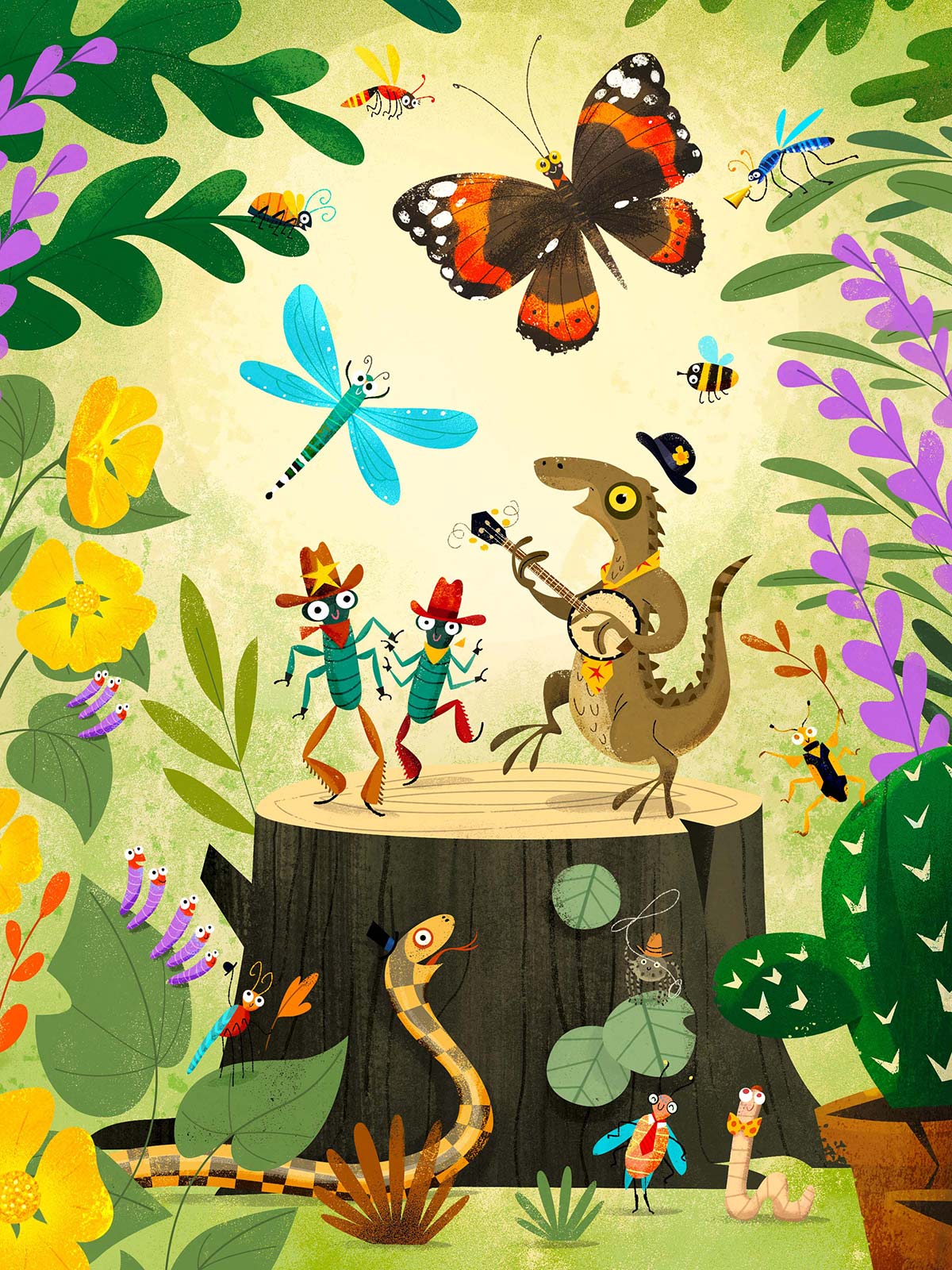
For instance, one June our velvet-leaf mallow hosted a huddle of violet-hued caterpillars with red heads. Or so I thought. They turned out to be the larvae (not butterfly caterpillars) of sawflies, which are named for the female’s egg-laying appendage that saws into plants. Adult sawflies are seen less often than their chubby larvae.
Not so for a large fly that’s commonly called an elephant mosquito (yes, mosquitoes are flies). Somehow I resisted the urge to swat the first one I ever saw, resting on a salvia leaf. Imagine my surprise when I learned that these iridescent mosquitoes feed on flower nectar, not blood. Plus, their aquatic larvae eat watery insects, including other mosquito larvae.
My first jagged ambush bug, lurking on a coreopsis flower, stumped me. Viewed from the side, these pea-sized predators have a silhouette that resembles a humpbacked dinosaur. Concealed on a bloom, they wait for a small butterfly, moth or bee to land. Then they grab the victim with their hooked forelegs, similar to a praying mantis’, and stab their sucking mouthpart (called a proboscis) into the body.
One evening, a green dragonfly called an eastern pondhawk sideswiped my left ear at top speed. Then she landed near my feet on a rock. After taking some photos, I stuck out my hand. To my delight, she flitted onto me! So have longhorn cactus flies, red admiral butterflies, robber flies, a picture-winged fly and a scaly cricket, along with assorted bugs, beetles and spiders.
Sometimes critters have fooled me, too. Like a hefty ant perched on an esperanza bloom. Wrong—it was a juvenile Texas bow-legged bug. Another time I spotted a firefly (which are beetles) on a plateau goldeneye leaf. Nope—it was a firefly-mimicking longhorn beetle.
Other pranksters in our gardens include ant-mimicking jumping spiders, velvet ants (wingless female wasps) and Beelzebub bee-eaters, a fuzzy robber fly that looks like a bumblebee. All use mimicry to either ward off predators or trick their prey (and me).
We’ve seen Texas spiny lizard mothers excavate burrows in flower beds. One time I happened by an autumn sage just in time to see a checkered garter snake gulp down an earthworm. In the summer, Rio Grande leopard frogs honeymoon in our 100-gallon stock-tank pond.
Bird adventures? You bet. One June a wild turkey hung out in our backyard. That same month, a juvenile green heron practiced his fishing skills in a shallow birdbath. We still laugh at videos taken of a black-crested titmouse mom pulling fur off our annoyed cat. Yes, the titmouse survived!
Fate wasn’t so kind when a red paper wasp landed on the street at my feet. I’d been en route to check our milkweed crop of antelope-horns. I crouched down, then grimaced.
The wasp mother was sawing the legs off an orb-weaver spider that she’d paralyzed with a sting. A few minutes later, she finished her gruesome task and lifted into the air, clutching her victim. Soon the legless spider would feed hungry wasp larvae.
Yes, Mother Nature can be cruel. But she can be fascinating and surprising, too. Take my advice and look closer. Soon you’ll be on your own garden adventure.