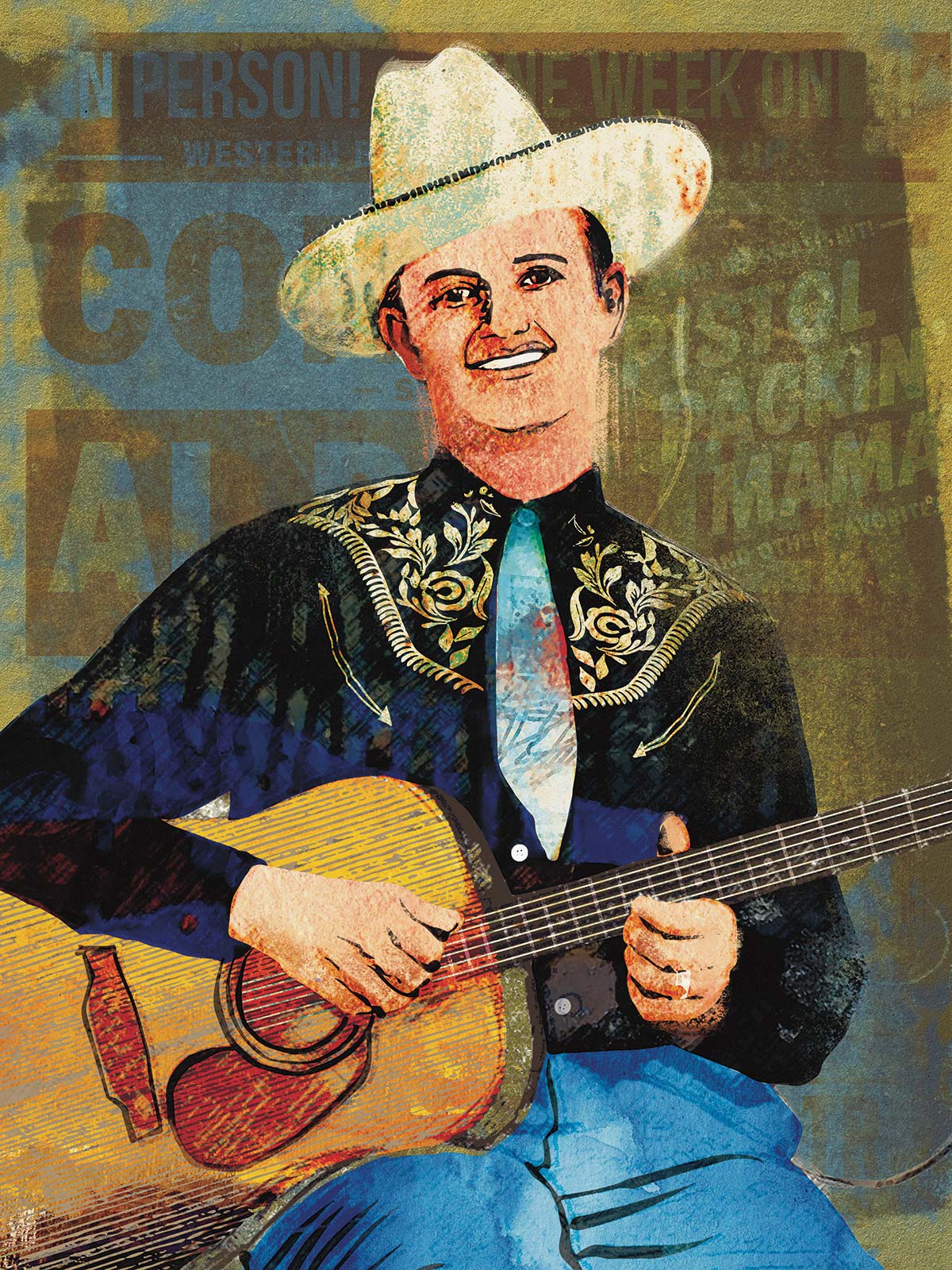
One of the top-selling records of 1943 was by East Texas honky-tonk singer and musician Al Dexter. His recording of Pistol Packin’ Mama—a catchy, danceable diversion for a war-weary country—hit the top of the pop and country charts.
Bing Crosby, accompanied by the Andrews Sisters, also had a hit with the song in 1943. Frank Sinatra sang Pistol Packin’ Mama for 14 straight weeks on the Your Hit Parade radio show. Roy Rogers, Glenn Miller and Harry James released covers in 1944, even as Life magazine declared Dexter’s claim to fame “a national earache.” Hollywood took advantage of the song’s popularity with a 1943 movie of the same name.
Within six months of its release, Dexter’s original version sold 1 million copies and would go on to sell 2 million more. Pistol Packin’ Mama paved an unlikely path for Dexter that led him from Jacksonville, Texas, where he was born Clarence Albert Poindexter on May 4, 1902, to fame and fortune.
Dexter’s musical journey began in the 1920s when he managed to squeeze out a living by performing in East Texas. His first band was an all-Black combo consisting of a saxophone, piano, bass and drums. He told writer Nick Tosches that none of the white musicians he approached at that time wanted to play with him.
“They wanted to play Benny Goodman stuff, that kind of music,” he said. Later, he put together a band for a honky-tonk near Longview, where his rollicking, barrelhouse sound caught the attention of the American Record Corp. label.
“The record company said they could not pay much royalty on records that sold for 16 cents wholesale,” he recalled, “but I said I would take it, as I’m not doing much anyway right now.”
Dexter’s first hit, Honky Tonk Blues, which he co-wrote with James B. Paris, is often cited as the first song to use the term “honky-tonk.” His biography on AllMusic acknowledges his contribution to the honky-tonk genre but adds: “The popular theory that Dexter actually coined the term can be blown full of holes; he had never heard of honky-tonk before his songwriting partner James B. Paris suggested it as a title in 1936.”
In 1975, Dexter told Tosches how he came to write his million-dollar contribution to the American songbook. The genesis of Pistol Packin’ Mama, he said, occurred at a tavern, the Roundup Club in Turnertown, east of Tyler, which Dexter happened to own.
“I had a bunch of girls workin’, and there was a little cross-eyed fellow who brought a girl in one night by the name of Jo Ann, and he asked me if I’d give her a job,” Dexter said. “The next day three or four women came up in the same V-8 Ford that little cross-eyed feller drove up in the day before, and they’re looking for Jo Ann.
“Jo Ann, she always said, ‘I love that little cross-eyed man.’ She didn’t know he was a married man.”
Dexter sold the Turnertown bar not long afterward, but he met up with Jo Ann again two or three years later, in 1942, when he was in another honky-tonk, trying to come up with a new song and listening to the jukebox playing the Bob Wills megahit Take Me Back to Tulsa. He noted the eight-bar chorus, eight-bar verse, eight-bar chorus structure and vowed to write a song with a similar arrangement.
“So I’m sittin’ there, watching things happen, and in came this gal Jo Ann,” he said. “She’s scratched up and she looks like she’s been fightin’ with wildcats.” Jo Ann explained to Dexter how the wife of the cross-eyed man had chased her through brush, brambles and barbed wire with a gun.
Said Dexter: “So I got the idea, ‘Lay that pistol down, babe, lay that pistol down.’ Got a woman after ya with a gun, you can’t outrun the darned thing, so you gotta beg her to lay it down. So I went out to the car and started writin’ these lyrics. I sang it over and over so I wouldn’t forget it, and then I had my song.”
That was the first of many. Twelve of Dexter’s songs—all recorded from 1943 to 1948 and most of which he wrote—sold a million copies each. He was inducted into the Nashville Songwriters Hall of Fame in 1971 and posthumously into the Texas Country Music Hall of Fame in 2010.
Dozens of contemporary performers, including Mac Wiseman, John Prine, Ronnie Milsap, Glen Campbell and Willie Nelson, have introduced Pistol Packin’ Mama and other Dexter songs to new generations of listeners. The fates of Jo Ann and the little cross-eyed man who inspired the tune are unknown.