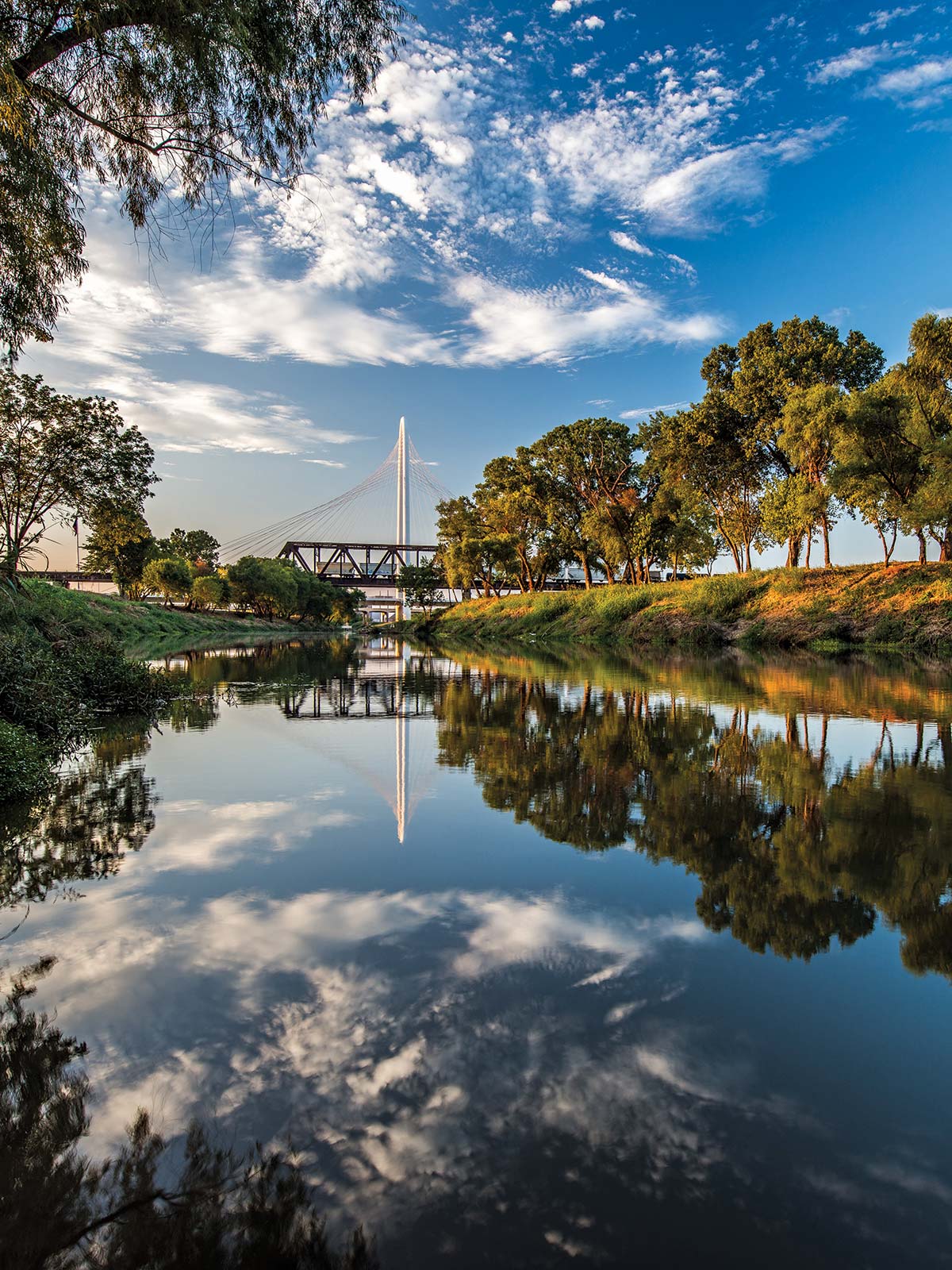
On a hot summer evening in 1975, dozens of Texans filed into a high school auditorium in Trinidad, about 50 miles southeast of Dallas. They were there to answer one simple question: could, or more importantly should, the Trinity River be tamed? Everyone present knew that the river was changing—it wasn’t quite so polluted anymore, at least—but the floods seemed to be worsening, ruining crops and drowning cattle.
Earlier generations had faced the same problems. And so that summer and the following winter, Texans gathered to debate what to do about one of the state’s wildest, moodiest rivers.
The Trinity’s extreme variability easily puts it among the most unruly American rivers. On its lower half, running from below Dallas to Trinity Bay on the Gulf, the channel might be a mere few hundred feet wide during low flows. But a flood in that same location can spread water more than 5 miles. This kind of variability made it hard to plan when and whether to plant crops or develop land within the flood plain.
Hundreds of Texans participated in official hearings like the one in Trinidad at towns along the Trinity, such as Crockett, Huntsville and Liberty, in 1975 and 1976. Archived transcriptions of these events created an invaluable record of how Texans grappled with what should be done about the Trinity.
These were raucous affairs, with booing, clapping and shouting, as wild as the river itself. Participants made their voices heard, and, in the process, they significantly influenced the management of the river that about half of all Texans depend upon today.
The stakes were high. Anything—livestock, crops, property—in the Trinity flood plain was vulnerable. Yet at the same time, the river’s floods (and the nutrient-rich sediment they brought with them) were also what allowed farmers to grow much more than in the drier and less fertile uplands. The extensive network of earthen levees and reservoirs built by the 1970s, meanwhile, was doing little to manage the flooding.
Residents were divided on what to do about it. Some testified that bolder plans might solve the issue of flooding once and for all. The proposed Tennessee Colony Reservoir, for example, would have covered a good portion of the Trinity in Henderson, Navarro, Freestone and Anderson counties and would have been the largest lake (nearly 150,000 acres) solely in Texas.
But many other Texans were skeptical. What, they asked, was the point of flood protection when the management plans included permanent flooding? As a woman at the Fairfield hearing put it, covering up the “best land” with a lake didn’t make sense.
Farther downriver, the construction of Lake Livingston in the 1960s had already forever flooded tens of thousands of acres. One rancher said he used to graze on land that is now “30 foot underwater, and I can’t run no cows there now.”
While the hearings could grow heated, with both sides lobbing accusations at the other, there was also widespread agreement that the Trinity was the lifeblood of these communities. People shared their stories, explaining the difference between a “clear rise” and a “muddy rise.” A clear rise “does all the damage and doesn’t leave you nothing,” whereas a muddy rise “takes all your crops, but it leaves you better soil.”
And thankfully, the days of “black rises”—when raw sewage flowed down from Dallas and Fort Worth, leaving massive piles of floating dead catfish—were over.
Ultimately, the consensus that emerged from the hearings of 1975 and 1976 was that the Trinity was best dealt with incrementally. Progress meant bringing more sewage treatment plants online, not canalizing the whole river.
We live with the results today: The Trinity River is now one of the most important rivers in Texas. More Texans live near and depend on its water than any other river in the state. While Houston and Dallas rely heavily on its water, the middle and lower sections are vital for ranchers, hunters and fishers.
But it remains untamed, too. More trophy-sized alligator gar, a massive, ancient fish, are caught on the Trinity than anywhere else in the world. These gar, along with many other animals, depend on the river’s floods—a natural rhythm that endures thanks to all those Texans who shared their stories 50 years ago.