The sky looks as thick and gray as dryer lint when the St. Vincent glides away from Pier 19 and into the Galveston Ship Channel with Capt. Jerome Kunz at the helm early on a Sunday morning.
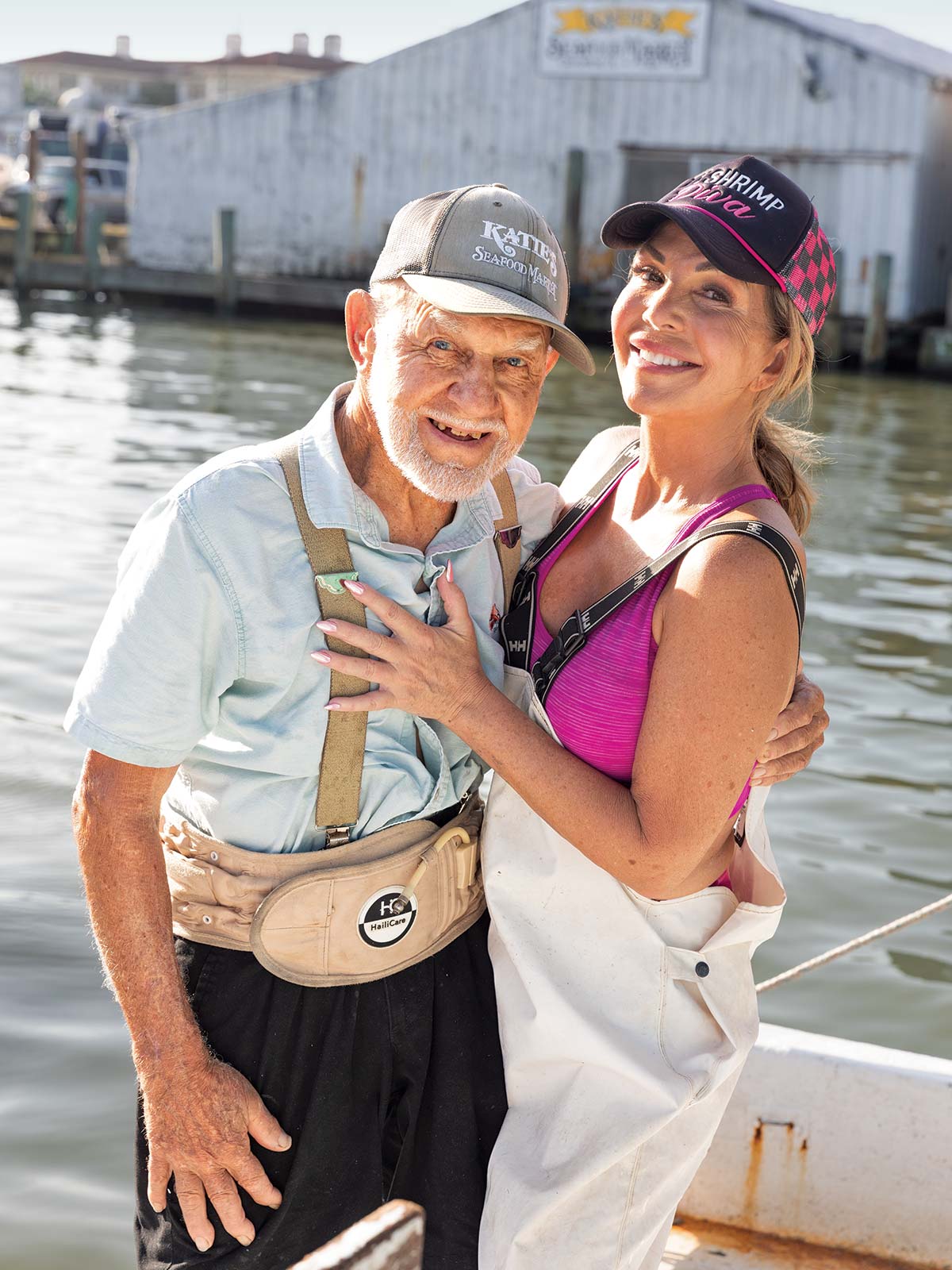
Pops, as Kunz is called, knows this channel well. He’s been shrimping here since he was 10, and at 93 he’s still dragging the nets twice a week.
I’ve come to Galveston in mid-May to join Pops and his daughter-in-law Nikki Johnson-Kunz, known as the Texas Shrimp Diva, on the St. Vincent and learn more about the shrimping business in Texas. Jason Kunz, Nikki’s husband and the youngest of Pops’ 10 children, is here too.
But this is no glamour tour. I’m warned that I’m likely to get wet, that the back-and-forth between shrimpers on the radio will get raunchy, and that the bathroom, if I need it, is a bucket. I have planned accordingly.
When we meet at the dock at 5:45 a.m., Pops nearly crushes my hand in his welcoming grip. Nikki, wearing a pink skirt and a pink-and-black checked cap that says “Texas Shrimp Diva,” leads me on board and shows me where I can stand without getting in the way.
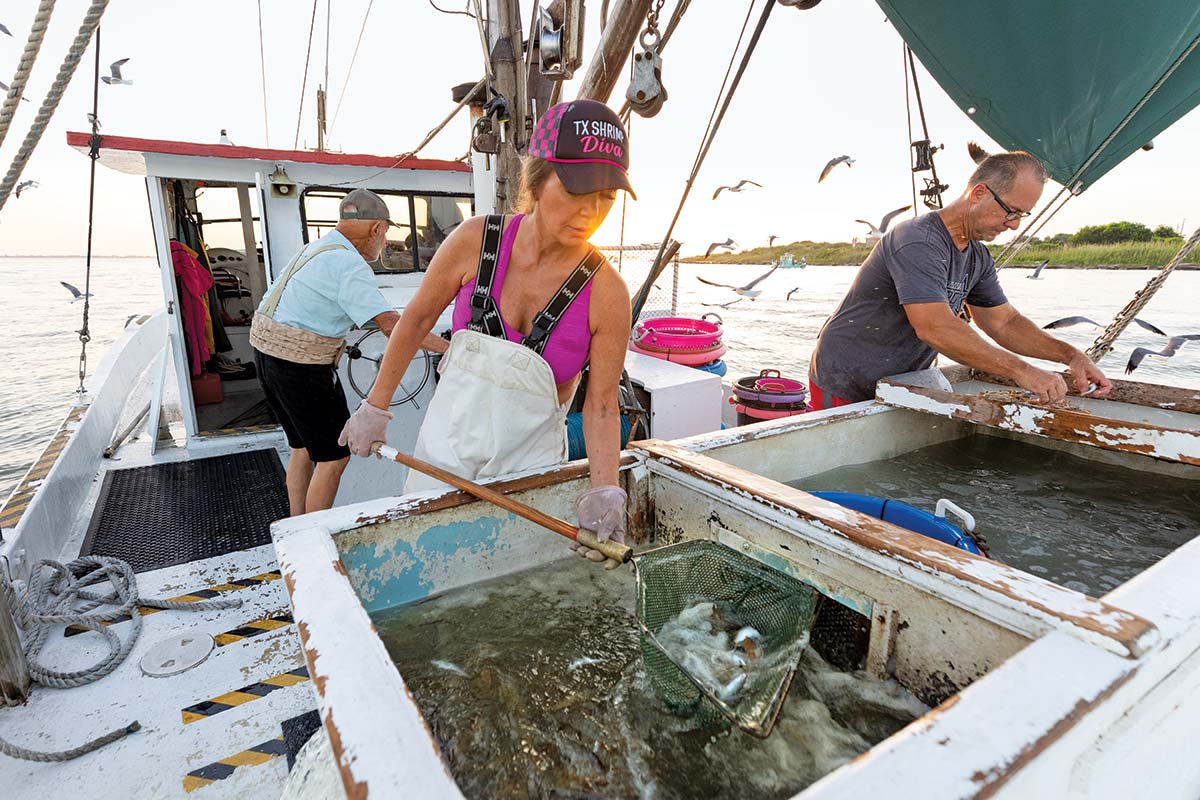
Nikki Johnson-Kunz works alongside her husband, Jason Kunz, on the shrimper St. Vincent.
Erich Schlegel
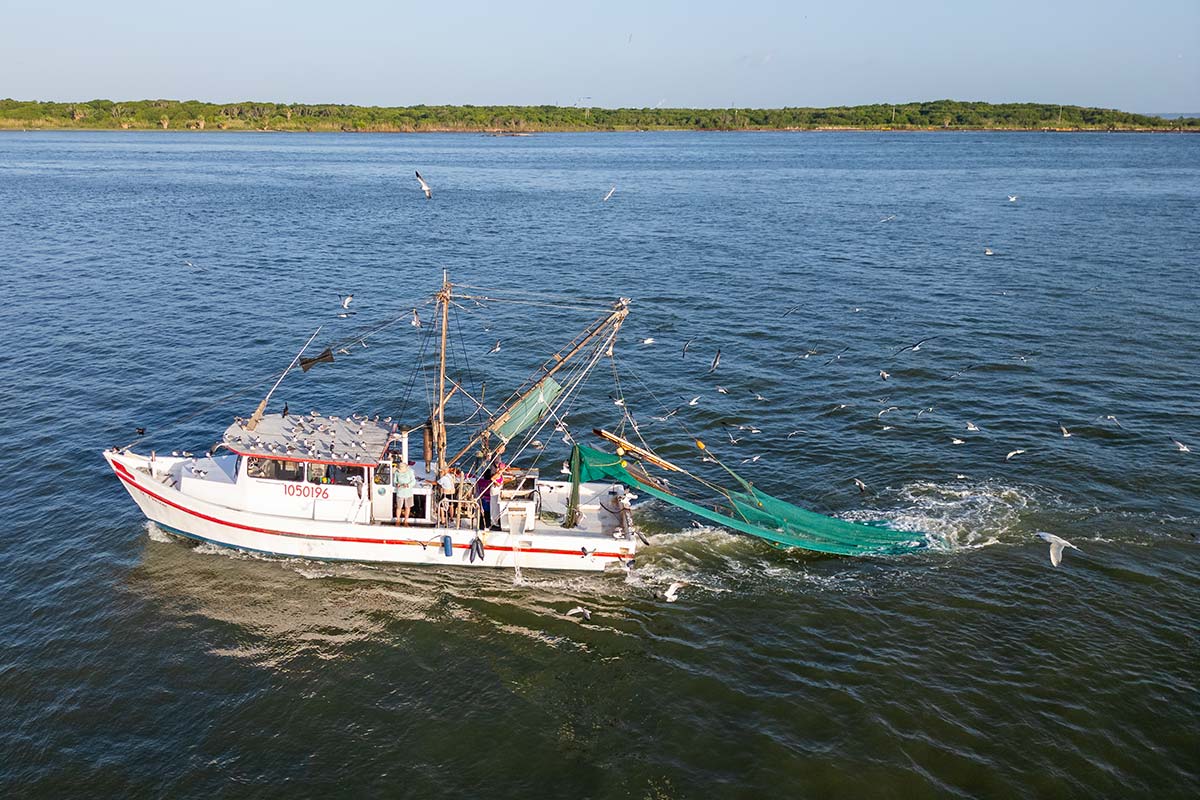
The St. Vincent drags its nets near the cruise ship port in Galveston.
Erich Schlegel
It’s welcome advice. Moving around a working shrimp boat feels a little like jumping into a rumbling engine, with heavy moving parts that could tear off a finger or flatten a toe. But it’s peaceful, too, with dolphins surfacing in the boat’s wake and pelicans flapping overhead.
Pops, wearing faded jeans held up by suspenders, steers the 53-foot St. Vincent past a cruise ship roughly 20 times its length. As we approach the historic tall ship Elissa, docked in the harbor, he tells me how he got his start in the shrimping business.
When Pops was a boy, his father bought a small boat and, with no firsthand experience, rigged it as a shrimping vessel. When Pops was 10, he quit school to help his dad provide for the family. At 15, he was patching and making his own nets, something he still does today.
“When I was just a little guy, I’d go out with him,” Pops tells me. “I thought I was pretty good at it, and I guess I was because I’m still doing it.”
Eventually, he bought his own boat. But the work has taken its toll. Pops walks with a stoop earned from decades of bending over the sorting box. He extends a finger to show me where the tip was cut off in an accident. He’s suffered too many cuts and bruises to count. The work was hard, but after Pops married, it supported his growing family.
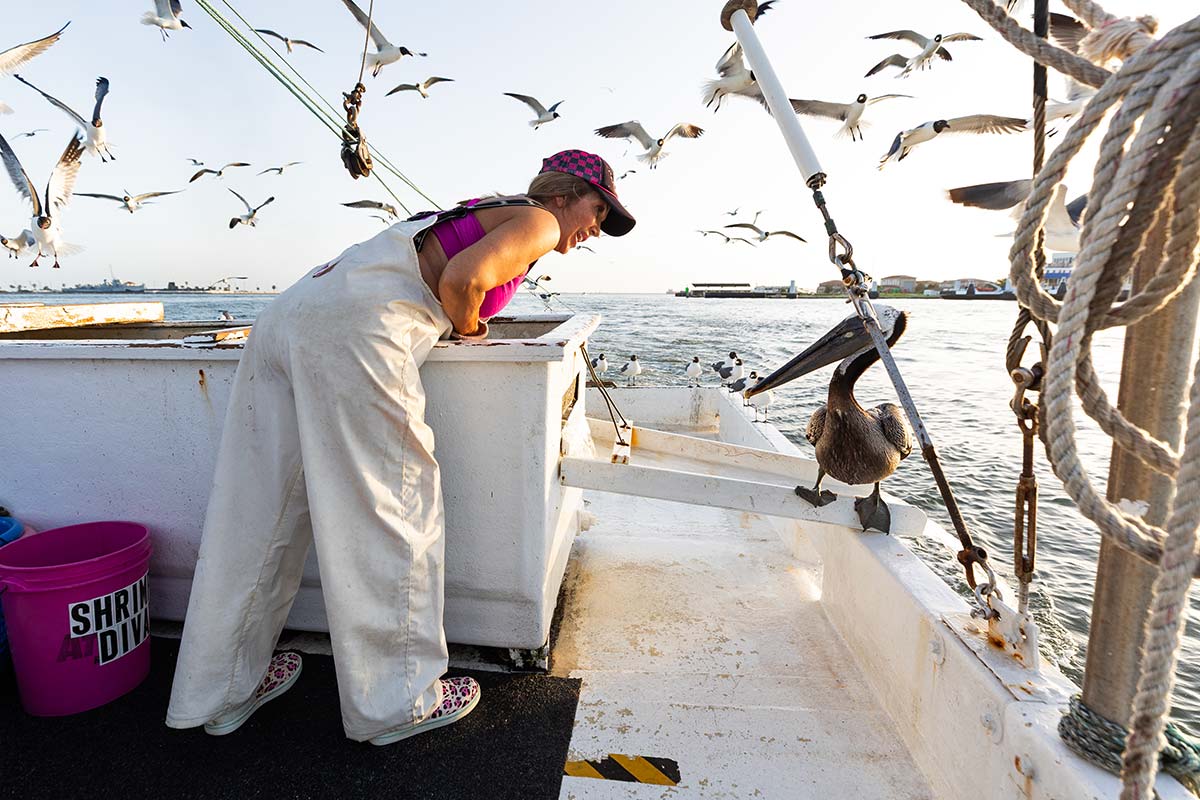
Johnson-Kunz talks to a pelican, which the Shrimp Diva’s 89,000 Facebook followers know she has dubbed Jasmine.
Erich Schlegel
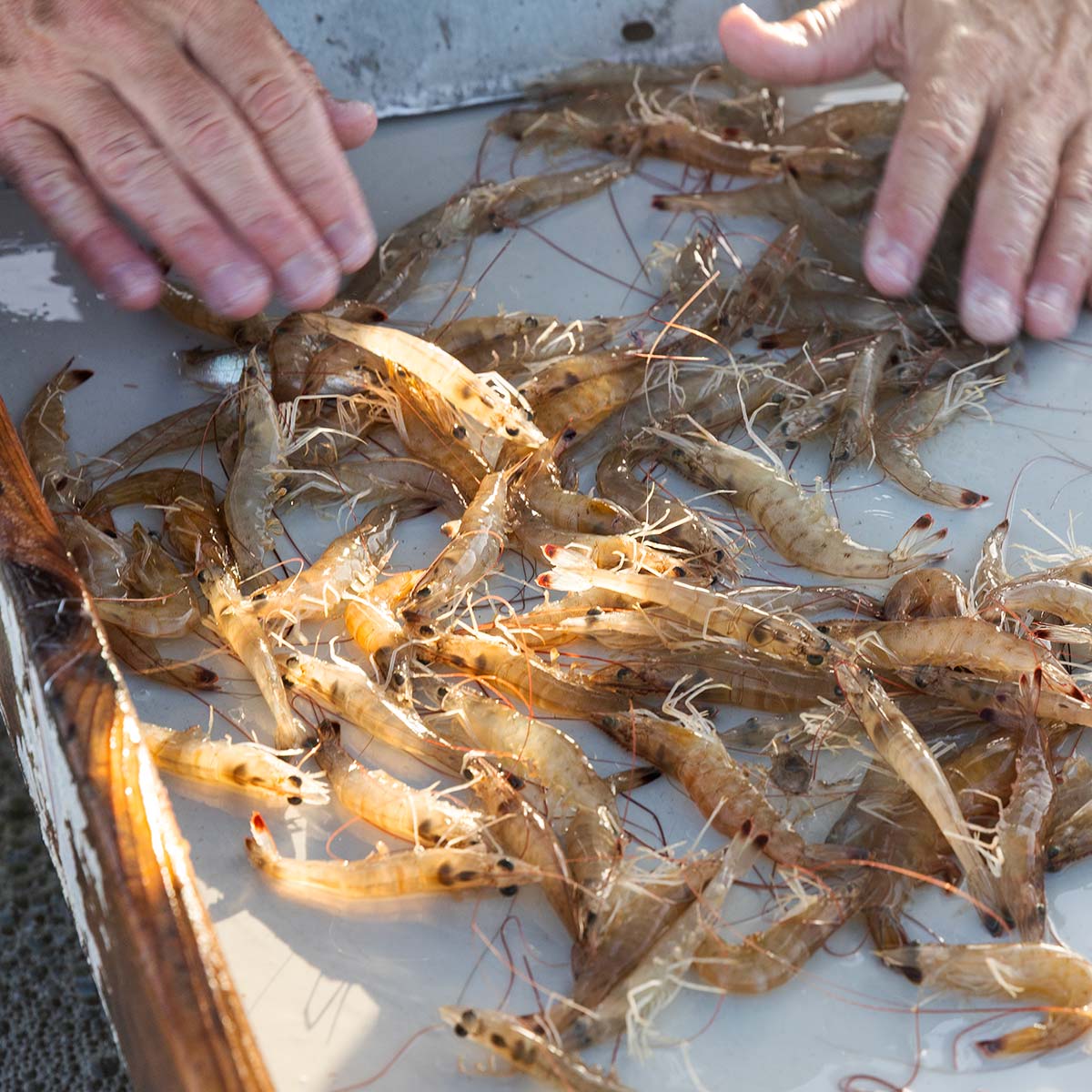
Sorting shrimp fresh from the Gulf.
Erich Schlegel
For years, he worked alone, getting up before dawn and driving 18 miles from his home in Hitchcock to the pier seven days a week. Now that he’s older, he only heads out on weekends. Nikki, a 56-year-old retired property manager, started joining him in 2018, when she noticed her father-in-law’s injuries.
“I’m only out here for him,” she says. “His mentality is ‘I can either hurt at home or hurt while I’m working.’ He’s the most honest and dedicated man I’ve met in my life—but he does wear me out.”
It took about a year to learn the ropes, but now Nikki’s at home working the winch, raising and lowering nets, and culling and sorting the catch. She’s taken on a new mission, too—raising awareness about wild-caught Gulf shrimp. Her Texas Shrimp Diva page on Facebook has attracted 89,000 followers who tune in to watch videos of her and Pops on the job.
After half an hour, the boat slows. Nikki ducks into the cabin to yank on a pair of waterproof coveralls and boots. Her makeup is perfect; her nails are manicured.
“You ready?” Pops says.
Nikki nods and the pair head out on deck, where Pops cranks the winch that lowers a pair of 1,200-pound metal trawl doors into the water. The net spreads out between the doors, and Pops returns to the cabin to steer the boat forward. Fifteen minutes later, he raises the nets from the water while Nikki and Jason maneuver the load over a live well and guide a stream of shrimp in.
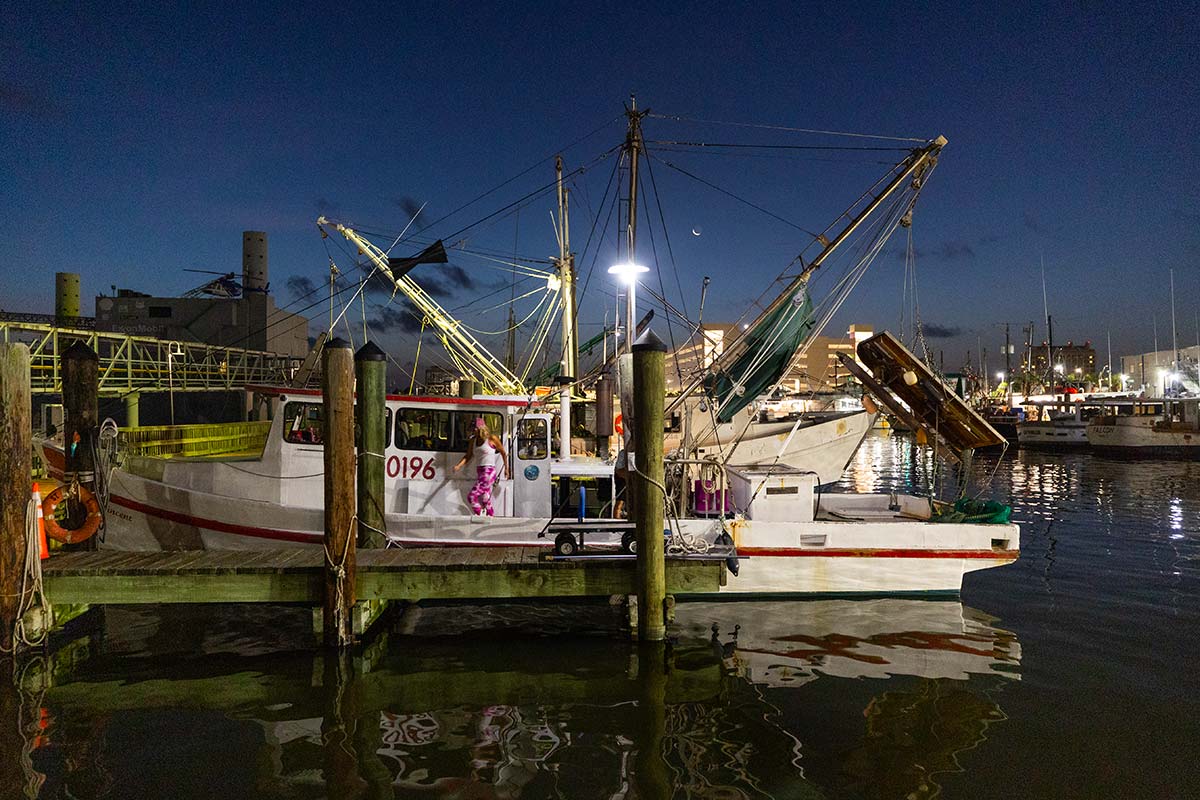
The St. Vincent in its berth at Pier 19 in Galveston.
Erich Schlegel
Suddenly, everyone’s moving at once. Nikki scoops up batches of the catch and spreads them onto a table. She and Jason use metal blades the size of license plates to quickly cull out small fish, squid and crabs, which they carefully return alive to the Gulf. Larger shrimp are separated out for table use; smaller shrimp will be sold as live bait or to buyers who dry it for snacks. Everything will be sold off the boat back at the pier.
Three times the nets go into the water, and three times the shrimpers sort and cull, their arms moving so quickly they’re a blur. Just after 8 a.m., Nikki gets a call.
“Woo-hoo!” she hollers, throwing her arms in the air. “Donny wants live bait!”
An hour later, as Pops turns the boat around to head back to the pier, he tells me that shrimping is a lot like gambling.
“It’s just like going to Las Vegas and rolling the dice,” he says. “One day you’ll get 1,000 pounds, the next day 10 pounds. You don’t know what’s coming up. I still get a charge out of that.”
Back at the pier, Donny Stanfield, the owner of Bait Daddys on the west end of Galveston Island, meets the boat. Nikki, Pops and Jason are ready with 40 pounds of live shrimp. Stanfield pays them $5 a pound; he’ll sell it at his shop for $13 a pint or $23 a quart. Business is just gearing up now, but during the summer, Stanfield will sell 700 pounds or more of live bait on a busy weekend.
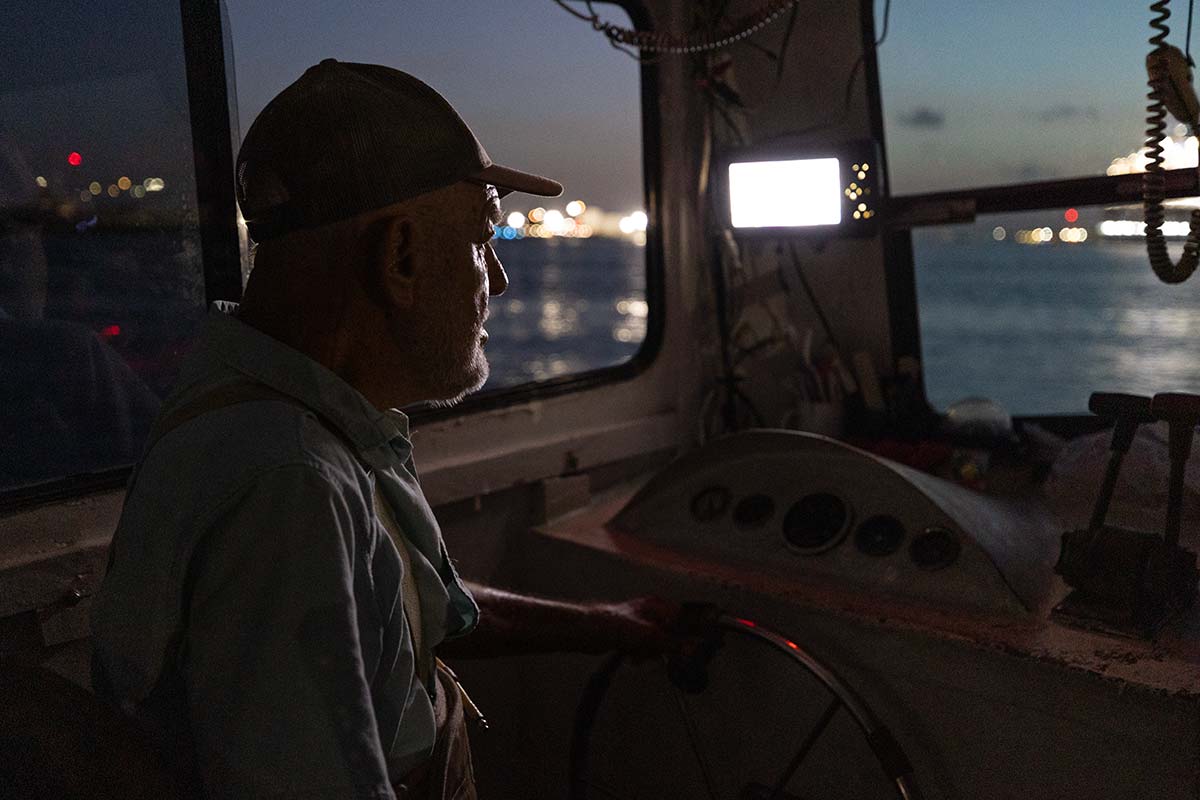
Pops heads into the Gulf at the start of an early morning run in May.
Erich Schlegel
“She’s done an amazing job of getting attention to an industry that needs it,” Stanfield says of Nikki. “The markets have changed. It’s just not the way it was, and there are no young ones coming up to take the place of the people doing it now.”
For Pops, it’s a different world than when he started. Gulf shrimp populations have remained stable, according to data from the National Oceanic and Atmospheric Administration, but declining profits have pushed out most shrimpers. Gulf-harvested shrimp accounted for 28.7% of the U.S. market in 1984 but just 4.5% in 2023. Shrimp imported from Ecuador, Indonesia and India has flooded the market, and American shrimpers can’t compete with their prices, especially as diesel costs have climbed.
With profits down and the number of independent shrimpers down, jobs in welding, seafood processing and boat repair also have declined.
Exacerbating the problem, some restaurants, either inadvertently or knowingly, advertise Gulf shrimp when they’re selling imported shrimp. (A December 2025 study by Houston-based SeaD Consulting, which developed a genetic test that can determine the source of shrimp, found that eight of 22 area restaurants it tested were selling imported shrimp advertised as Gulf shrimp.)
Last September, a state law requiring sellers to accurately label shrimp as wild caught, farm raised or imported went into effect. Look for the Wild Caught Texas Shrimp logo.
“It’s simple. When you’re at the grocery store, flip over that bag of shrimp and see if it reads product of Ecuador, Indonesia or China,” Nikki says. “We’re just asking you to buy a product of the United States. That’s what keeps us on the water.”