I’m rather certain that most Texans have heard these words: “Texas is a state of mind, but I think it is more than that. It is a mystique closely approximating a religion.”
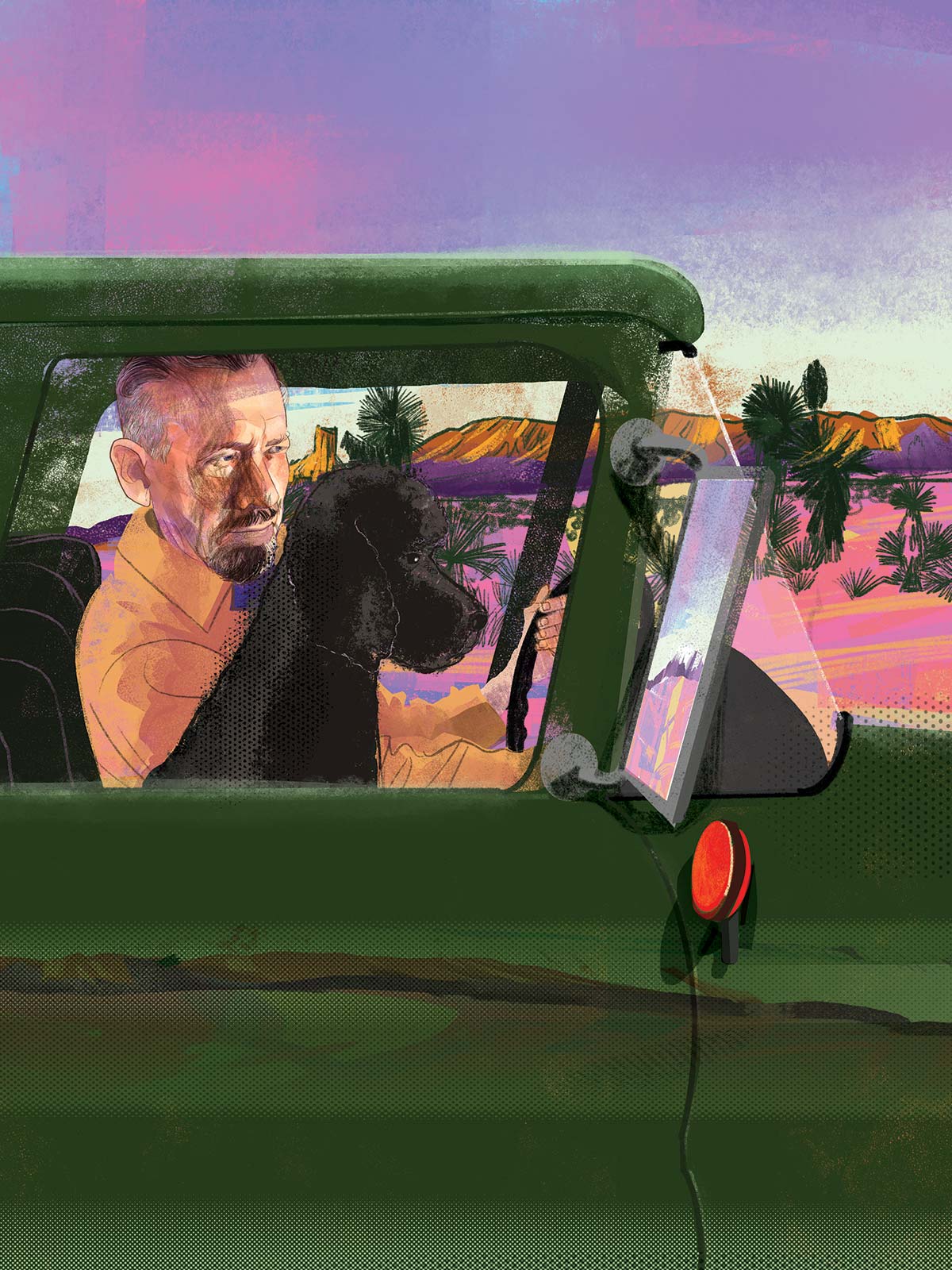
John Steinbeck wrote that in Travels With Charley: In Search of America. Charley was a standard poodle and Steinbeck’s traveling companion in 1960, when together they cruised America’s highways and back roads in a GMC pickup truck with a makeshift camper that Steinbeck called Rocinante (named after Don Quixote’s horse).
What may be news to many is that Steinbeck’s comments about Texas went well beyond this sentence—10 pages beyond. The Pulitzer- and Nobel-winning novelist from California (and later New York) had a lot to say about our state in this nonfiction work, but, as people on the border say, he wrote it con cariño (with affection).
“When I started this narrative I knew that sooner or later I would have to have a go at Texas, and I dreaded it,” Steinbeck wrote. “I could have bypassed Texas about as easily as a space traveler can avoid the Milky Way. Once you are in Texas it seems to take forever to get out, and some people never do.”
Listen as W.F. Strong Narrates This Story
Check out Listen to History for more of our audio stories, and visit Texas Standard for more tales from W.F. Strong (most of which are true).
Steinbeck’s third wife, Elaine Anderson Steinbeck, was from Austin.“Even if I wanted to avoid Texas, I could not, for I am wived in Texas and mother-in-lawed and uncled and aunted and cousined within an inch of my life,” he wrote.
“Staying away from Texas geographically is no help whatsoever, for Texas moves through our house in New York, and our fishing cottage at Sag Harbor… It permeates the world to a ridiculous degree.”
Steinbeck lamented the struggles all writers have in trying to define Texas and Texans. He said they all end up “floundering” and lose themselves in “generalizations” that have little meaning. He said that he was no exception to this rule, but he tried anyway.
“Texas,” he wrote, “is a state of mind. Texas is an obsession. Above all, Texas is a nation in every sense of the word.”
But, Steinbeck noted, “A Texan outside of Texas is a foreigner.” He said his wife claimed to be a “Texan that got away.”
But he didn’t buy it. He wrote, “She has virtually no accent until she talks to a Texan, when she instantly reverts. Soon she is saying yes, air, hair and guess with two syllables: yayus, ayer, hayer and gayus.”
Texans claim “the right to secede at will,” he wrote. “They want to be able to secede, but they don’t want anyone to want them to.”
And he learned about the serious business of football. “Sectional football games have the glory and despair of war,” he wrote, “and when a Texas team takes the field against a foreign state, it is an army with banners.”
Above all, Steinbeck knew well that Texans are tight. If you attack one Texan, you attack them all. They circle the wagons. There may be no “geographical unity in Texas,” he wrote. “Its unity lies in the mind. And this is not only in Texas. The word Texas becomes a symbol to everyone in the world.”