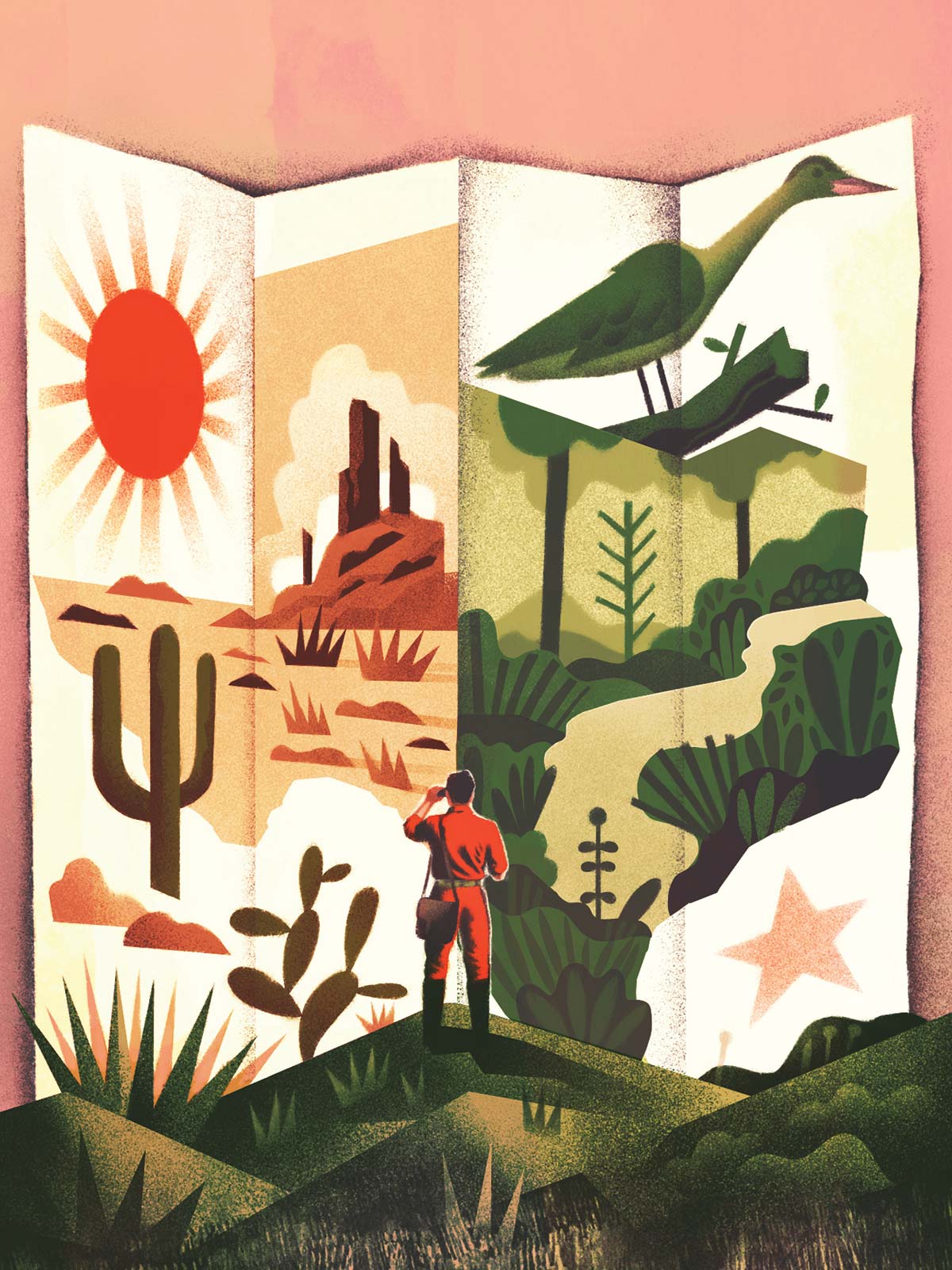
If you examine any good map of Texas, you’ll notice a natural division of East and West Texas that runs from the eastern edge of the Panhandle down to Abilene and San Angelo and on past Uvalde to Carrizo Springs and Laredo.
On the west side of that line is arid land, and on the east side, it’s wetter and greener. It becomes increasingly dry as you go west and wet and humid as you go east.
This line is better known as the 100th meridian, and it maintains this calculus of wet and dry lands all the way up into Canada.
John Wesley Powell, famous for exploring and mapping the Colorado River and the Grand Canyon over 150 years ago, was one of the first conservationists to see that the 100th meridian served as a demarcation.
Listen as W.F. Strong Narrates This Story
Check out Listen to History for more of our audio stories, and visit Texas Standard for more tales from W.F. Strong (most of which are true).
“Passing from east to west across this belt a wonderful transformation is observed,” he wrote. “On the east a luxuriant growth of grass is seen, and the gaudy flowers … make the prairie landscape beautiful.
“Passing westward, species after species of luxuriant grass and brilliant flowering plants disappear; the ground gradually becomes naked, with bunch grasses here and there; now and then a thorny cactus is seen, and the yucca plant thrusts out its sharp bayonets.”
Powell, for whom Lake Powell in Arizona and Utah is named, would become the head of the U.S. Geological Survey in 1881. He used his knowledge of the West to create a prescriptive map for water management.
Powell took his map to a Senate committee in 1890 and suggested dividing the Western U.S. into water districts that would be managed by the people living along the rivers rather than the states. He advocated for need over greed.
The senators practically rioted, as this flew in the face of the fever dream of Darwinian development that had dominated the Western states. The gold must be mined, the forests harvested, the rivers dammed and the railroads built.
Powell argued for sustainability and good stewardship of the Earth. Powell was against big dams—ironic, given that his namesake lake was created by Glen Canyon Dam. He preferred smaller, more democratic irrigation systems that he believed would be more efficient for the land and serve more people more equitably.
As we know, the arid West was not developed as Powell envisioned, but it’s interesting to consider what might have been if Powell had had his way.
What’s more interesting to me are the facts on the ground these days. The geological truths that defined the 100th meridian in Texas a century and a half ago are now truer for the 98th meridian, running just west of Fort Worth, east of San Antonio and west of Corpus Christi. This tells us that the Texas water challenges of the future will be far greater than any our ancestors faced.