Most discussions of the Temple jazz scene in the early 20th century—if indeed there are such discussions or there was a jazz scene to discuss—begin and end with Scott Joplin.
Joplin, a Texan and the acknowledged king of ragtime music, was in Temple for at least a short while in 1896 as a member of the Texas Medley Quartet and published three of his very early compositions while in the Central Texas city.
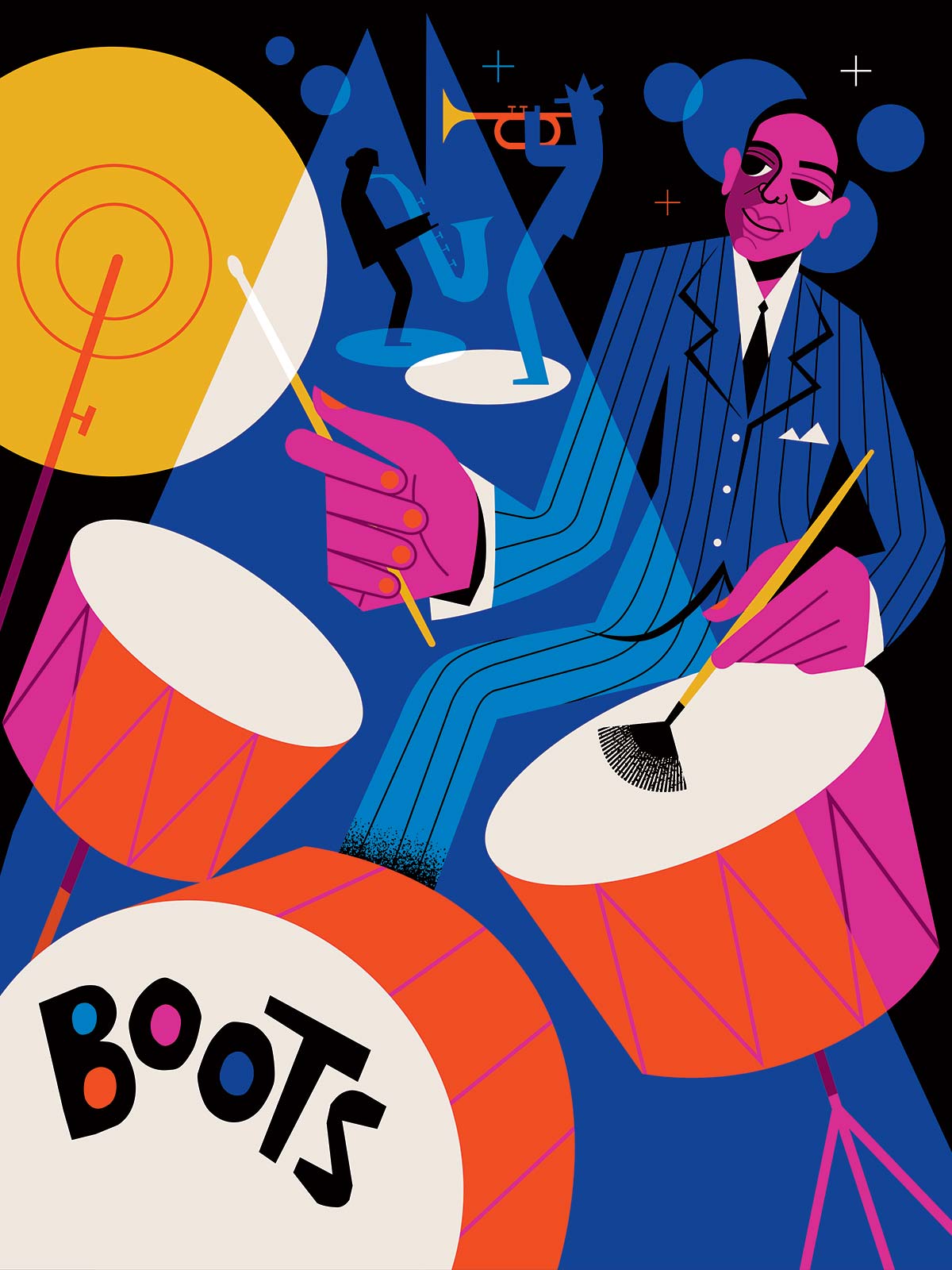
But the discussion ought to include Clifford “Boots” Douglas, who was born in Temple 12 years later. Douglas took up the drums when he was 15 and would go on to become the best jazz musician and arranger you’ve never heard of.
In 1926 he took his talents to San Antonio, where his first gig was with Millard McNeal’s Southern Melody Boys. He formed his own band, Boots and His Buddies, soon after.
“Although born the same year as fellow San Antonio bandleader Don Albert, we know far, far less about Boots Douglas and his band than we do Albert. That’s because Boots made the mistake of being born in Temple, Texas, instead of New Orleans,” wrote a blogger for Wired for Sound. “The fact that Boots’ early Bluebird sessions were sometimes as good or better than Albert’s Vocalion session from the same time frame was of no apparent concern to jazz historians.”
The band was usually billed as Boots and His 13 Buddies, though sometimes circumstances reduced him to 11 Buddies. The name very likely came from a popular comic strip of the day called Boots and Her Buddies.
Boots’ band was what’s known as a territory band—dance bands, usually consisting of a dozen or so musicians, that crisscrossed specific regions of the U.S. from the 1920s through the 1960s, performing popular songs of the day. They played one-nighters six or seven nights a week, at venues like meeting and dance halls and hotel ballrooms.
Jazz historians have called these bands the cover bands of their day and credit them with bringing popular music to places that national booking agents ignored.
In this era, San Antonio was a regular stop for the major record labels’ field trips to record regional artists and genres. Boots and His Buddies recorded 42 sides for the RCA Victor/Bluebird Records label in San Antonio between 1935 and 1938.
Texas writer and jazz scholar Dave Oliphant, who is responsible for much of what little we know about Douglas, notes that Boots and His Buddies was unlike other jazz groups or individual artists from Texas because they “never left the state for fame in Kansas City, New York, Chicago or Los Angeles.”
But the band did occasionally play outside the state. A Paris, Texas, newspaper from July 1937 noted, “The Douglas band comes to Paris from engagements at the Kit Kat Klub, St. Louis; the Grand Terrace Café, Chicago; and from recent fill-in spots in Dallas’s Chez Maurice.”
Boots and His Buddies continued to tour, almost exclusively in Texas, through the 1940s before Douglas called it quits and moved to Los Angeles in 1950.
He continued to play part time in California, until he didn’t. The Handbook of Texas notes that Social Security death records list a Clifford Douglas, who was born September 7, 1906, in Texas and died October 27, 2000, in Los Angeles.