When one spark can turn acres into ashes, wildfire mitigation is a necessity.
While electric cooperatives and fire departments serve communities in different ways, both are committed to protecting lives, property and the places we call home. MidSouth Electric Cooperative and Montgomery County Emergency Service District No. 2 implement industry-leading technologies and preventive actions to form a critical first line of defense against wildfires.
Texas saw a significant increase in wildfires this summer with the Ross Fire burning over 90,000 acres—the largest summertime wildfire in Texas history.
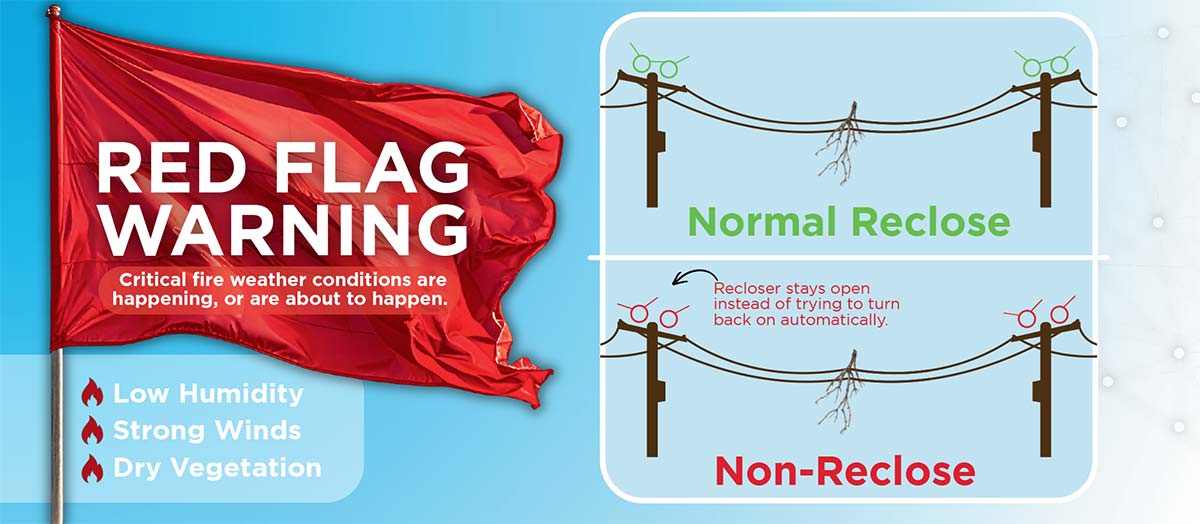
Primary driving factors behind wildfires in MidSouth EC’s territory include fuel moisture (the amount of water in vegetation and organic debris) and weather. If the humidity is low enough, winds high enough and fuel dry enough, the National Weather Service issues a red flag warning.
“We make a lot of decisions based on those red flag warnings,” said Rusty Griffith, assistant fire chief at MCESD 2. “We determine if increased personnel are needed, send additional trucks to a scene and begin communicating to the public necessary prevention measures.”
MidSouth EC also takes red flag warnings seriously, so much so that it developed MSEC Red Flag, an automated software synced with NWS data that alert the co-op’s smart grid devices during fire weather conditions. MSEC Red Flag determines the specific geographical locations where red flag warnings have been issued and applies grid safety measures accordingly.
Smart devices known as reclosers monitor electric current along the grid, disrupting power flow when circuit faults occur. Many times faults are temporary in nature and the recloser will disrupt power long enough for the circuit fault to resolve on its own. If the fault persists, reclosers will lock open until a MidSouth EC lineman crew can investigate and correct whatever caused the fault.
During official fire weather conditions, MSEC Red Flag automatically increases the sensitivity of the reclosers and disables reclosing. If a fault is detected, the reclosers in question will open to disrupt power flow until lineman crews inspect the fault location and surrounding area.
“We don’t reclose when a fault is detected because it could potentially cause sparks and increase the risk of fire during red flag conditions,” said Justin Brysch, MidSouth EC engineering manager. “MSEC Red Flag is designed to help us be proactive by increasing sensitivity to faults. Many faults are temporary without any identifiable cause. However, during red flag conditions, we are going to send a crew out to make inspection before reenergizing any high-voltage line. If we find an issue before it is a problem, then we can avoid potential fires.”
Distribution fault anticipation provides another layer of fire defense to the MidSouth smart grid. Developed by Texas A&M University, this groundbreaking software is capable of detecting potential issues on the electric system and immediately notifying the command center. DFA interprets variations in electrical currents and alerts MidSouth EC to investigate potential problems in an effort to prevent sparks along the grid.
“These new technologies absolutely work and are effective, especially in remote areas where detection might be a little less likely to occur,” Griffith said. “Early detection on high-risk days is extremely important because dispatching crews quickly and mitigating problems early is so important.”
In addition to preventative smart technologies, preventive maintenance is essential to wildfire mitigation, which is why MidSouth EC prioritizes vegetation management and right-of-way clearance.
Trees and other vegetation growing too close to power lines can create safety hazards. To reduce these risks, MidSouth performs regular right-of-way maintenance to ensure appropriate clearances.
This work includes trimming trees, removing hazardous limbs and identifying vegetation that could threaten power lines during severe weather. These efforts are especially important in rural and heavily wooded areas like Sam Houston National Forest, where dense vegetation can increase wildfire risks and make emergency response more challenging.
“The preventative maintenance MidSouth does is critical,” Griffith said. “Having clearance is super important, especially for stray limbs. Extreme fires will move across the canopy. Fire will move from treetop to treetop and can spread a quarter- to a half-mile in advance of itself. But most of the time, fire travels around the ground, so having those rights-of-way cleared reduces the flame height and gives us a better opportunity to control and extinguish a fire should it start.”
Wildfire prevention doesn’t begin when smoke appears. It begins with the everyday work of preventive technology innovation and managing vegetation around MidSouth infrastructure. Your co-op and local fire departments work together to keep small risks from becoming large emergencies because the only acceptable wildfire is the one that never starts.
To report a hazardous tree or request vegetation management, call (936) 825-5100.
Reclosers: Self-controlled, high-voltage smart devices used to automatically detect and interrupt faults, then attempt to restore power after a short delay.
Circuit faults: Impeded electric flow, often due to interference or damage.