People may think the debut of ABC’s Monday Night Football marked the first time football was played under the lights at night. They are off by 78 years. The original night game was at the 1892 Great Mansfield Fair in Tioga County, Pennsylvania. Attendees were promised that they would see electric lights brighten the night sky. Thomas Edison, who invented the modern light bulb 13 years earlier and created General Electric, sent his Thomson-Houston machine with its 30-bulb capacity.
The two teams were Mansfield State Normal and Wyoming Seminary. At sunset the field grew dark. A pole carrying lights was moved to the middle of the field. Difficult to see the players, the referee called the game over. Final score: a 0-0 tie.
Flash forward to September 1970. A different kind of historic nighttime football is about to launch. A bevy of naysayers including the press, network executives and National Football League team owners believe ABC’s vanity project, Monday Night Football, is destined to fail.
The show, created by television legend Roone Arledge, is designed to break all the sports broadcasting rules. Rule No. 1 is the concept that sporting events must have two announcers in the broadcast booth. Arledge wanted three.
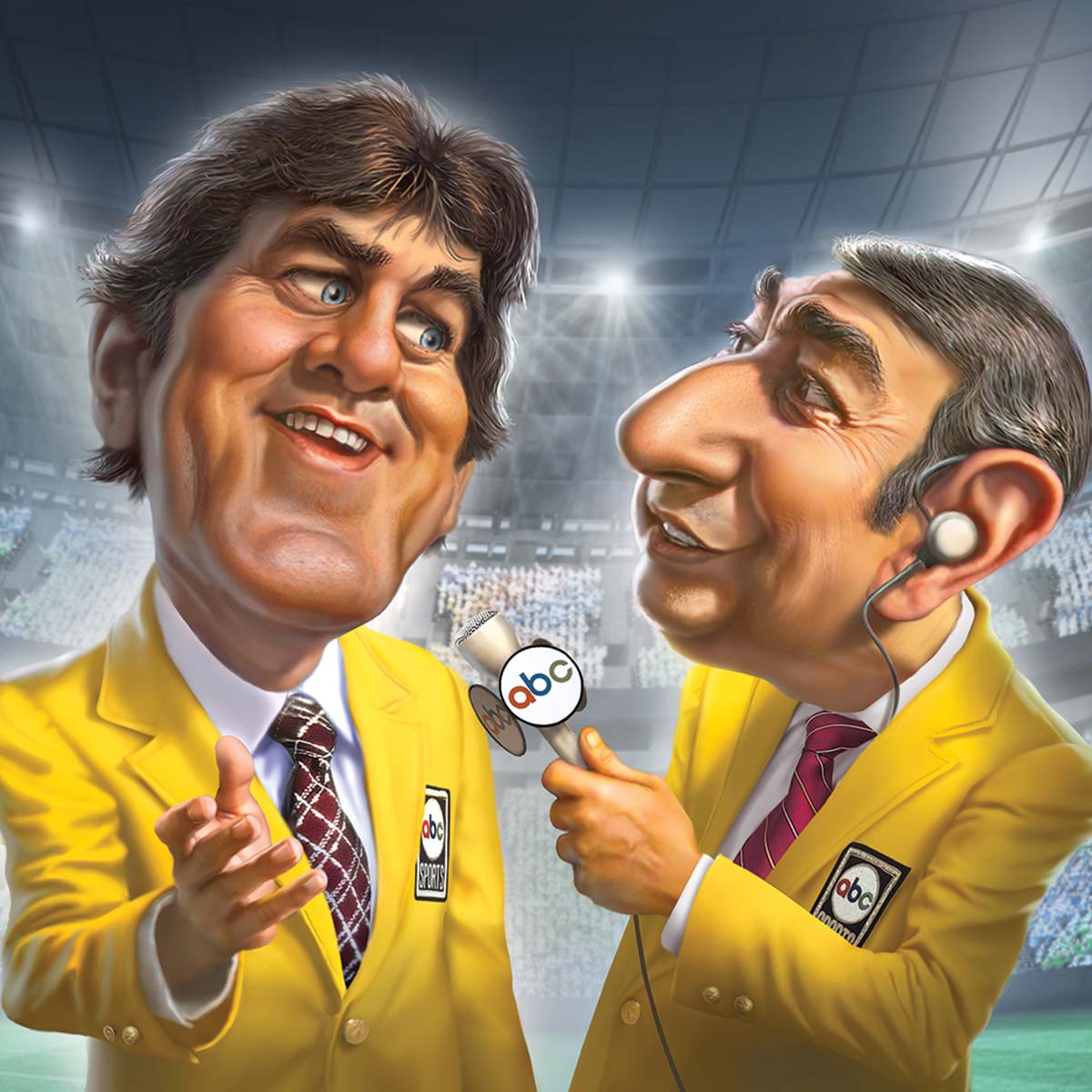
The first play-by-play announcer on MNF would be Keith Jackson, ol’ reliable no matter the sport. (He’d be replaced with Frank Gifford by season two.) The second man in the booth would be commentator Howard Cosell, credited as the inventor of hard-hitting TV sports journalism.
The third man in the booth? Don Meredith, former quarterback for the Dallas Cowboys. Born in Mount Vernon, Texas, Meredith was no stranger to those Americans who followed NFL football. What nobody saw besides Arledge was that the northern lawyer and the southern quarterback would become the most liked American comedy team since Dean Martin and Jerry Lewis. Nobody said a football game had to be serious, Arledge complained. “I’m tired of football being treated like a religion. The games aren’t played in Westminster Abbey.”
Monday Night Football, because of the comedic conflicts between Cosell and Meredith, propelled to the top of the ratings. The show was a monster hit, changed the way sports are covered on TV and gave ABC its first profit in a decade.
When the huge production team from MNF rolled into an NFL town before a game, it was as big as the game itself. Banquets were held in their honor. The announcers were often given the key to the city. It was a spectacle bigger than the game. What teams are playing? Didn’t matter. Cosell and Meredith were in town! Meredith dubbed it “Mother Love’s Traveling Freak Show.”
But before the September 21, 1970, on-air debut, there was a practice game involving the Lions and the Chiefs. This rehearsal was never broadcast. Good thing. Mother Love was not pleased.
Arledge told what happened in his autobiography, Roone: A Memoir.
“Don had problems. He was talking in cliches. (‘Hello football fans everywhere.’) Using 10 sentences to say what could be said in three, analyzing the obvious, and because he hadn’t done his homework, having a tough time keeping track of who was whom and on which team.”
Hearing this criticism, Meredith stood, threw down his earpiece and said, “Screw this.” He acted as if he were going to leave. They convinced him to stay.
But the next day, after a second harsh critique, it happened again.
“Look fellas,” he said, again standing up. “This really isn’t my bag, and I don’t even know that much about football. I only know the X’s and O’s Mr. [Tom] Landry taught me in Texas. So I’ll just leave.”
Arledge and MNF director Chet Forte made it clear to Meredith that this was a natural process, and their notes were only suggestions for improvements.
Meredith left and Cosell ran after him. He persuaded Meredith to have a drink before he left for the airport. Then in a reminder of his signature phrase—“tell it like it is”—Cosell tried to do just that.
“Don,” Cosell said, according to his autobiography, Howard Cosell, “in my opinion you’ll be making the biggest mistake of your life if you even think about leaving us. You’re going to come out of this a hero. Middle America will love you. Southern America will love you. … You’ll wear the white hat. I’ll wear the black hat, and you’ll have no problems from the very beginning.”
All of which turned out to be 100% accurate.
“Dandy lifted his glass,” Cosell wrote. “By golly. I’m with you, Coach. All the way.”
On debut night, at precisely 9 p.m. Eastern time, the flashy opening video showed the countdown in the game truck outside. It focused on the inner workings of the production team, sending a message that this game would be different.
The first words from Jackson: “From Municipal Stadium in Cleveland, Ohio, two powers in professional football meet for the first time ever as members of the new American conference of the National Football League.” He introduced the sponsors, Ford, Marlboro and Goodyear.
Then Cosell did a welcome: “It’s a hot, sultry, almost windless night where the Browns will play host to the New York Jets. Good evening everyone. I’m Howard Cosell, and welcome to ABC’s Monday night prime-time National Football League series.”
What happened next surprised Meredith. He heard “roll the tape” in his earpiece, and then was surprised to see a video montage about him when he was the Cowboys’ quarterback. It showed his sacks, interceptions, fumbles and botched handoffs. ABC did it to “set up Meredith’s comic persona,” according to co-authors Marc Gunther and Bill Carter in their book, Monday Night Mayhem: The Inside Story Behind ABC’s Monday Night Football.
“The gag worked,” they wrote. “It sparked sympathy immediately for the just-folks new announcer, even if it presented a grossly distorted picture of Meredith’s mostly stellar career on the field.
“Meredith didn’t know he was going to be roasted in the film clip, but his aw-shucks reaction furnished the first impression: Cosell came on sour; Meredith came on sweet. Black hat/white hat. An act was born.”
Now was the time to shine for the ex-player who introduced himself to America on Monday nights this way: “I’m Billy Jack’s little brother, Jeff and Hazel’s baby boy, and I’m from Mount Vernon, Texas.”
He would become one of the most famous and beloved men in America. But that would take a few more weeks.
Text excerpted from Dandy Don Meredith (Yankee Cowboy Publishing, 2024).