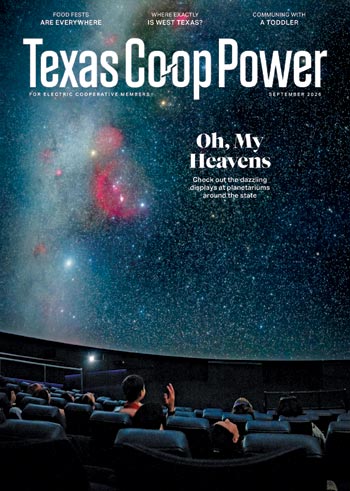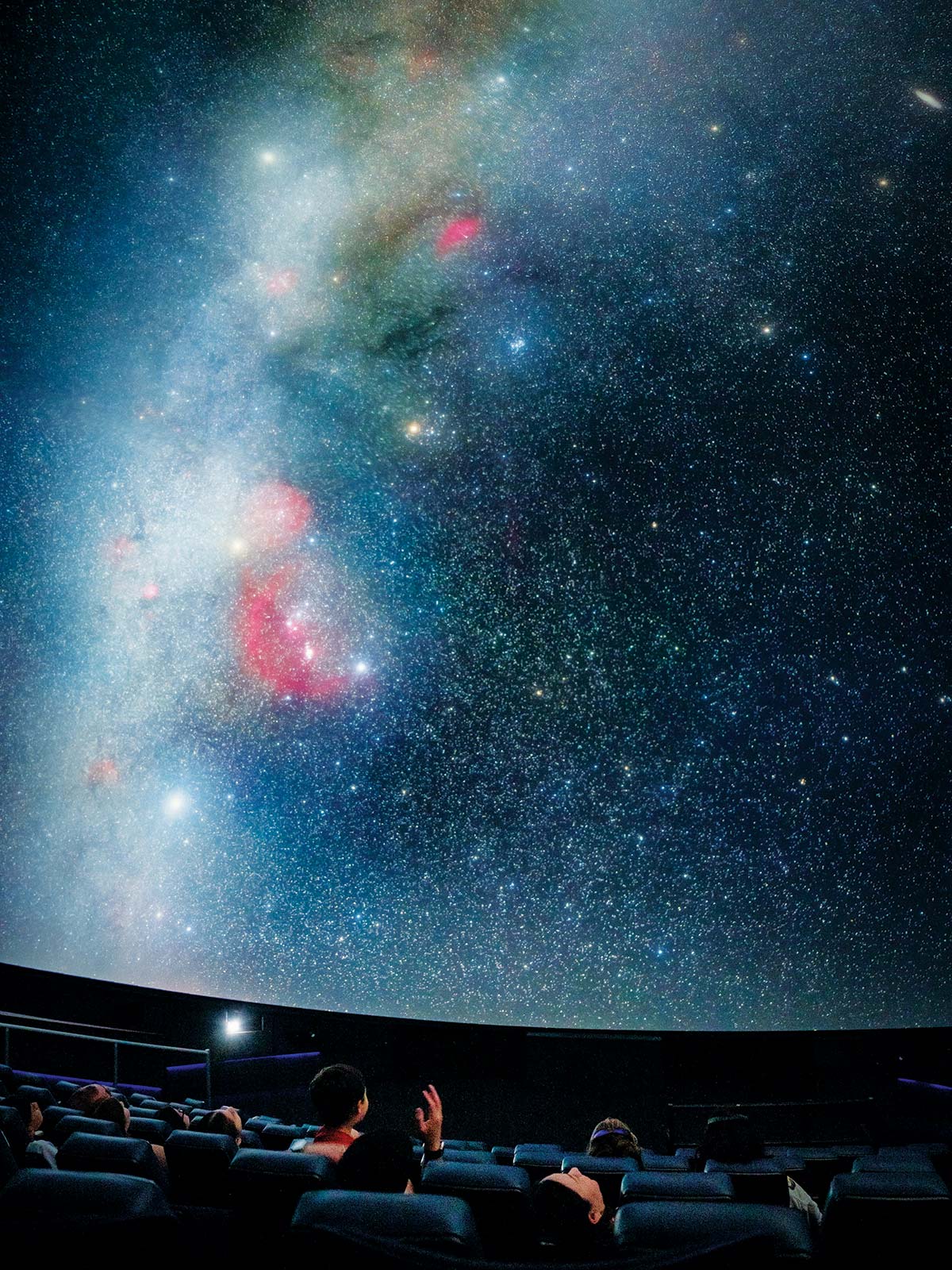
In the 1950s, Harlingen Air Force Base used a domed planetarium building to teach pilots navigation by the stars. When the base closed in 1962, the building was donated to what is now the University of Texas Rio Grande Valley, and it eventually fell into disrepair.
But in 2008, H-E-B funded renovations that added a digital projector system and, in 2012, a new dome. Now regular folks of all ages can visit and get a front-row seat to the stars in Edinburg.
“H-E-B asked that it be free and open to the public,” says Christian Hernandez, program specialist at the UTRGV planetarium. “They wanted to inspire a new generation, and I think they made good on that desire.”
The Milky Way shines high above in September, with the constellation Pegasus rising in the east. Venus will be bright in early evening, with Jupiter most visible at dawn. But if it’s cloudy or you live near a big city or industry, you won’t be able to see any of it.
At a planetarium, you can enjoy these constellations and planets as well as other astronomical wonders from a comfy chair with no worries about light pollution from cities or satellites, cloudy skies, heat or cold, bugs, or the hard ground. And in Texas—with at least 15 permanent planetariums across the state—chances are good that there’s one just down the road from you and with technological advances you might not expect.
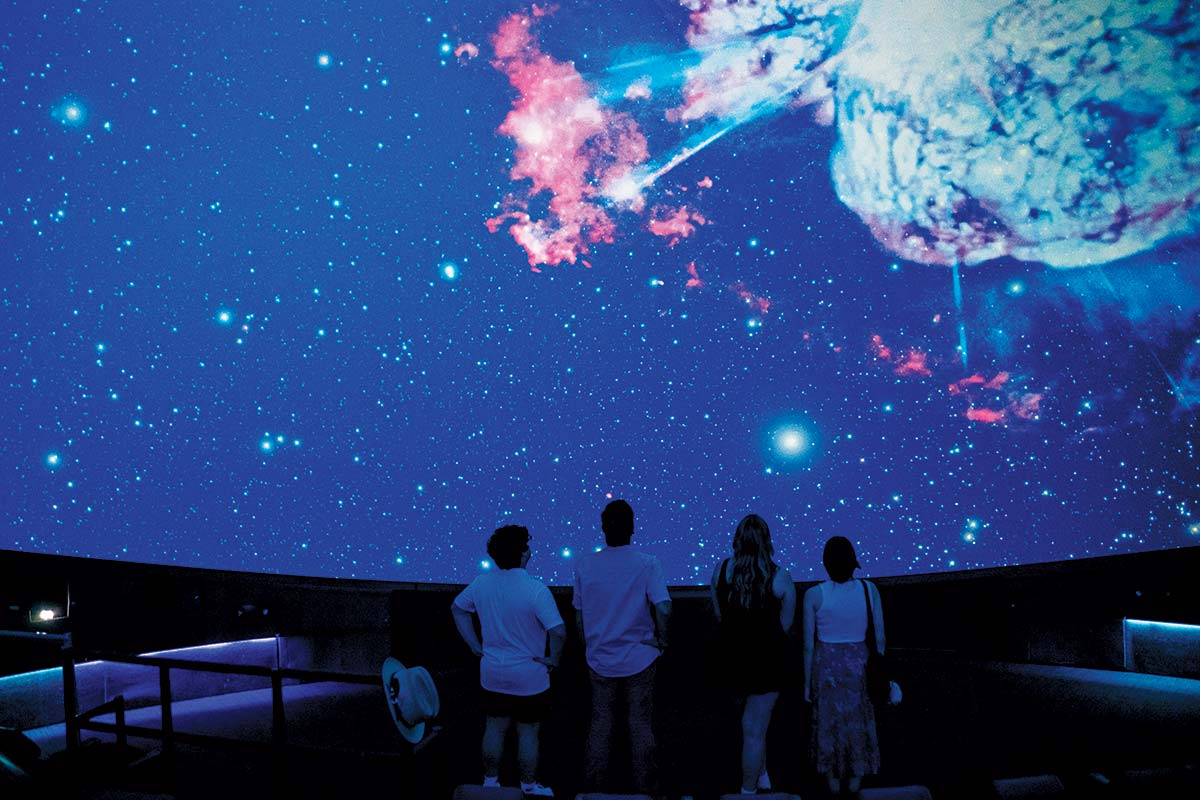
The wonders of the night sky are always accessible at the Burke Baker Planetarium.
Tiffany Hofeldt
Space Over Time
The first modern planetarium opened in Munich, Germany, in 1925, displaying 4,500 stars and the planets of our solar system. Five years later, the first facility in the U.S., the Adler Planetarium, opened in Chicago. More quickly followed in Philadelphia, Los Angeles and New York City. Texas got its first, Fort Worth’s 40-foot-diameter Noble Planetarium, in 1955, and soon Houston and Abilene had their own.
Planetarium popularity soared after the Soviet Union’s Sputnik 1 satellite launched in 1957 and during the 1960s race to the moon. These days, as artificial light drowns out more of the night sky, folks flock to planetariums to see what they’re missing outside.
Those early planetariums used mechanical star projectors that beamed light through slides patterned with tiny holes to depict celestial bodies on a domed ceiling. Gears and motors simulated the movements of stars and planets, creating astonishingly realistic night skies.
Such machines, made by Zeiss, a German company that produced the original Munich projector, and Pennsylvania-based Spitz Laboratories, which developed its first system in the 1940s, remain in use at many planetariums.
But now most facilities have digital projector systems that blend multiple high-resolution images into an uninterrupted scene covering the entire dome. These systems can produce the likenesses of millions of stars and extremely detailed 3D objects and events in deep space. Advances in sound and control systems and improved dome surfaces help make planetarium experiences even more immersive and realistic.
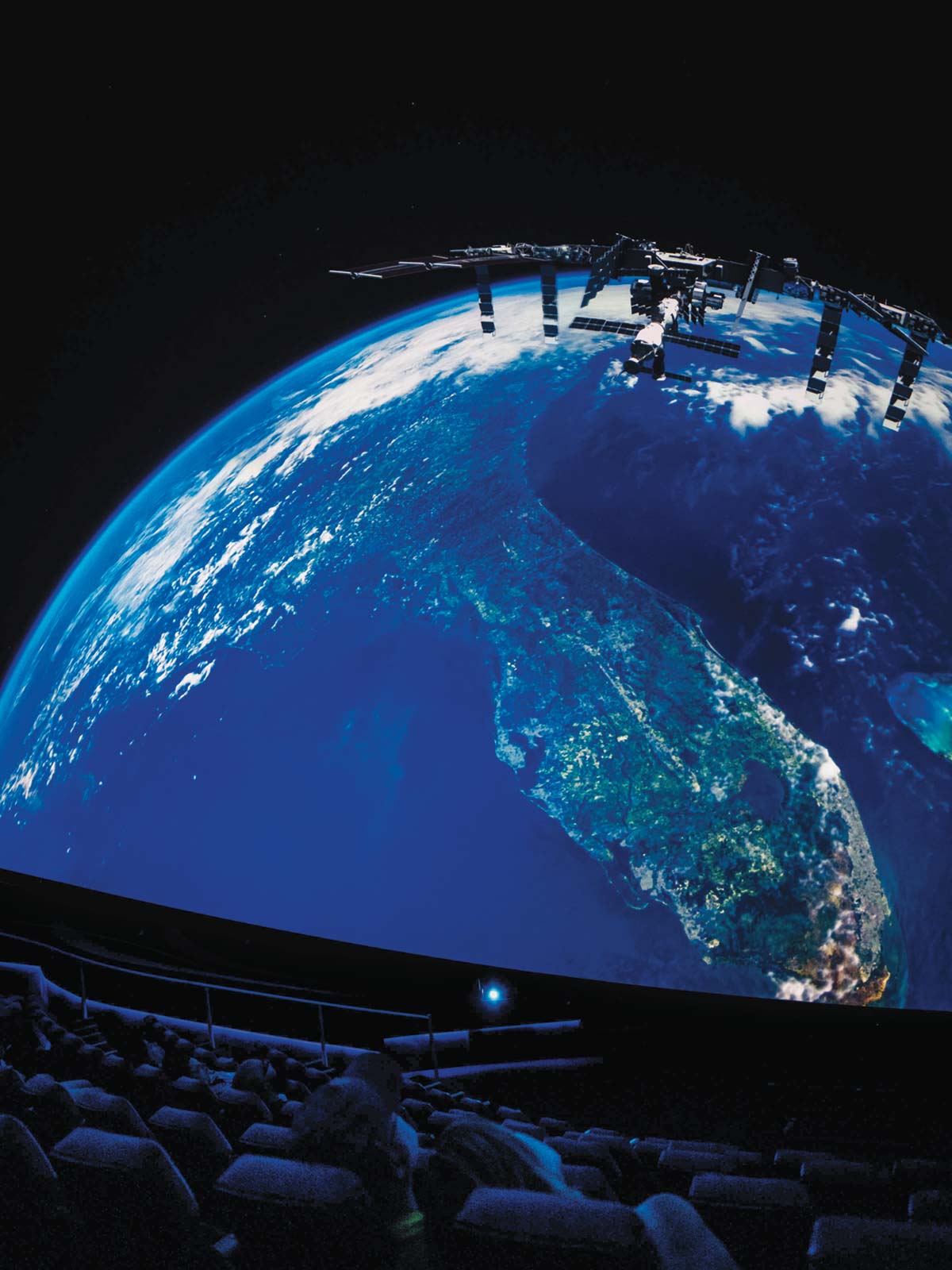
With more than a dozen planetariums around the state, visitors have access to celestial sites that can stir the imagination.
Tiffany Hofeldt
For example, the Stephen F. Austin State University Planetarium in Nacogdoches, which opened in 2018, features a state-of-the-art 4K Digistar system, says Director Dan Bruton.
Abilene’s Morgan Jones Planetarium upgraded in 2004 from its original Spitz Star Projector to a digital projector, says Jason Barber, planetarium director, and in 2019, it installed a laser system.
“With modern projectors, you can go into the stars, you can model the entire Milky Way,” Barber explains. “It’s kind of like a video game, but the shape of a dome creates a 3D effect, so you feel like you’re there. It’s like being in a spaceship.”
Beyond Space
Nowadays, planetarium experiences go well beyond tours of the night sky, popular as those are. You can fly visually through space and time and view immersive films about the Great Barrier Reef, dinosaurs or Mars. Experience a laser light show set to music from artists like Pink Floyd, Queen and Taylor Swift.
The H-E-B Planetarium in South Texas shows educational films about space, Hernandez says, and others just for entertainment.
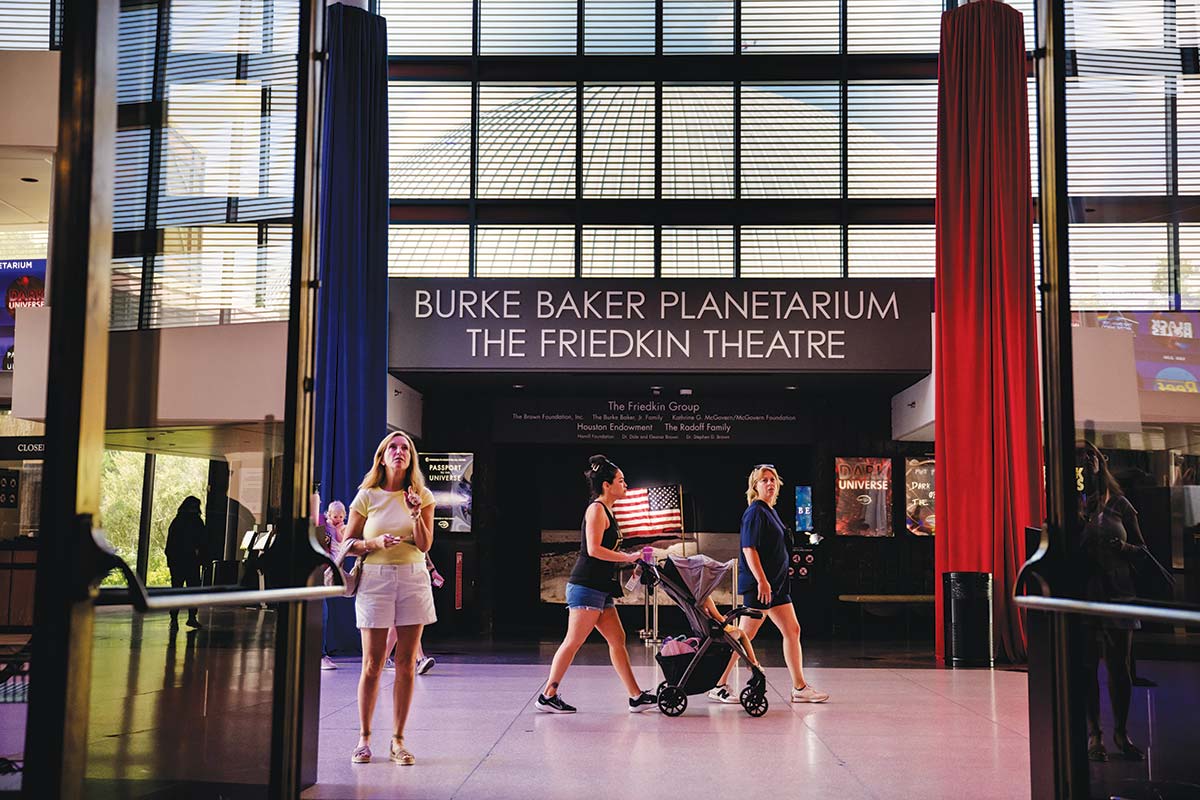
Burke Baker was one of the first planetariums in Texas when it opened in 1964.
Tiffany Hofeldt
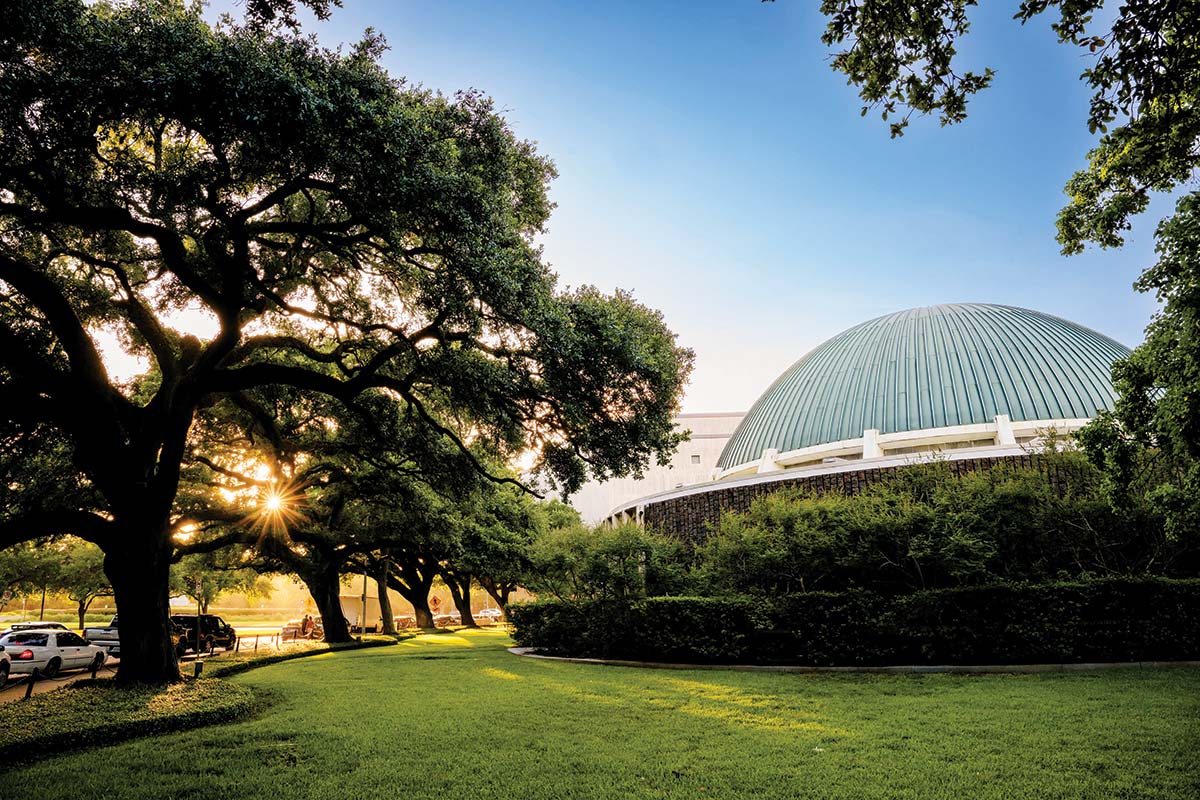
Sunset at the Burke Baker Planetarium, where, indoors, it can always be nighttime.
Tiffany Hofeldt
Bruton says SFASU designed its planetarium to connect the university with its East Texas community and make science accessible and engaging for all ages. Astronomy students at the university keep track of what’s currently visible in the sky—perhaps a constellation, planet or comet—and program the Digistar system to show it. Immersive shows include Dark Universe, which explores dark matter, dark energy and the structure of the universe, and Antarctica, a dive into one of the most extreme environments on Earth.
Abilene presents monthly public shows, and Barber’s favorite is one produced by the European Southern Observatory in Chile, called Unveiling the Invisible Universe. It uses actual time-lapse imagery of stars, not a computer model, he says. Another, Messengers of Time and Space, shows how astronomers use land-based telescopes along with space-based facilities like NASA’s James Webb Space Telescope, currently orbiting the sun 1 million miles away from Earth, and Hubble, circling 300 miles above Earth since 1990.
“Planetariums give people a sense of perspective,” Hernandez says. “It’s one thing to talk about the scale of the universe, but that 360-degree dome screen does an amazing job of letting you feel it. Watching a film about searching for the edge of the solar system, it really hits you how big the solar system is.
“Films that go into the universe, dark holes and cosmic matter really put into perspective that we are a blue dot in a grand tapestry of planets and stars. It’s an important and humbling experience.”
Bruton agrees. “Under the dome, phenomena that can seem abstract or distant become tangible and awe-inspiring. It’s like a time machine, looking back at how the universe was.”
So grab one of those comfy chairs at your local planetarium. You’re bound to have a stellar experience.