If you met Charles Siringo in 1927 Los Angeles, you couldn’t have guessed that he was a legend of the Old West. That year, Neil Clark, writing for The American Magazine, described Siringo as “a small man, weighing barely a hundred and thirty pounds, but wire-tough, brown of face, and keen of eye, with humor still invincible in spite of his seventy-two years, and a mind razor-sharp for accuracy and pertinent detail.”
Yet Siringo had written a handful of books about his incredible adventures—as a trail-driving cowboy, detective, businessman and writer who had chased outlaws and infiltrated criminal networks—making him well-known among the cowboys who held his stories dear.
He was born February 7, 1855, in Matagorda County, and a year later his father died. Antonio Siringo had sailed from southern Italy and settled on Matagorda Peninsula with his wife, Bridgit, an Irish immigrant.
Charles Siringo made the name proud—riding, roping and writing his way to Hollywood over several decades. But he started out as a simple cowboy on Texas’ coastal plains. In his autobiography A Lone Star Cowboy, he writes that he was 11 years old in 1867, when he “became a full-fledged cowboy, wearing broad sombrero, high-heeled boots, Mexican spurs, and the dignity of a full-grown man.”
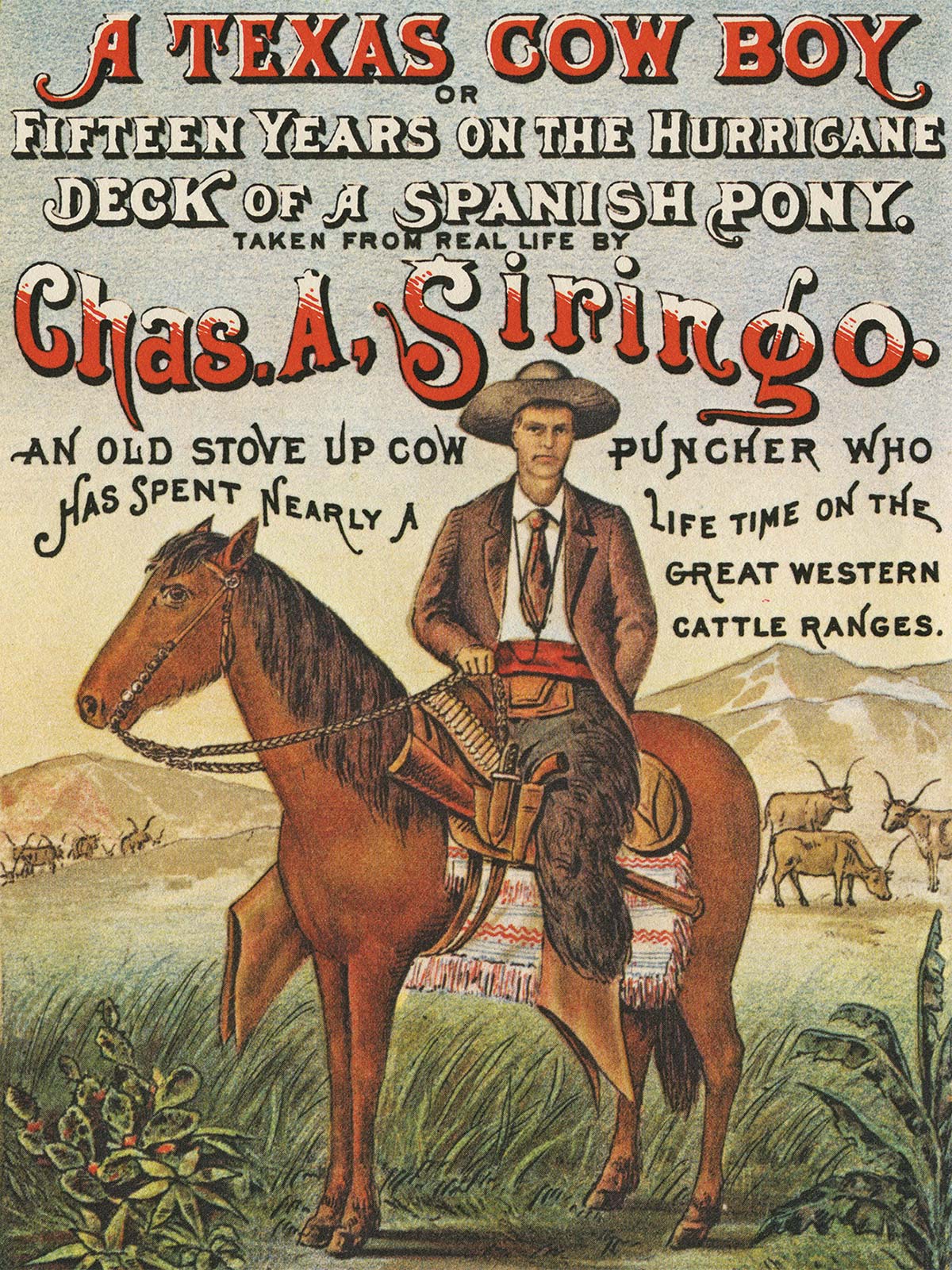
In another book—the first of his seven—A Texas Cow Boy or Fifteen Years on the Hurricane Deck of a Spanish Pony, Siringo described his first job on the Chisholm Trail, in the spring of 1876, driving a herd of 2,500 “mossy-horn steers” to Kansas for $30 a month. “Everything went on lovely with the exception of swimming swollen streams, fighting … among ourselves and a stampede every stormy night.”
For years, he steered longhorns along the dusty trail and labored under windswept downpours. Trailing into New Mexico atop his horse, Whiskey-Peet, and armed with a Sharps rifle, he prowled for outlaws and cattle rustlers along the way.
In 1884, Siringo married and briefly settled down in Caldwell, Kansas, where he became a restaurateur. In his off-hours, the honest-to-goodness cowpuncher began writing about his adventures as a way to earn some extra cash.
A Texas Cow Boy was published in 1885 to wide acclaim. Historian J. Frank Dobie called it one of the most important books on cowboy life. Will Rogers later wrote Siringo that this was the first book he had read and that it was the bible for cowboys.
The book tells of Siringo’s years on the LX Ranch in the Panhandle, during which he met and later pursued outlaw Billy the Kid. He warmly writes about the Kid’s compassionate side, relating a story of the outlaw coming to the aid of a sick man and personally paying for a team to haul him off to Las Vegas for treatment.
In 1886, Siringo joined the Pinkerton National Detective Agency, and for the next two decades lived by his wits on the road.
His work took him to Mexico City, Alaska and all points in between, and he is credited with making more than 100 arrests. And though he had a reputation as a fine shot, Siringo was proud that he made most of his arrests without violence.
In 1907, he quit the Pinkerton Agency and moved to his Sunny Slope Ranch in Santa Fe, New Mexico. There he wrote his second book, A Cowboy Detective, including his role in Idaho’s Coeur d’Alene miners’ strike of 1892. His task was to infiltrate the labor union and acquire proof of criminal acts.
“I had to take an iron-clad ‘Molly Maguire’ oath that I would never turn traitor to the union cause,” he wrote. “If I did, death would be my reward.” This was no idle threat on the part of the strikers, as they were guilty of blowing up mines and murdering workers. Siringo’s testimony put 18 union leaders behind bars.
In the 1920s, Siringo moved to LA, where his friendship with William S. Hart earned him a view into the world of Hollywood as a consultant to the movie studios. Because of his prowess as a cowboy and Pinkerton detective, he established a rapport with famous Western figures, among them Rogers, Bat Masterson and Clarence Darrow.
When Siringo died October 18, 1928, at 73, Hart and Rogers sent a joint telegram expressing their sentiments; it read in part, “Another American plainsman has taken the long trail.”