This year our nation celebrated its 250th anniversary of independence from Britain. But in the two centuries leading up to 1776, a different struggle for sovereignty smoldered farther to the west of what would become the United States of America. It pitted two European powers against each other for control of their North American colonies.
On one hand, France laid claim to land from northeastern Canada to the Great Lakes to the bayous of Louisiana. On the other hand, Spain claimed Florida, Texas and much of today’s American Southwest. These claims overlapped at the wilderness frontier where French Louisiana rubbed up against Spanish Texas in today’s southeast Texas.
That frontier borderland worried Spanish authorities in the 17th and 18th centuries. Populated by Indigenous groups, the region was located far from Mexico City, the seat of New Spain’s power, and near French Louisiana. The Spanish crown decided to establish a protective buffer zone of Catholic missions and military presidios to keep France out of Texas.
Because of the region’s distance from other Spanish strongholds, Spain sought the allegiance of Native American groups who had called the Pineywoods home for centuries. Missionaries tried to convert Native Americans to Christianity, and soldiers tried to move them from their settlements into mission communities.
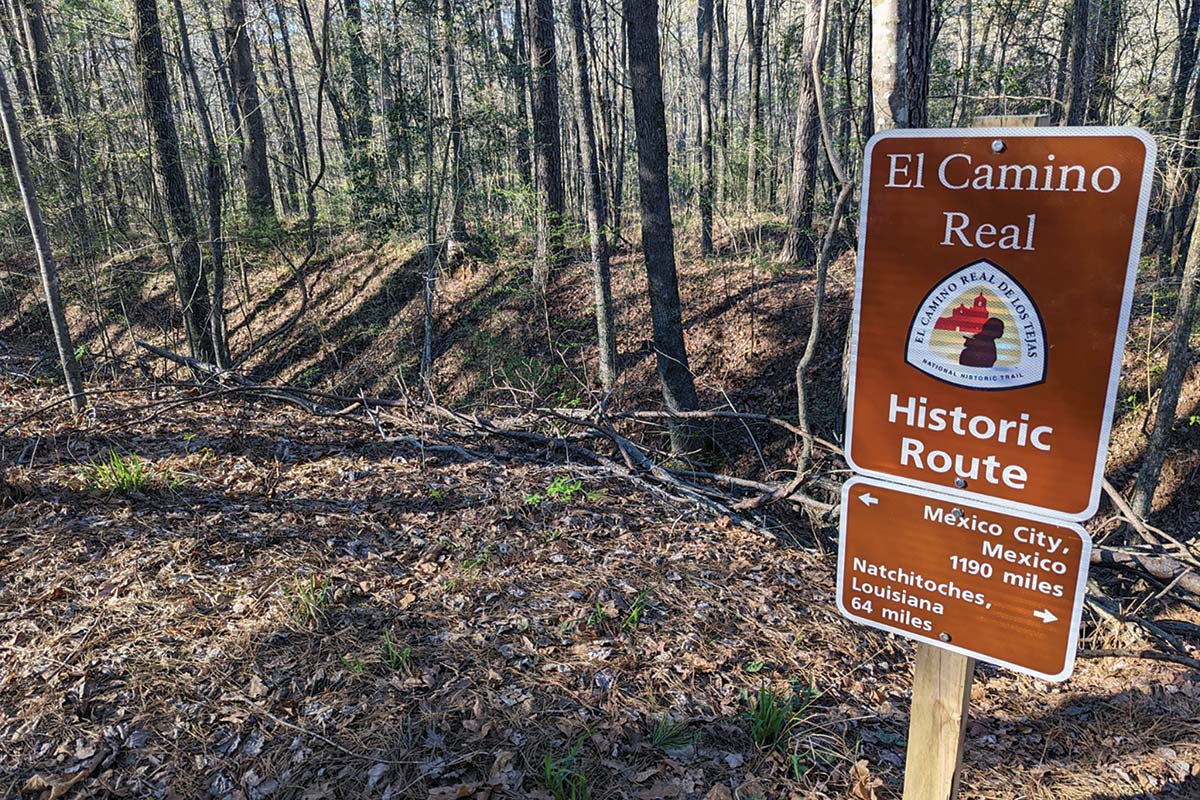
Eventually more than two dozen missions were built across Spanish Texas. Many were located along El Camino Real (the King’s Highway), which today is roughly traced by Texas State Highway 21 and Louisiana Highway 6. Some maps label it the Old San Antonio Road.
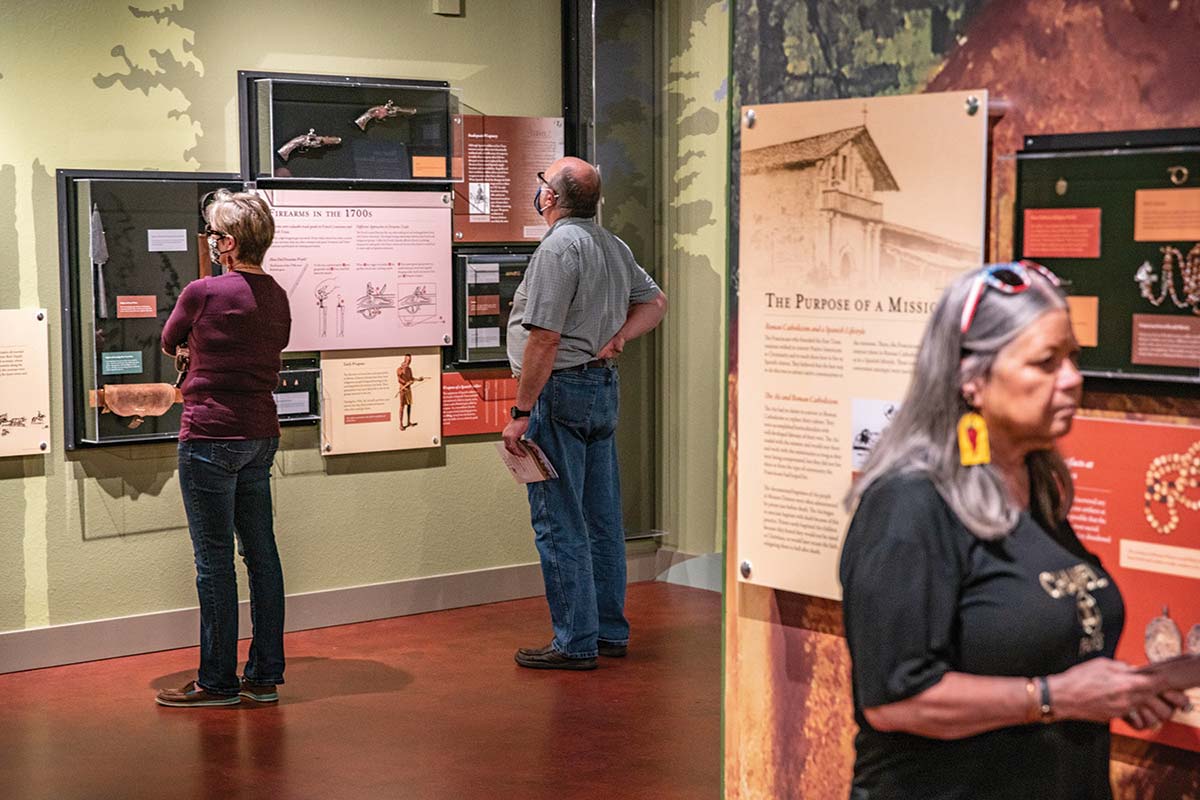
Visitors view exhibits interpreting the historic era of Spanish missions in East Texas at Mission Dolores State Historic Site in San Augustine.
The original route followed ancient animal and Native trails from Mexico to the first capital of Spanish Texas at Los Adaes, near today’s Robeline, Louisiana.
In the 1690s the first missions were established in East Texas among Caddoan-speaking groups. The name Texas, in fact, came from the Caddo word táysha, meaning friend or ally. The goal of the first missions was to teach the ways of the Catholic church and Spanish culture and language to the Caddo people.
Native groups in Spanish Texas, like the Caddo, already lived in permanent, well-governed agricultural communities. Other groups were seminomadic, moving place to place based on seasons of hunting and trading.
Few Texas Natives found reasons to adopt European ways or settle into mission communities. By 1730 three early East Texas missions were closed and relocated to San Antonio, where missions proved more promising.
The end of the Seven Years’ War, in 1763, resulted in Spain taking control of Louisiana. No longer did New Spain need a Pineywoods buffer zone to keep the French out of Texas. By the time the ink was dry on the U.S. Constitution, all Spanish missions in East Texas were gone. But the fascinating history of those missions remains alive and well.
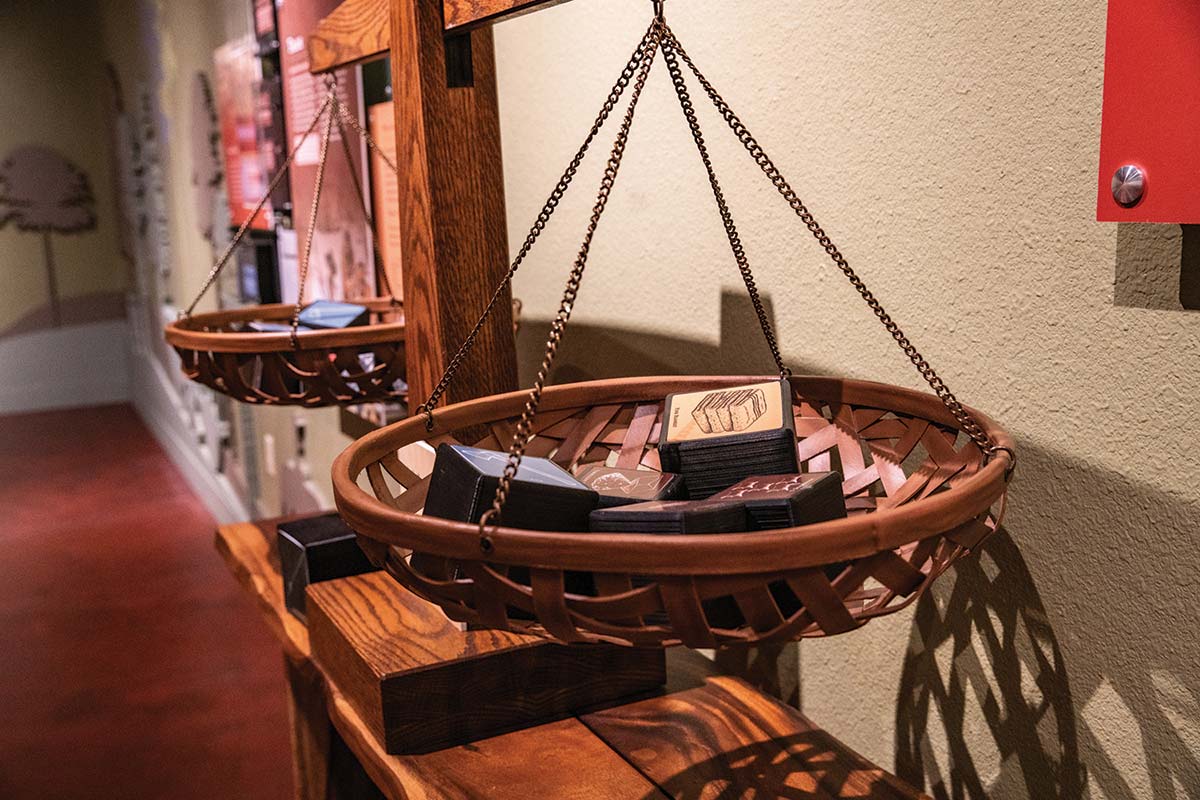
An interactive scale allows visitors to understand the value of goods exchanged between Caddo people and European traders at Mission Dolores State Historic Site.
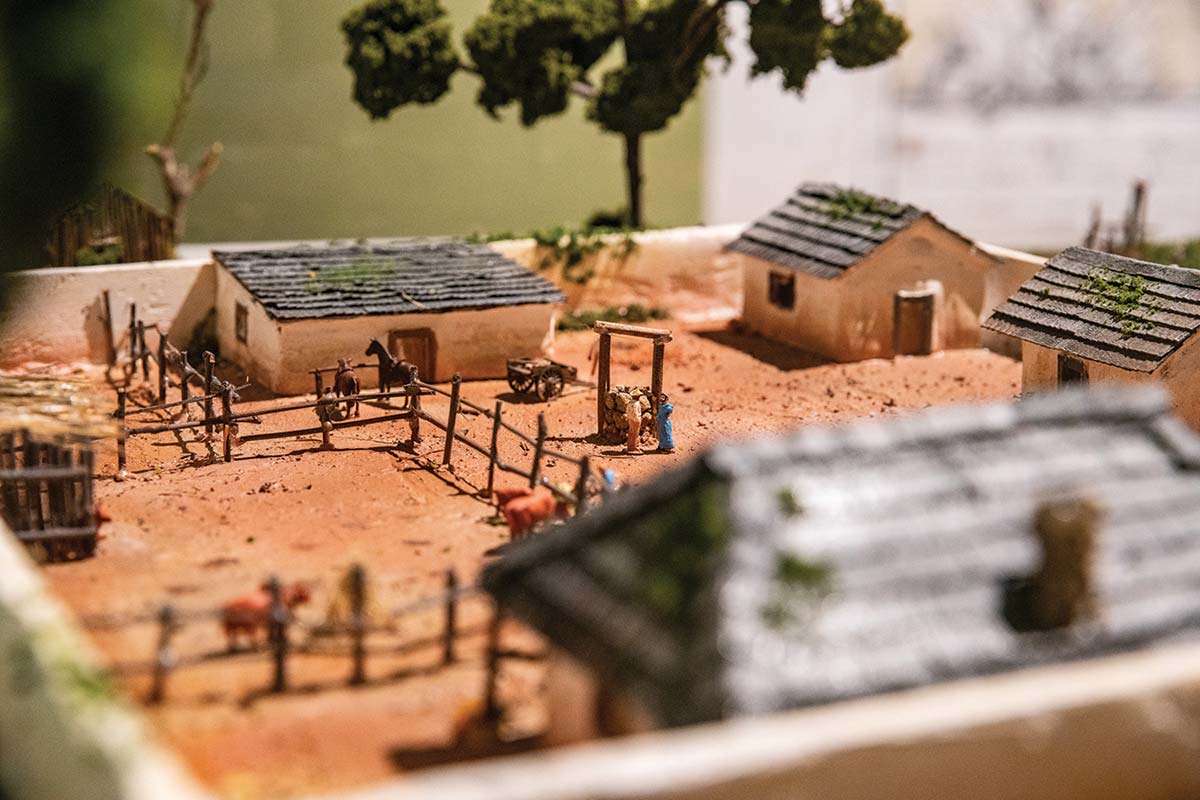
A scale model of the mission grounds shows the historic era of Spanish missions in East Texas.
San Antonio Missions
The legacy of the mission-building era comes alive in San Antonio along a 9-mile stretch of the San Antonio River south of downtown. Today you can drive, walk or bike on scenic lanes along the river to four Spanish missions, which comprise San Antonio Missions National Historical Park.
Though open to the public, each mission remains an active Catholic parish. Three of the four—Mission Concepción, Mission Espada and Mission San Juan—were originally established in East Texas. The fourth and largest, Mission San José, sits on its original site.
The ornate Baroque-style structure was built from local limestone beginning in 1768. Eventually it housed 350 Native Americans in 84 two-room apartments. During the 1930s, the Works Progress Administration—a Depression-era federal jobs program—almost fully restored Mission San José. Today it boasts a visitor center and remains known as “Queen of the Missions.”
The park trail also includes an aqueduct, an elaborate system of dams and 13 miles of irrigation ditches from the 1740s that still provide water to area farms.
In downtown San Antonio lies the city’s most famous Spanish mission, Mission San Antonio de Valero. You may know it better as the Alamo.
Together, the five missions represent the nation’s largest concentration of Spanish colonial missions—a fact recognized in 2015 by UNESCO, which named the missions a World Heritage Site, the only such site in Texas.
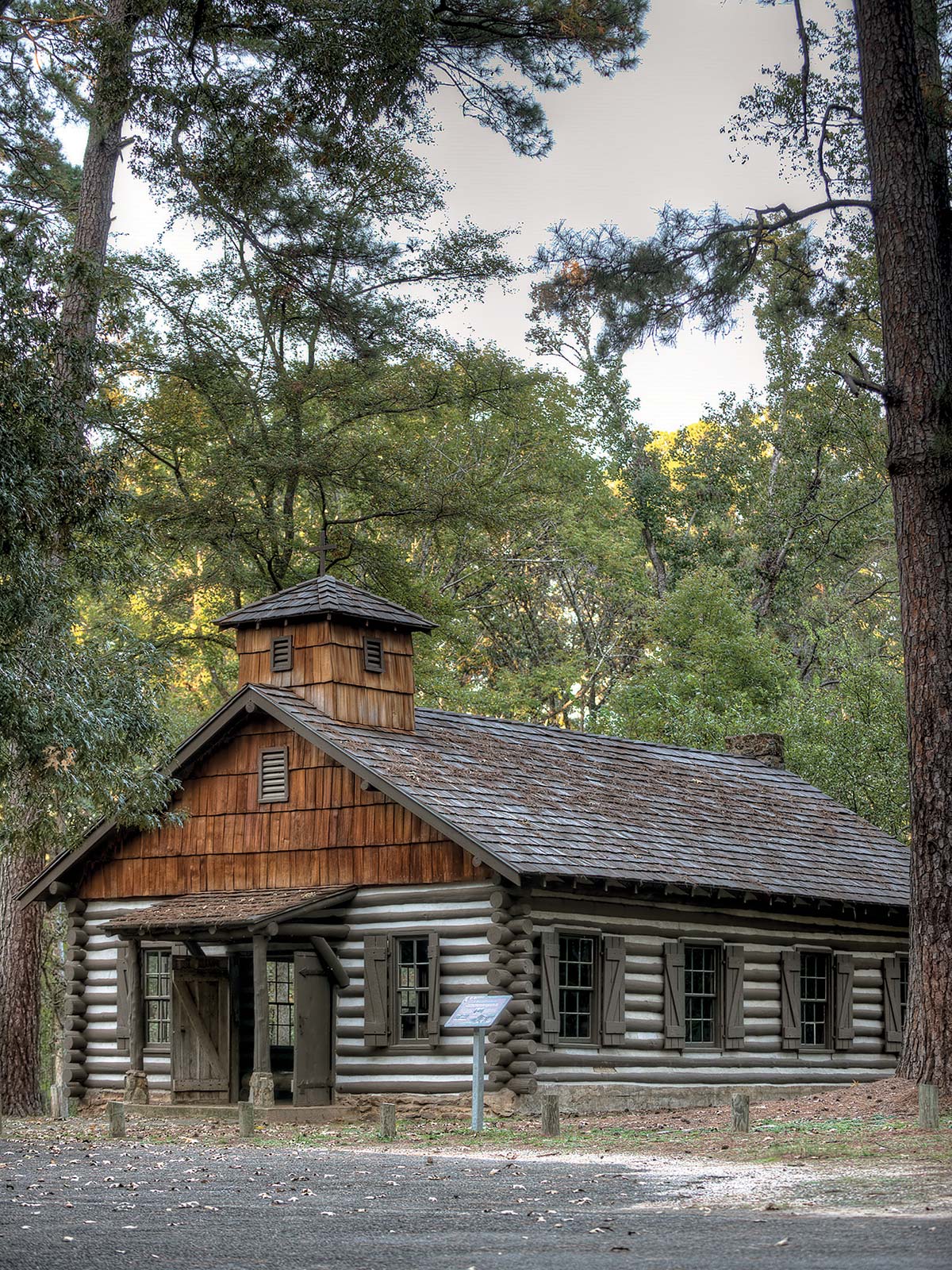
Mission Tejas State Park in Grapeland features a timber church representing the early Spanish mission in East Texas.
Pineywoods Legacy
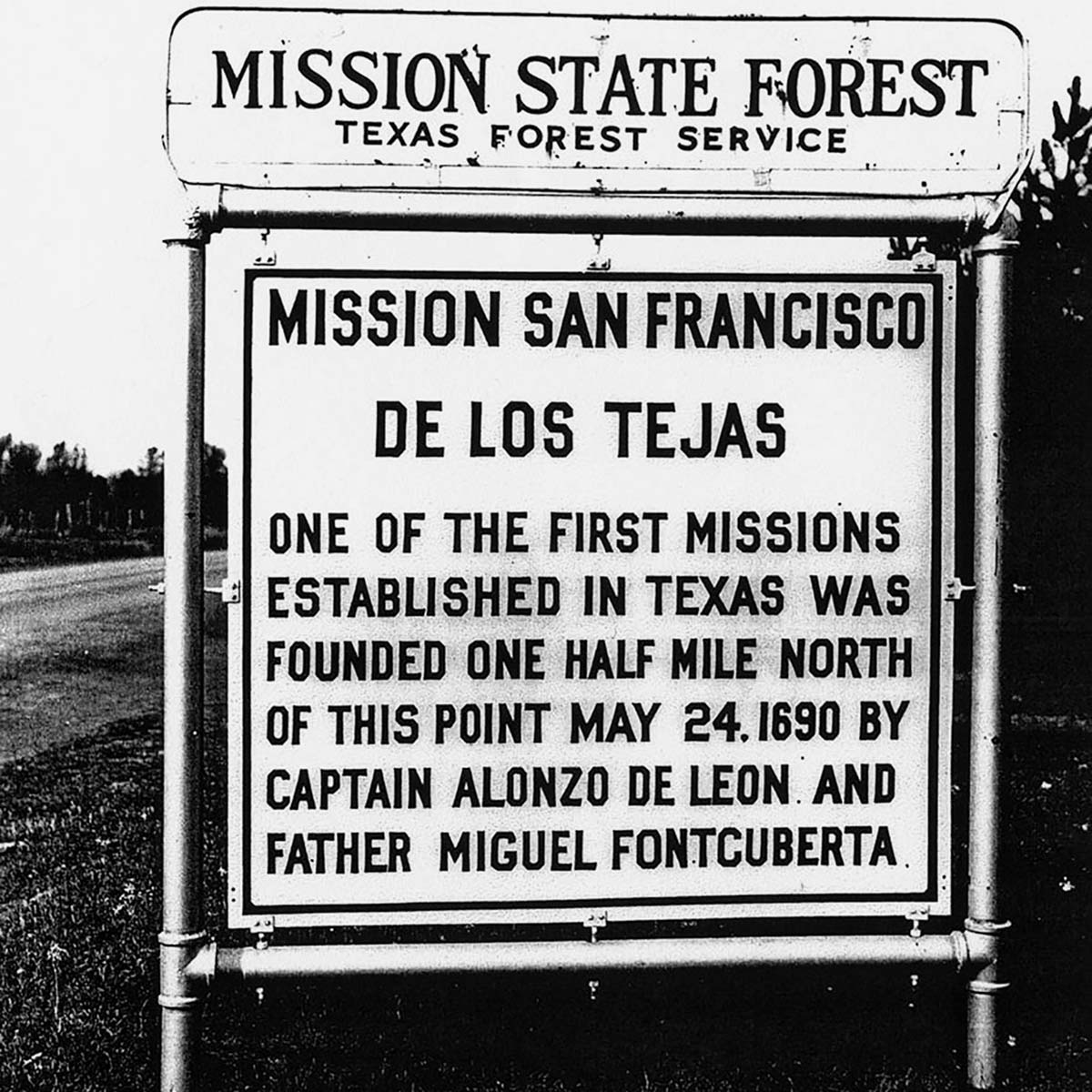
San Antonio’s Mission Espada began in 1690 as Mission San Francisco de los Tejas, the first mission in Texas.
Spanish authorities learned in 1685 that a ship bearing 180 French colonists had landed near what we now know as Matagorda Bay in Victoria County. To thwart any French settlement, the authorities in Mexico sent a group of priests and soldiers trekking eastward along El Camino Real.
They found a suitable mission site close to a creek at a Caddo village near the present-day community of Augusta, in northern Houston County. Relations went well at first. The Spanish called the Caddo group Tejas Indians. The Caddo referred to the Spaniards as táysha or ally.
That first winter, however, the Spanish unknowingly brought smallpox to the local population who, never having been exposed to European diseases, had no natural immunity.
The resulting epidemic killed some 3,300 people and aroused suspicions among Native leaders. Meanwhile Spanish soldiers became more brutal in dealings with the Indigenous groups. In response, the Caddo planned an attack on the Spanish, who got wind of the plan, and in 1693 burned the mission buildings and fled west along El Camino Real toward safety in Mexico.
Today Mission Tejas State Park sits on State Highway 21 at Weches, a few miles east of the original mission site. To commemorate that early history of East Texas, the park features a replica mission church, log cabin and nature trails.
A few miles east on the old King’s Highway lies Caddo Mounds State Historic Site, which honors Native American history and culture. Three ancient ceremonial mounds flank a replica grass house. Exhibits and programs interpret life in a Caddo village of 1,200 years ago.
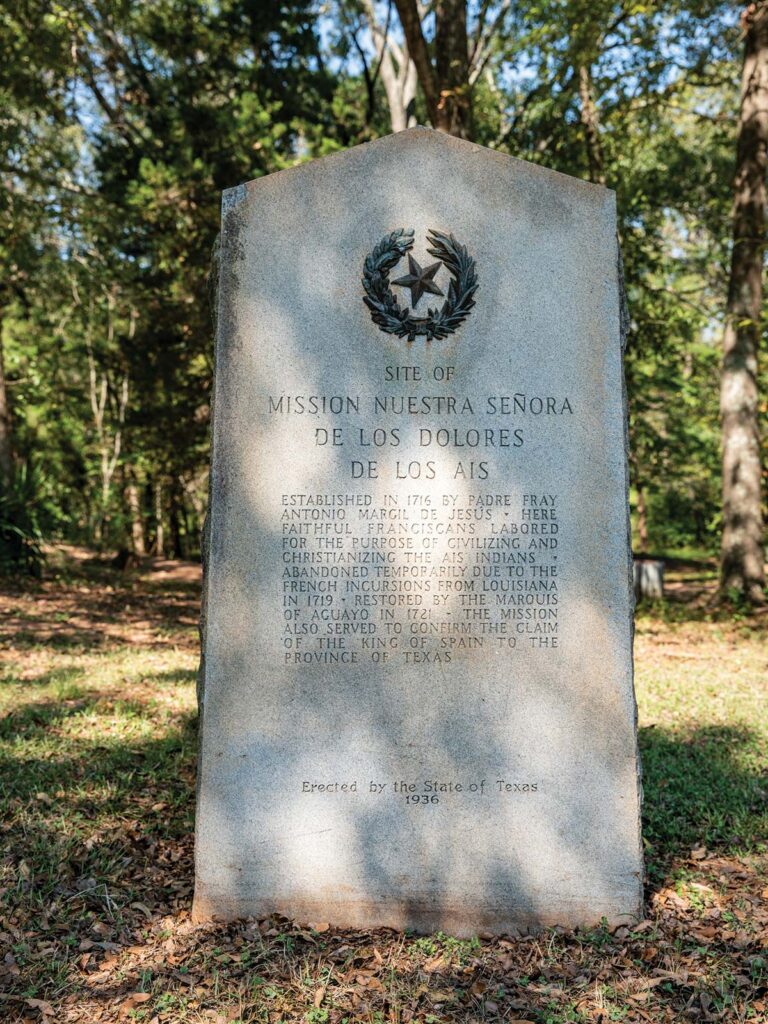
A 1936 state historic marker for Mission Dolores in San Augustine.
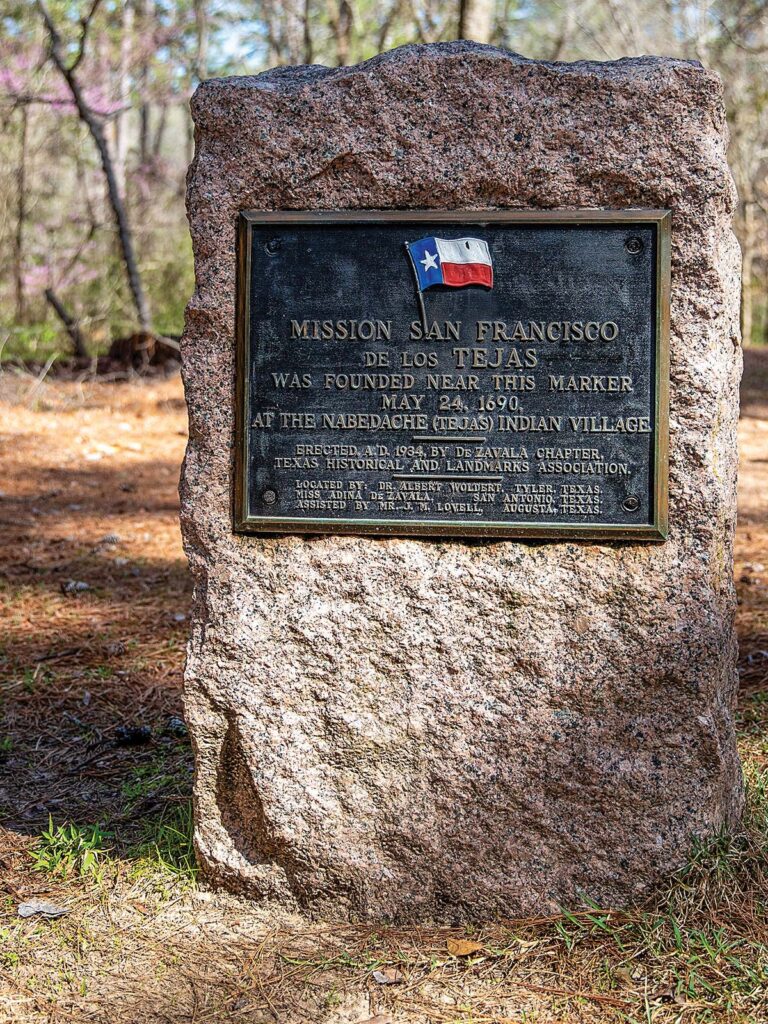
A 1930s granite state marker at Mission Tejas State Park.
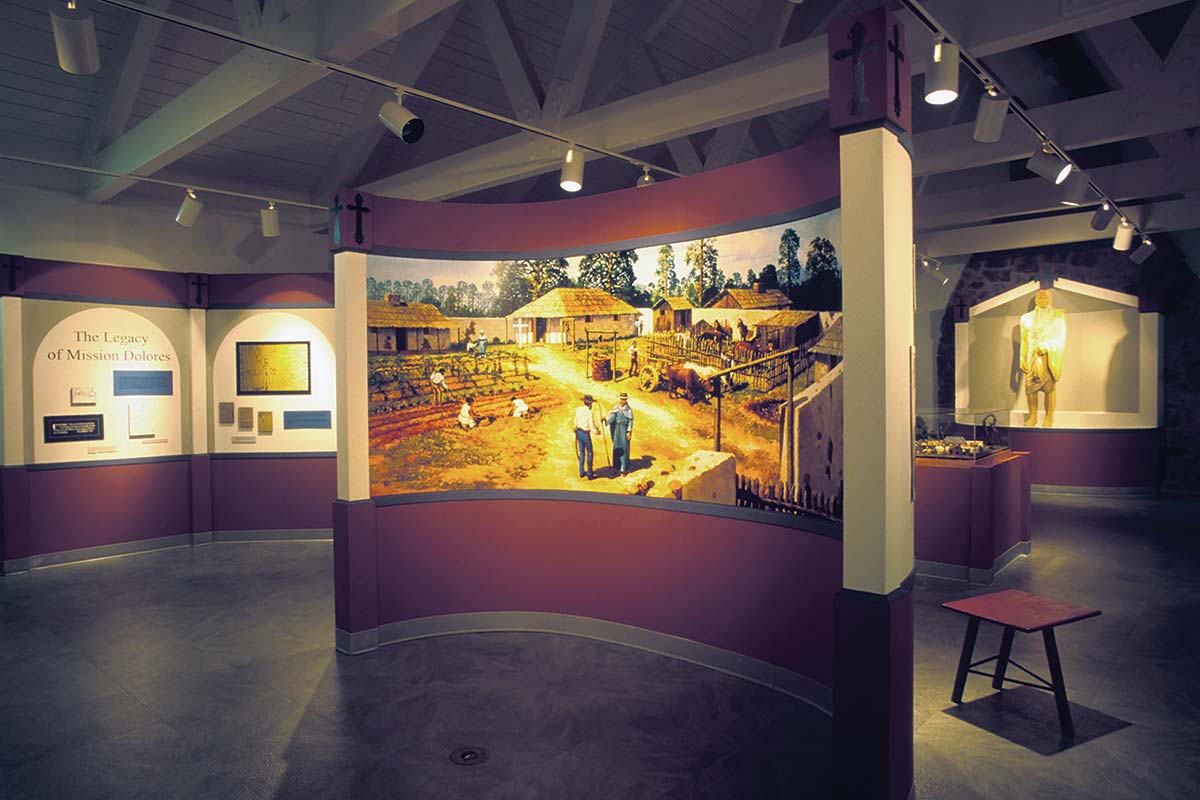
Mission Dolores, a Spanish mission rebuilt in 1721, offers visitors exhibits on life in Spanish Texas.
Trekking the Swales
For centuries El Camino Real ebbed and flowed with traffic—herds of bison, Native American hunters, Spanish colonists and French traders. After Texas became a republic in 1836 and then joined the U.S. in 1845, an ever-increasing trickle of American settlers became a flood that opened Texas.
So important was this ancient route that in 2004 Congress officially designated it as El Camino Real de los Tejas National Historic Trail—the Royal Road of the Tejas Indians.
Centuries of traffic by humans, livestock, wagons and carts wore down segments of the road deep into the sandy loam and red clay dirt of East Texas. One of the largest known physical remnants of the historic trail is marked by signage on Texas 21 near Geneva, in Sabine County. Owned and maintained by El Camino Real de los Tejas National Historic Trail Association, the site is known as the Lobanillo Swales.
These swales, or worn channels, feature parallel ruts measuring 12 feet wide and 18 feet deep, running nearly a quarter of a mile through the pine forest.
The swale got its name because it crossed an early ranch known as El Lobanillo, established by Spanish colonist Antonio Gil Y’Barbo, who founded Nacogdoches. A state historical marker at Geneva describes Lobanillo as the oldest continuously occupied site in East Texas.
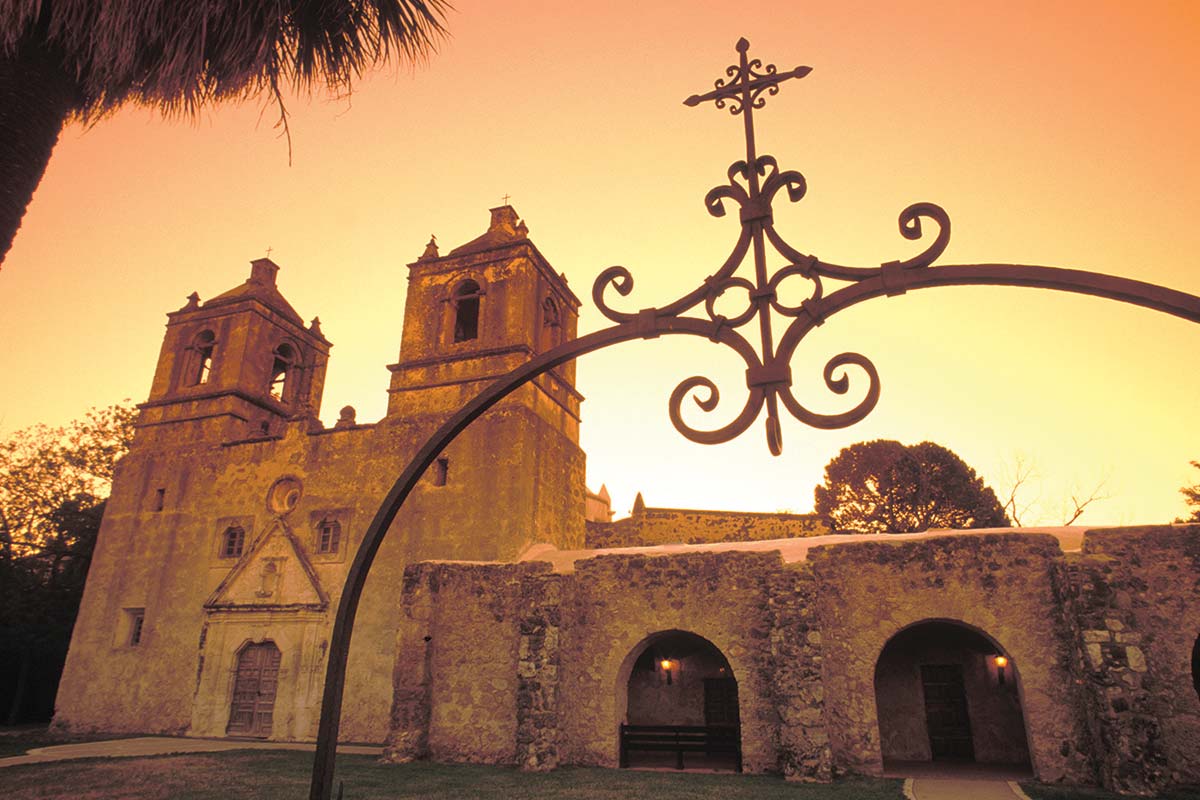
Mission Nuestra Señora de la Purisima Concepción de Acuña was dedicated in 1755 and appears very much as it did over two centuries ago.
War and Peace
Tension between Spanish Texas and French Louisiana mostly remained a “cold war” of threats and maneuvers. In fact, scatterings of Spanish and French residents, traders, Native Americans, and travelers typically lived in peace along El Camino Real. Such was the atmosphere when missionaries in 1717 established a fort and mission at modern-day San Augustine.
Nuestra Señora de los Dolores de los Ais—Our Lady of Sorrows for the Ais—was named because priests tried to convert to Christianity the area’s original inhabitants, the Ais tribe of the Hasinai Natives. In 1719 a French attack on Spanish troops resulted in abandonment of the mission. It was reestablished in 1721 on a site the Spanish found easier to defend.
That location is now home to Mission Dolores State Historic Site, which tells the story of the Ais and the mission.
Mission Dolores and other East Texas missions were abandoned in 1773, after Louisiana fell under Spanish control. Little by little, all above-ground evidence of the Dolores mission was lost. However, years of study by archaeologists from Stephen F. Austin State University determined the location and many details of the mission site.
Excavations revealed rubbish sites, wells, post holes, wall remnants and many 18th-century artifacts. The state historic site’s interpretive displays now use these findings to bring to life the unique saga of Spanish missions in early East Texas.