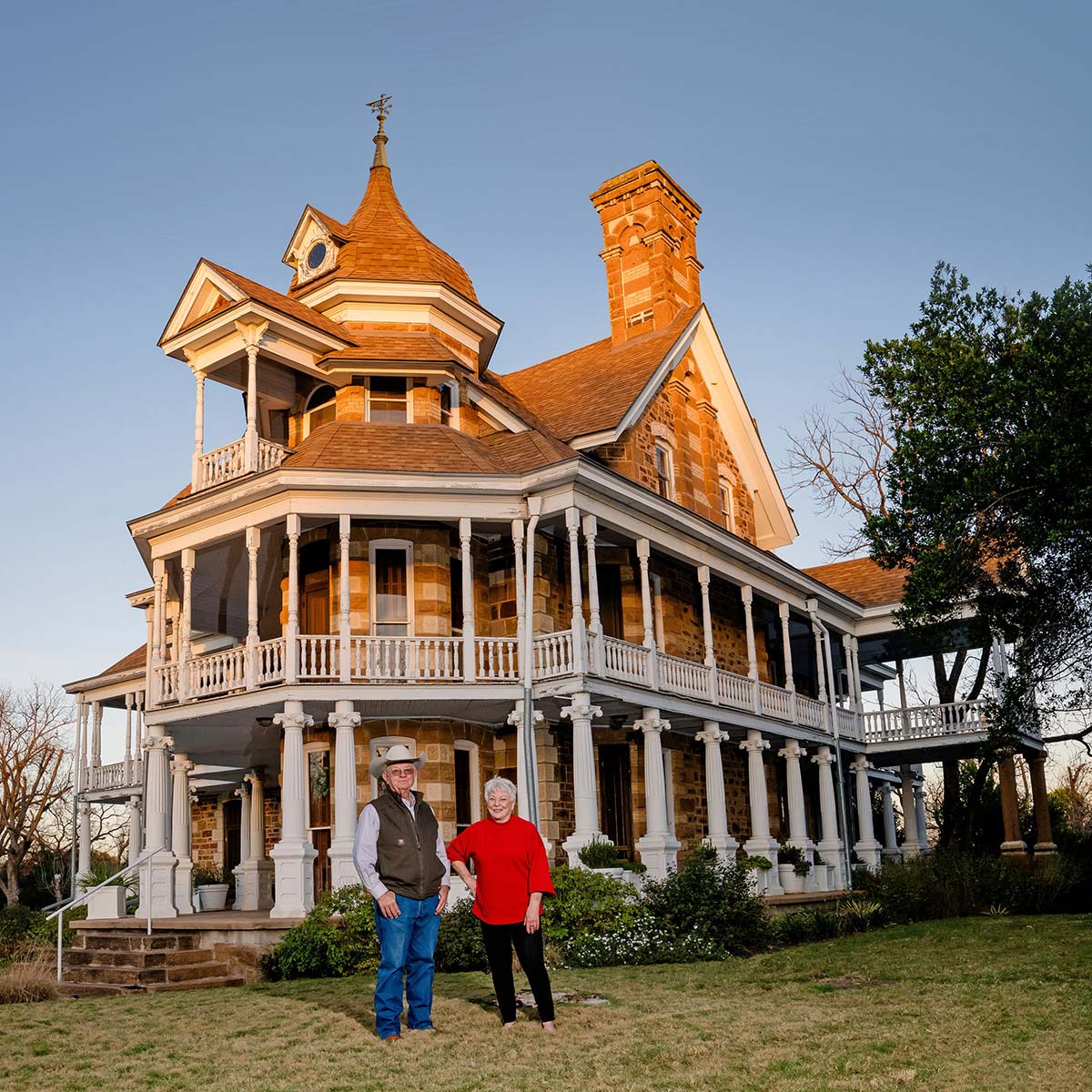
It’s the first Saturday of the month, and visitors have arrived to tour the three-story Seaquist House in Mason. Adorned with pillars, gables, balconies, a tower and turret, and four chimneys, the sandstone mansion graces Broad Street.
Three blocks south, on the town square, stands the Mason County Courthouse, also built of sandstone. With massive white columns on all four sides, it’s crowned with a domed clock tower.
Both historical landmarks were nearly lost, one to neglect and the other to fire. But with small-town resiliency, Mason residents pulled together to save their architectural heritage through two projects that required enormous helpings of time and funding.
On the Seaquist’s front porch this morning, a docent welcomes everyone with a brief history of the 1887 Victorian Italianate home. Another volunteer on hand is Jan Appleby, a retired teacher who spearheaded efforts to rescue the Seaquist.
“It was up to us to save this house,” she says. “Nobody had lived in it for seven years. You couldn’t see the front of the house because of all the ligustrums. There were broken windows and screens. The inside was in bad shape with no electricity or running water. Plaster was falling from the walls, and the smell was horrific.”
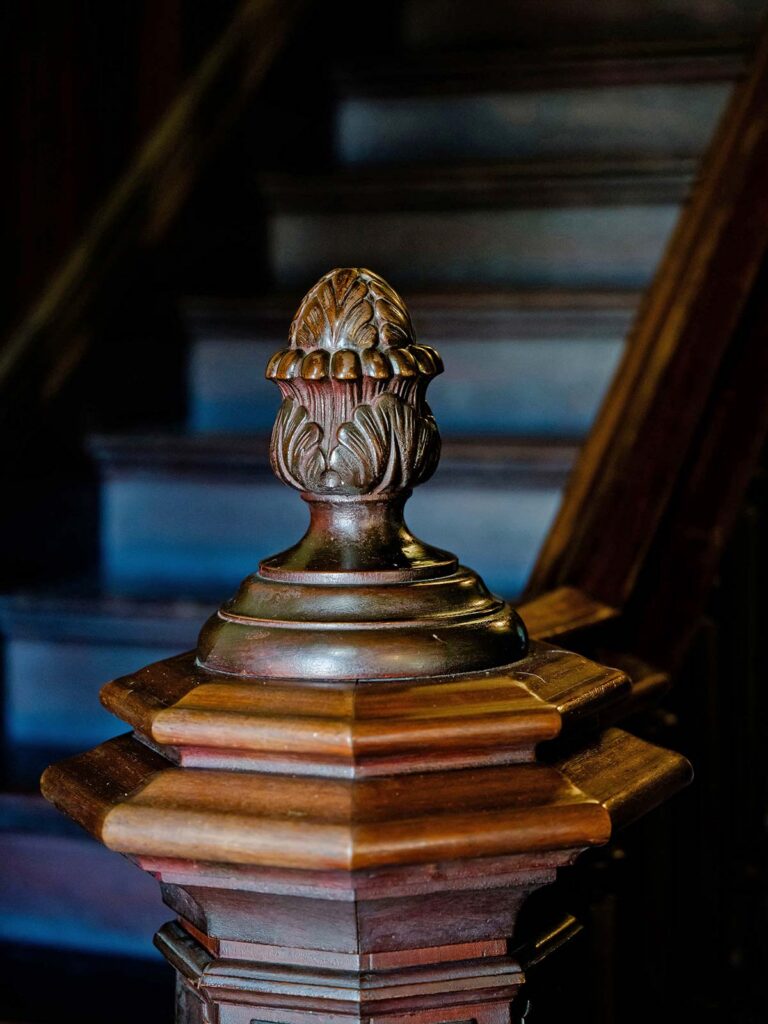
A hand-carved wooden finial on the stairs is original to the Seaquist House.
Tiffany Hofeldt
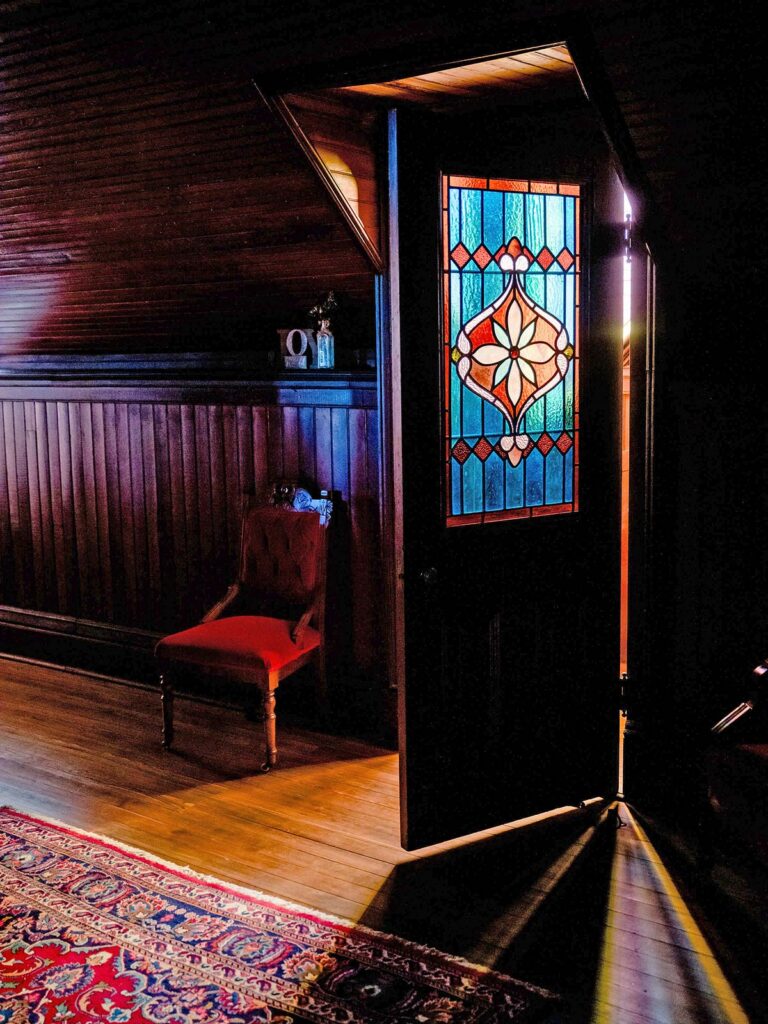
Stained glass adorns a door in the 1887 mansion.
Tiffany Hofeldt
In Good Hands
For a time, the future appeared bleak for the abandoned house, a social hot spot in its heyday. Historical records show that master stonemason and minister Thomas Broad bought the land in June 1886 and soon thereafter started building a two-story stone residence with a massive basement. In 1891, banker Edward Reynolds bought the unfinished house and hired German architect Richard Grosse to add a third floor with a ballroom as well as wraparound porches and balconies.
In 1899, Reynolds went to prison for embezzlement and never returned to Mason. His wife, Jennie, and their children lived in the house until 1919 when she sold it to bootmaker Oscar Seaquist. The home remained in his family for two more generations. In 1974, it was awarded a Texas Historical Marker and placed on the National Register of Historic Places. Unable to maintain the house, the family moved out in 2005. Seven years later, the property went up for sale.
Soon, Appleby—chair of the Mason County Historical Commission at the time—started a campaign to save it.
Rescue efforts gained traction when Preservation Texas, a nonprofit organization dedicated to protecting historic landmarks from demolition, placed the Seaquist on its Most Endangered Places List in 2014. The publicity spurred formation of the nonprofit Seaquist House Foundation, which purchased the home in January 2015 for $400,000. Enough was raised to pay off the note by October 2017.
Since then, countless supporters have donated labor and thousands of dollars to restore the Seaquist’s interior, richly accented in walnut: doors, staircases, window frames and shutters, beadboard walls and ceilings, and railings and newel posts. Volunteers pulled down wallpaper, pulled up carpeting, scraped away plaster, replaced electrical wiring and plumbing, painted walls, and refinished long-leaf pine floors and other woodwork, to name only a fraction of the fixes.
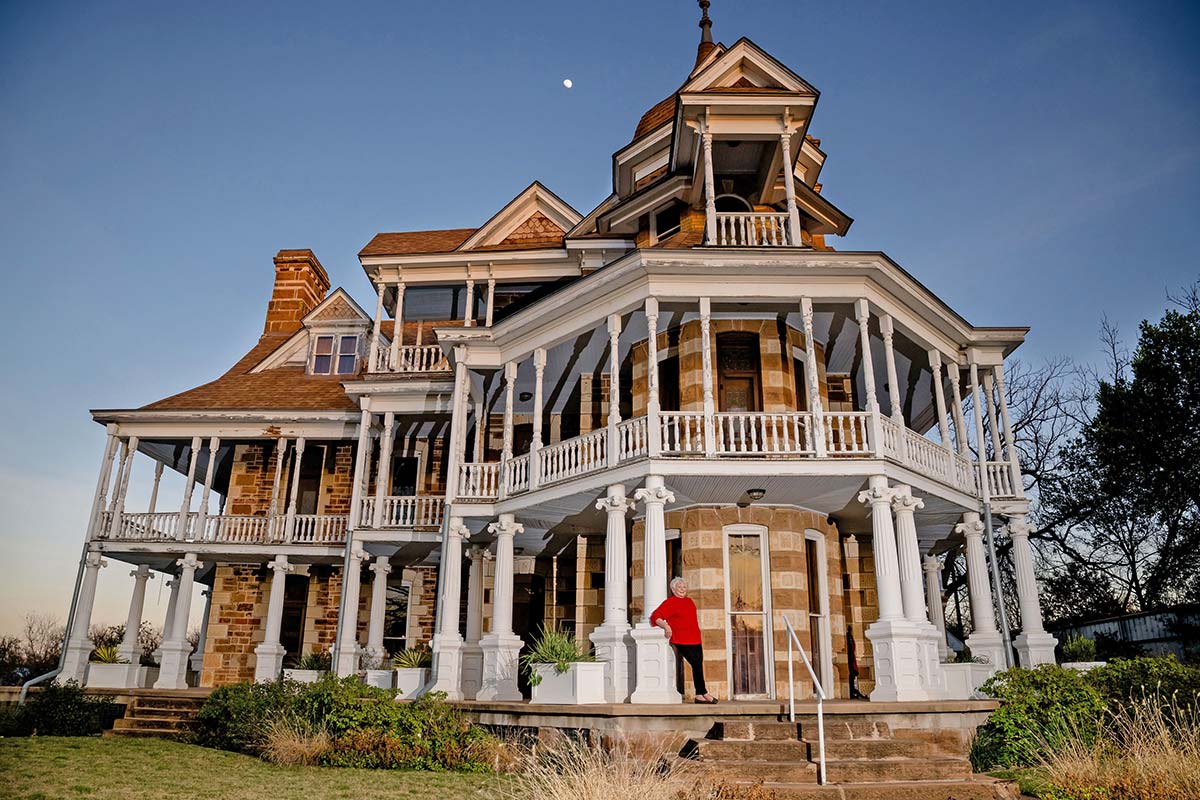
Jan Appleby at the front of the house.
Tiffany Hofeldt
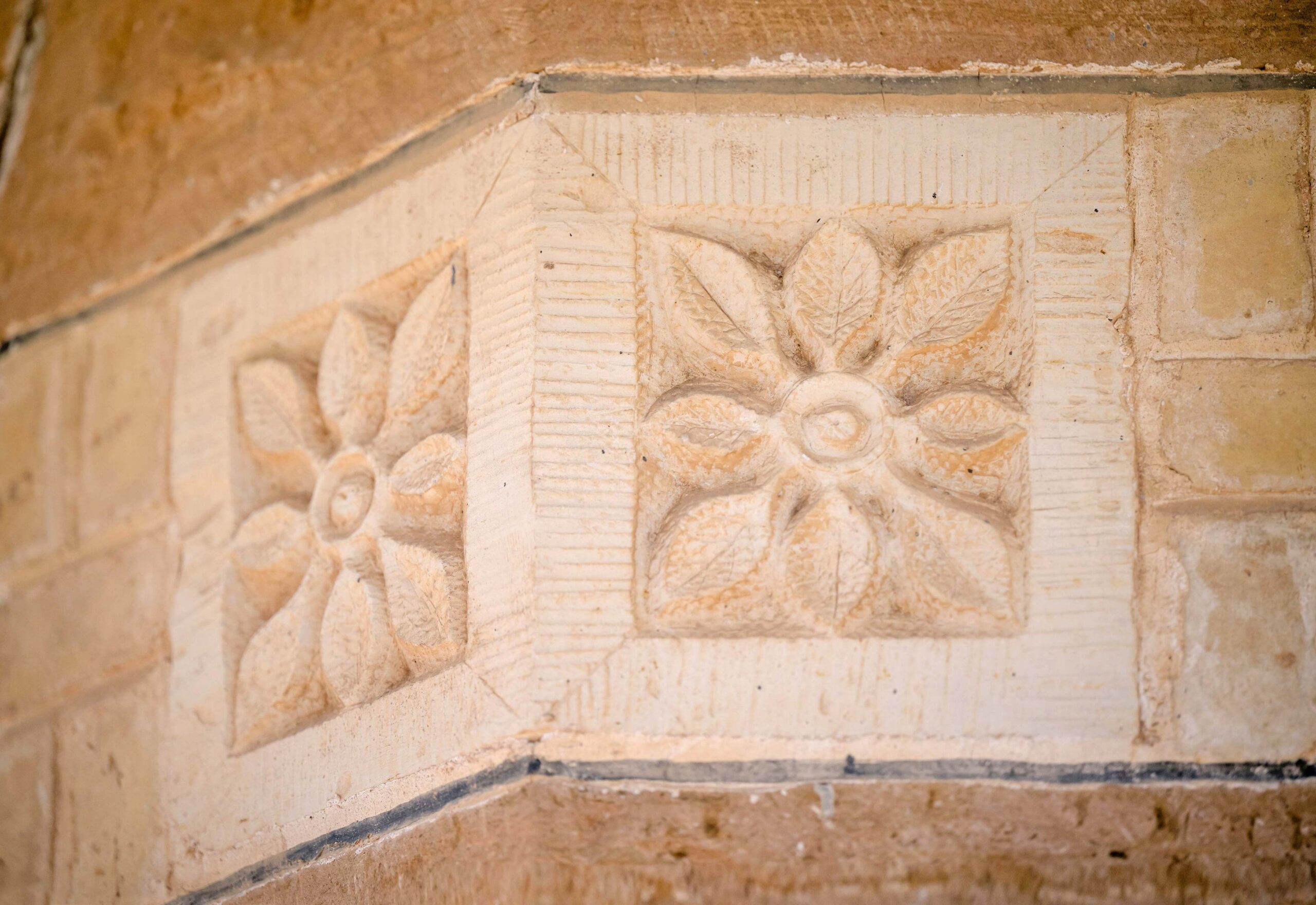
Floral motifs embellish limestone blocks on exterior walls.
Tiffany Hofeldt
When built 139 years ago, immigrant masons using primitive tools crafted ornate details throughout the Seaquist, which boasts 22 rooms and 15 fireplaces. On exterior walls, hand-carved floral motifs and other patterns embellish limestone blocks. A bathroom wall features a panel of S-curved wainscoting fashioned from walnut.
The spacious third-floor ballroom draws the most gasps. Dark walnut panels stretch across towering walls and vaulted ceilings hung with chandeliers. Behind a paneled door, narrow stairs lead to a small balcony, which overlooks the dance floor and once held musicians who performed for social gatherings. In other panel-encased rooms, guests played cards and billiards while waiters served libations from the bar.
Festive occasions have since returned to the Seaquist, which can be rented for weddings, receptions and other events. In the meantime, renovations continue. One last major project will focus on repairing and repainting the home’s exterior.
From the Ashes
For his part, volunteer Jerry Bearden, a Central Texas Electric Cooperative member, serves as president of the Seaquist House Foundation. He was also heavily involved in restoring the 1910 Classical Revival courthouse. The Mason County judge for 20 years before he retired in 2022, Bearden was there the awful night of February 4, 2021, soon after an arsonist torched the building.
Within minutes, the roof and clock tower collapsed. On the lawn, Bearden dropped to his knees as the ceiling above his first-floor office caved in and engulfed his desk.
“The heat was so intense that it cracked sandstone blocks made by the original artisans,” Bearden says. “A piece of metal bent by the heat is displayed at our city library.”
Law officials apprehended Nicholas Miller of Mason the next day and charged him with two felony counts of arson. In February 2024, he was found guilty and given two 75-year prison sentences for burning the courthouse and a family home.
Amid the ashes, some good news bolstered spirits. For one thing, county records had been moved out in preparation for interior renovations funded by the Texas Historic Courthouse Preservation Program. Then engineers who examined the building’s four exterior sandstone walls and 16 columns declared them structurally sound for use in rebuilding the courthouse. After crews worked a month to remove truckloads of charred debris, recovery began.
But to rebuild, Mason County faced a price tag of nearly $20 million. Toward that goal, $3.6 million still remained from the original state grant. Friends of the Mason County Courthouse raised $5.5 million. The Texas Association of Counties awarded $7 million in insurance money, and the Legislature approved $6 million toward the project.
“We came up with enough money to rebuild this courthouse,” Bearden says. “It didn’t cost taxpayers a dime.” Remaining funds were placed in a foundation to fund future courthouse maintenance.

Original floor tiles bear singe marks from the 2021 fire at the Mason County Courthouse.
Tiffany Hofeldt
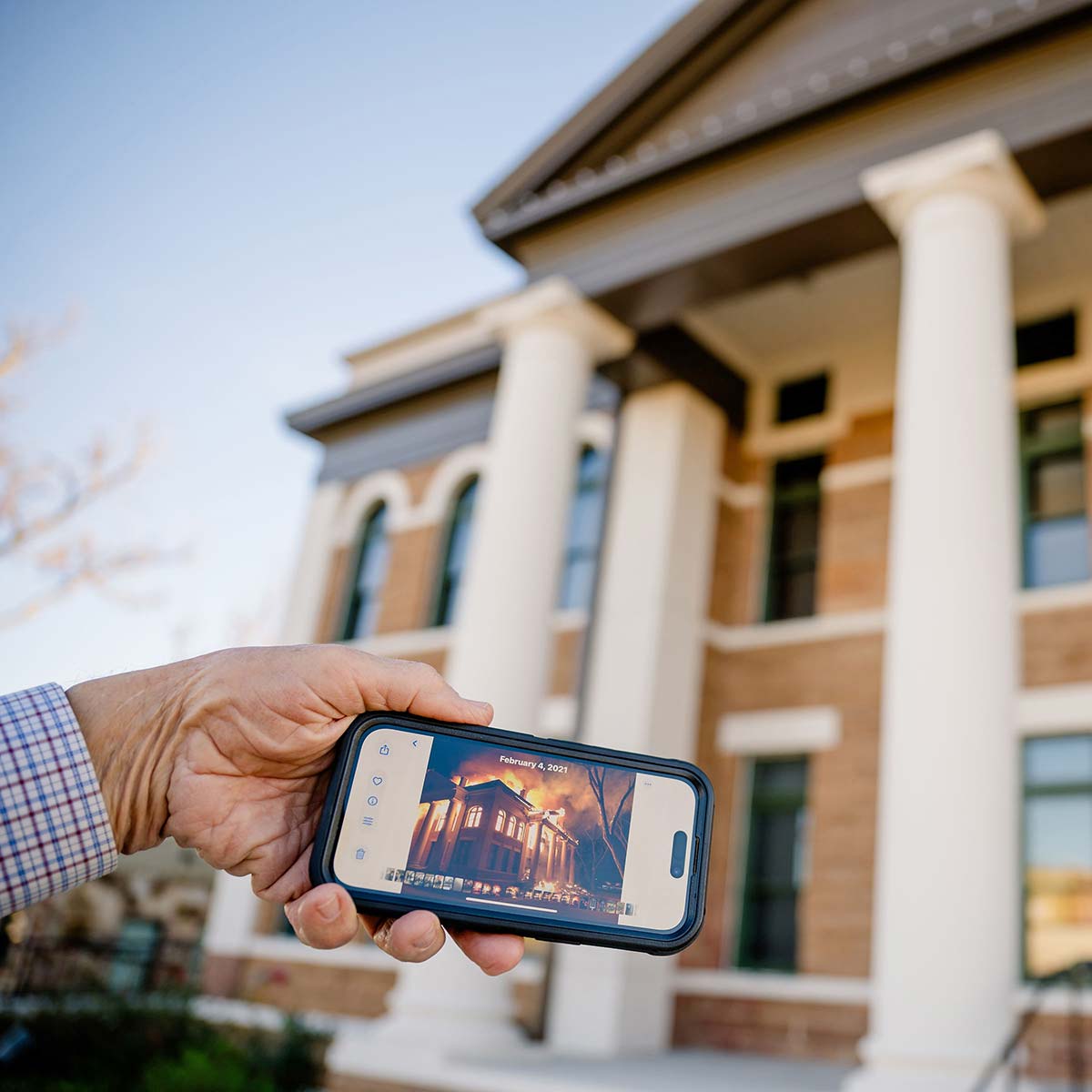
Jerry Bearden, a former Mason County judge, shows photos from the night the courthouse burned.
Tiffany Hofeldt
As project manager, CPM Texas of Austin drew from historical records and paint scrapings taken prior to the fire to restore the courthouse to its 1910 appearance.
Corridors display floors of red-stained cement and original square white tiles, many of which bear singe marks from the blaze. Eight metal fireplaces, once used to heat rooms, are painted in original colors, such as golden yellow, emerald green and burgundy red. Seven heavy vault doors gleam with black paint and gold etchings of filigrees and maker name Diebold Safe & Locks Co.
Throughout the courthouse, destroyed furnishings, such as the original district judge’s bench, courtroom pews, jury box and witness stand, were replaced with historical replicas. So, too, was the domed clock tower. The new cupola—made of sheet metal that took thousands of hours to fabricate—houses an electronic clock and chimes, modern versions of the old iron bell and clock mechanism that were gutted by the fire.
Three years after that fire, the Mason County Courthouse reopened for business. On July 13, 2024, more than 750 people applauded and cheered when Bearden, standing on the courthouse steps with other dignitaries, cut a red ribbon during a rededication ceremony. Just as Bearden had publicly vowed, their courthouse phoenix had risen from ashes.
Three blocks away, the Seaquist House had survived near ruin too.
“Politics and religion can divide people,” Appleby says. “But they’ll come together for something important like the Seaquist House and the courthouse. And that’s amazing.”
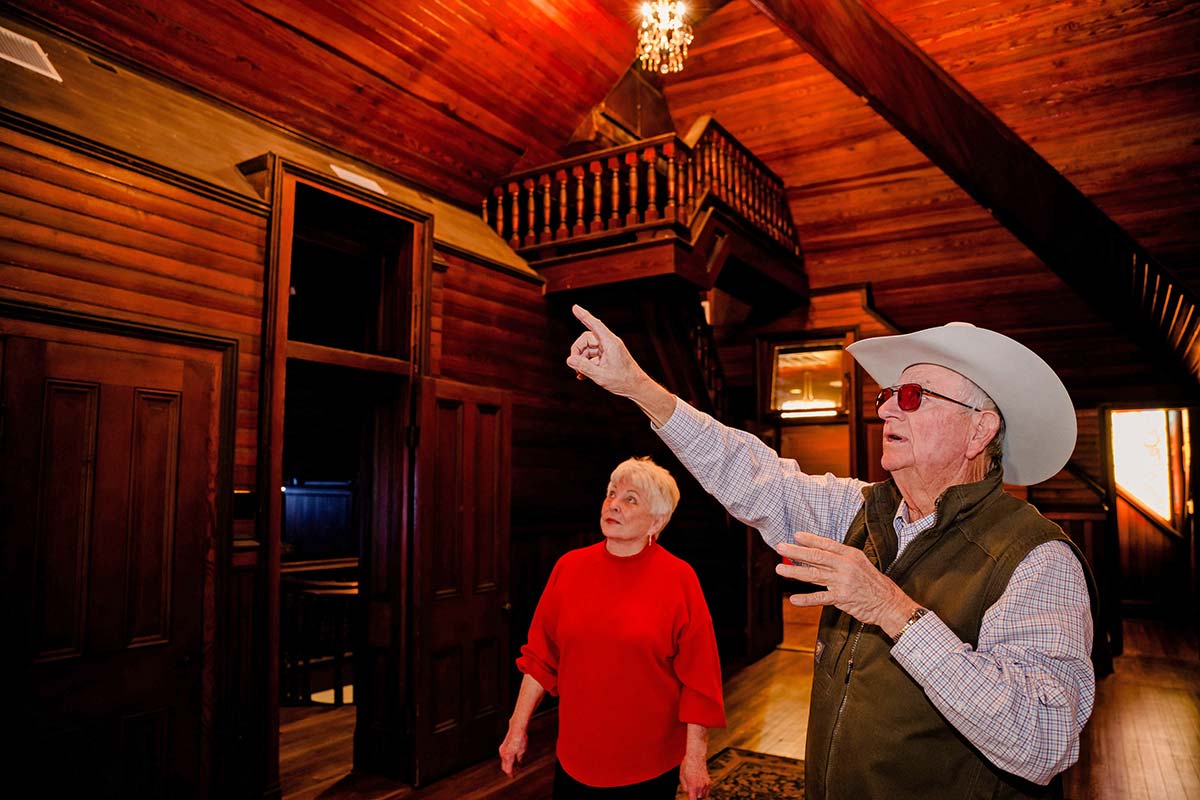
Jerry Bearden, with Appleby, points out details in the grand ballroom of the Seaquist.
Tiffany Hofeldt
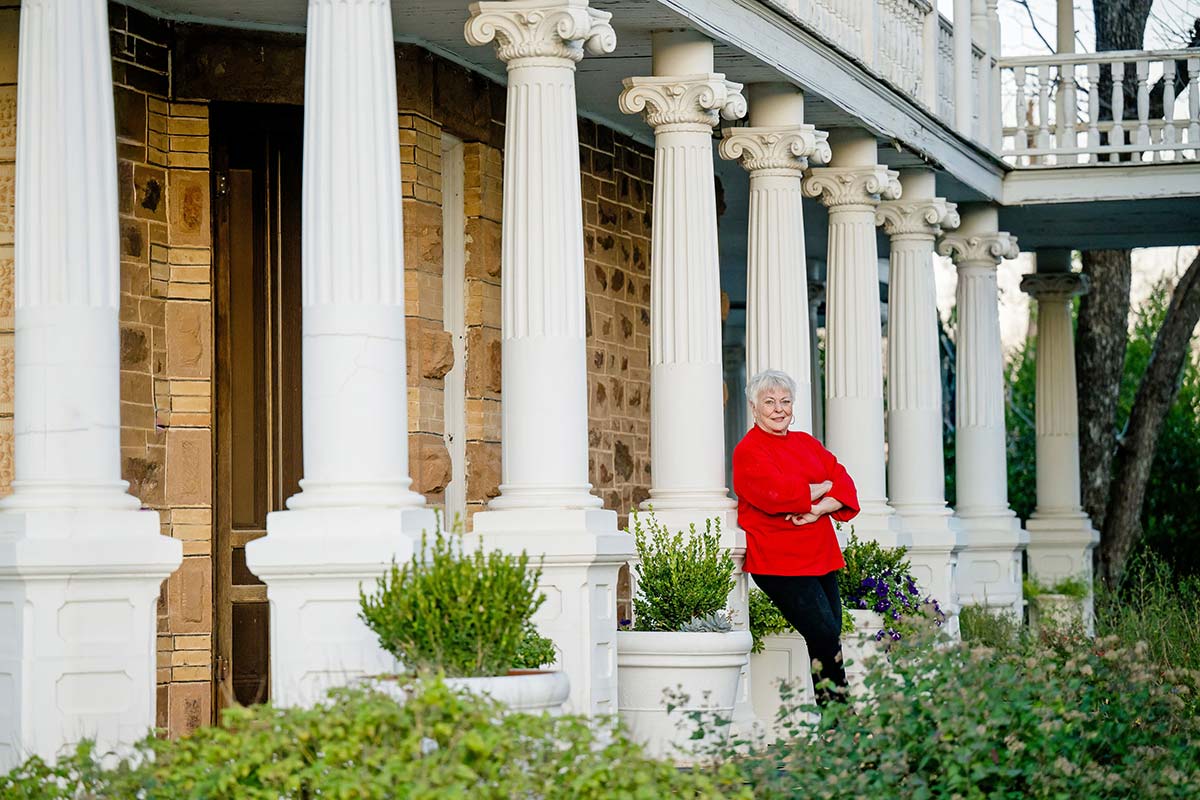
Appleby is a retired teacher who spearheaded efforts to rescue the Seaquist.
Tiffany Hofeldt

Bearden in front of the rebuilt courthouse.
Tiffany Hofeldt
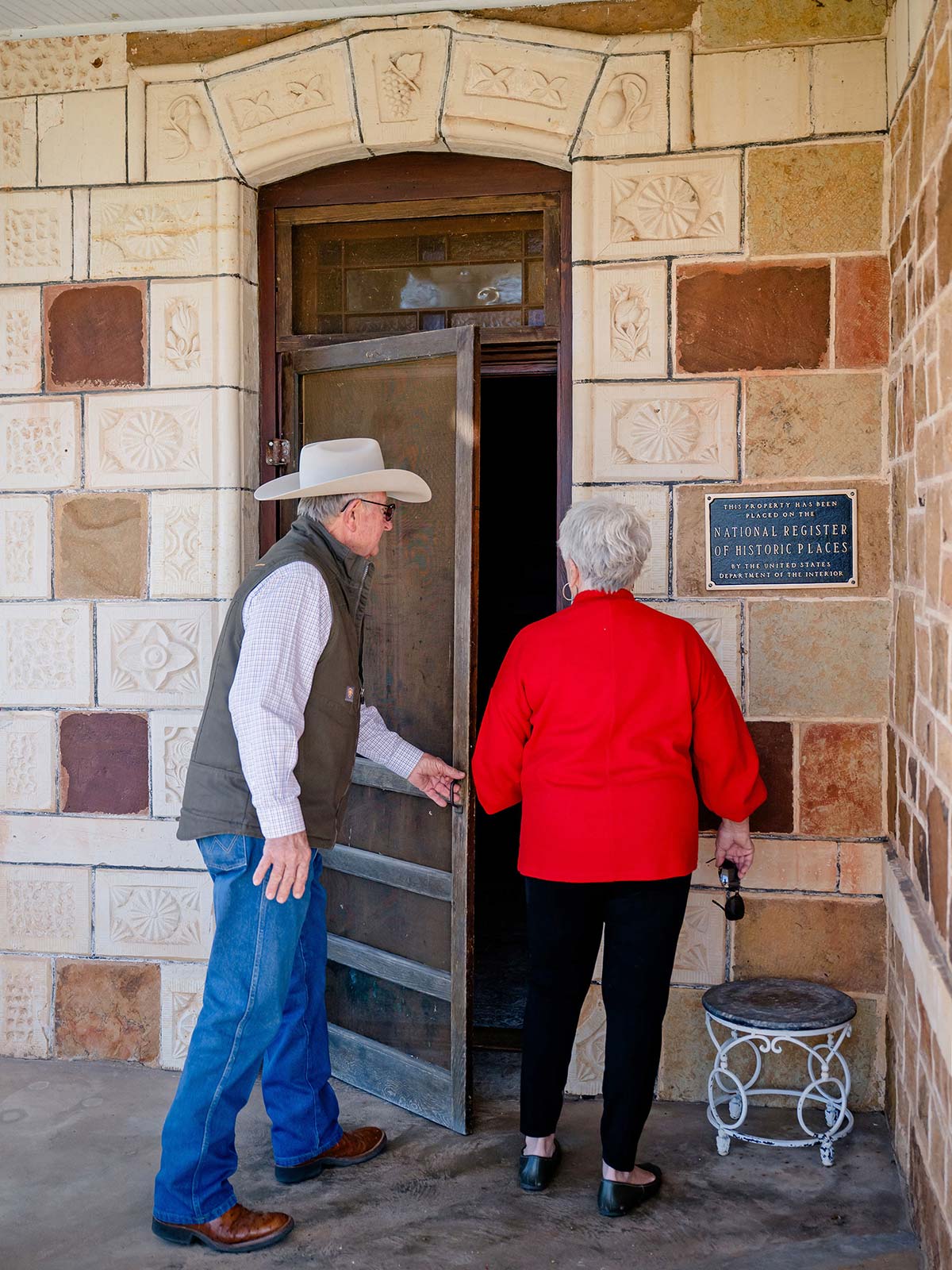
Bearden and Appleby enter the three-story Seaquist House.
Tiffany Hofeldt